The AI tools for hotels worth your attention in 2026 fall into nine groups: guest messaging chatbots, AI in the team inbox, revenue management and pricing AI, review and reputation AI, marketing AI, booking assistants, operations and task AI, voice AI on the phone, and AI concierges with digital guest directories. Which ones you need depends less on the model inside than on three questions: what guest data the tool can see, which channels it works on, and how it hands a guest over to your team.
Short answer: for most hotels, the best AI to start with is an AI chatbot on WhatsApp and the website, AI in the team inbox for drafts and translation, and guest messages timed by your PMS. Revenue, review and voice AI come next, depending on your size and your guests. The comparison table shows all nine side by side, and the buyer’s checklist helps you compare vendors.
Most hoteliers do not start with a strategy. They start with a problem (unanswered WhatsApp messages at night, a front desk buried in the same ten questions, rates set by gut feeling) and buy a tool for it. Two years later the hotel runs five AI tools, each with its own login, its own copy of the guest list and no idea what the others did. This guide walks through each category of AI tools for hotels: what it does, an example of it at work, what it is good for, where it falls short, and where chatlyn fits. For the wider picture of one hotel AI across the whole stay, start there; this article is the practical tour of the shelf.
What artificial intelligence for hotels means in practice
Artificial intelligence for hotels is software that reads, predicts or writes so your team does not have to do it by hand. It reads a guest’s message and answers it, predicts next month’s demand from booking pace, or writes a first draft of a reply for a colleague to check. Most of what is sold as AI today is one of three things: a language model that understands and writes text, a forecasting model that finds patterns in numbers, or plain automation (rules and schedules) with an AI label on it.
The difference matters when you buy. A language model can answer “Is the pool heated in May?” from your house information, in the guest’s language. A forecasting model can suggest a rate for a Saturday in October. A rule can send a message three days before arrival. All three are useful, but only the first two learn from data, and only the first one talks to your guests. Ask every vendor which of the three you are paying for.
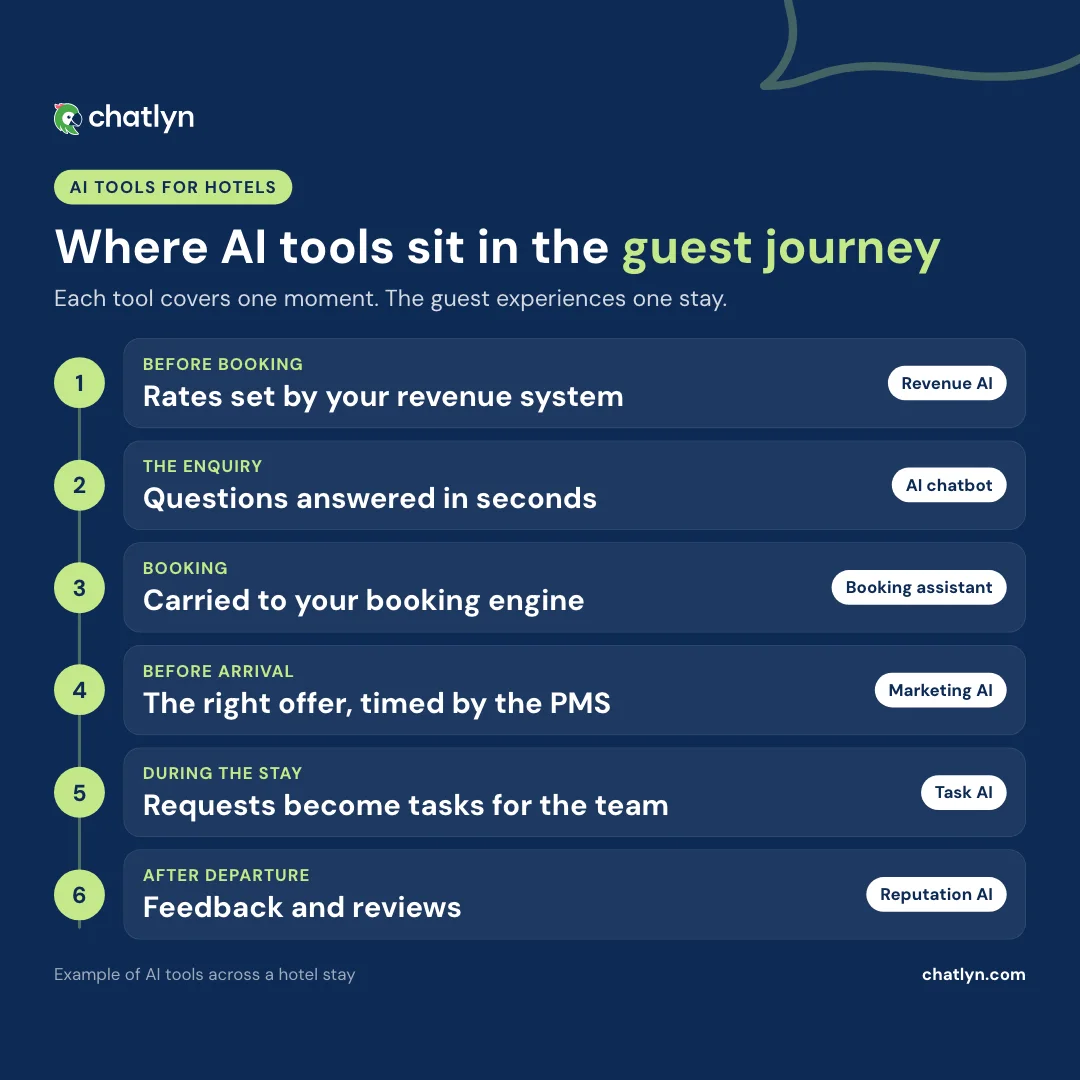
Each tool also sits at a particular moment of the stay. Pricing AI works before the guest ever writes; chatbots and booking assistants at the enquiry; marketing AI before arrival; inbox and task AI during the stay; review tools after departure. Mapping your tools to these moments shows quickly where you have gaps and where two tools do the same job.
9 types of AI tools for hotels, with examples
For each category you will find what it does, a concrete example, what it is good for, its limits and, for most of them, where chatlyn fits.
1. AI chatbots and guest messaging AI
What it does. An AI chatbot answers guest questions in writing, in the chat on your website, on WhatsApp or on other messaging channels, from information you provide: check-in times, parking, breakfast, spa hours, the dog policy. The better ones answer in the language the guest writes in and pass anything they cannot handle to a person, with the whole conversation.
Example. A guest writes at 21:12 in German, asking when they can check in and whether there is parking. The AI replies within seconds, in German: check-in from 15:00, free parking by the entrance. When the guest asks for flowers in the room for their anniversary, the AI passes the request to the front office, where a colleague confirms it the next morning.

Good for. The repetitive questions that fill the front desk’s inbox, at any hour, in every language your guests write in. At Spa Resort Geinberg, the AI webchat answered 86% of enquiries without staff; the other 14% went to the team. At Hotel Enzian Obertauern, the AI handled around 85% of routine enquiries, replying in about three seconds.
Limits. A chatbot is only as good as what it knows. Trained on a stale website, it gives stale answers. Rule-based bots (decision trees with buttons) break as soon as a guest phrases a question differently. And a bot that cannot hand over cleanly frustrates guests more than no bot at all.
Where chatlyn fits. This is chatlyn’s core. The AI hotel chatbot answers on WhatsApp, webchat, Facebook Messenger, Instagram and newly created Booking.com inboxes from your own files and web pages, in your hotel’s tone and in the guest’s language. Weak answers land in a review queue with a drafted fix, so every correction stays learned. Think of it as an AI hotel receptionist for written questions: it takes the routine and hands the rest to your team, translated and with the full conversation.
2. AI in the team inbox: drafts, translation and summaries
What it does. Here the AI works for your staff rather than for the guest. It drafts replies for a colleague to check and send, translates incoming messages into the reader’s language and outgoing ones into the guest’s, summarises long threads and labels conversations by topic.
Example. A four-paragraph email from a wedding planner arrives in Italian. Your reservations manager, who works in German, reads it translated, with a short summary at the top. The AI has drafted a reply from your events information; she corrects one detail and sends it.
Good for. Email above all, where automatic replies are risky: shared addresses such as info@ receive newsletters, long chains and complaints that no machine should answer unattended. Drafts keep a person in charge while removing the blank page. Translation lets a small team serve guests in many languages.
Limits. Drafts save time only if they are good enough to edit rather than rewrite, which again depends on your knowledge. And an inbox AI helps only with the channels that actually arrive in that inbox: a tool that sees email but not WhatsApp covers half the conversation.
Where chatlyn fits. chatlyn’s guest messaging software brings WhatsApp, email, webchat, Booking.com, Messenger and Instagram into one inbox. The AI summarises, labels and translates both ways, and on email it drafts replies for a colleague to check and send. IMLAUER Hotels cut the time spent logging in to separate channels by 54% after moving to one inbox.
3. Revenue management and pricing AI
What it does. A revenue management system (RMS) with AI forecasts demand from booking pace, historical occupancy, events and market data, and recommends or sets room rates per day and room type.
Example. Bookings for a trade fair weekend pick up faster than last year. The system spots it three weeks out and suggests raising rates for Friday and Saturday, with a minimum stay to protect the Sunday.
Good for. Properties with enough rooms, channels and rate plans that no person can review every date every day. It frees the revenue manager to make decisions rather than update spreadsheets.
Limits. Forecasts need clean data from your PMS and channel manager, and they struggle with events that have never happened before. Fully automatic pricing without human review can also clash with your positioning, for example by discounting a luxury house too hard in a quiet week.
4. AI for reviews and reputation
What it does. Reputation tools collect reviews from booking and review sites, detect sentiment and recurring themes (noise, breakfast, Wi-Fi) and often draft replies to public reviews.
Example. Across two months of reviews, the tool notices that mentions of a slow check-in are rising on Fridays, and flags it for the general manager with sample quotes.
Good for. Seeing patterns across hundreds of reviews that nobody has time to read one by one, and keeping reply times on public reviews short.
Limits. AI-drafted review replies tend to sound alike, and guests notice. A reply to a disappointed guest should read as if someone actually read the review. And by the time a bad review is public, the moment to fix the problem has passed.
Where chatlyn fits. chatlyn helps before the review is written: guests can reach you on WhatsApp during the stay, so a cold room gets fixed on the evening it happens instead of appearing in a review a week later. A message after departure, triggered by your PMS, can ask for feedback and a review.
5. AI in hotel marketing: segments and personalised offers
What it does. Marketing AI groups guests into segments (families, spa lovers, returning couples, business travellers) from their data and helps you send each group the right offer at the right time, sometimes with AI-written copy.
Example. Three days before arrival, each guest receives a WhatsApp message with the programme for their dates and a button to reserve a table. Hotel Enzian Obertauern sends pre-arrival messages of this kind, introducing its restaurants and sharing the weekly programme for the guest’s exact days. Those messages reached a 92% open rate, and restaurant reservations from WhatsApp campaigns rose by 38%.

Good for. Turning a static guest database into offers people read. The channel matters as much as the segment: at Spa Resort Geinberg, WhatsApp campaigns were opened by 95% of recipients, against about 20% for email.
Limits. Segments are only as good as the data behind them. A marketing tool that sees bookings but not conversations misses what guests actually asked for. And personalisation that goes too far (“We noticed you ordered three bottles of wine”) feels intrusive rather than attentive.
Where chatlyn fits. The hotel CRM puts stays and spend from your PMS and every conversation on one guest profile, and the AI tags guests from both. Live segments (in-house, arriving today, birthdays this week) stay current on their own. PMS events and journeys send WhatsApp messages with images and buttons at each moment of the stay, with clicks and conversions per step.
6. AI booking assistants
What it does. A booking assistant answers the questions that come before a booking (room types, views, what is included) and guides the guest towards it.
Example. A guest asks on WhatsApp whether the sea-view rooms have a terrace and says they would like to come in June. The AI answers from your room descriptions, asks for dates and the number of guests, and sends a link to your booking engine with the search filled in. The guest sees rooms and rates there, and books.

Good for. Enquiries that would otherwise go unanswered overnight and end up on an online travel agency. Answering while the guest is still interested is the whole point.
Limits. Be careful with any tool that claims its AI books for the guest inside the chat. Rates, availability, payment and cancellation terms belong in your booking engine, where they are always current. An AI quoting a price from last week’s website is a complaint waiting to happen.
Where chatlyn fits. chatlyn’s AI for hotel booking takes the guest into your booking engine, where rates and availability are always current. In the chat on your website it opens a date picker that carries the guest there with dates and guests filled in; on WhatsApp it sends a link with the search filled in, where your booking engine supports it.
7. AI for operations and tasks
What it does. Operations AI turns requests into work: housekeeping priorities, maintenance tickets, room-readiness forecasts, staff schedules. Increasingly, it also picks up requests hidden inside guest conversations.
Example. A guest writes on WhatsApp: “Could we have a cot in the room, and is a late check-out possible on Sunday?” Instead of a colleague copying this into a note, the AI turns both requests into tasks for the team.
Good for. Making sure nothing a guest asked for gets lost between shifts, and sparing the front office from retyping requests.
Limits. Task AI needs a clear owner for every task, or it only moves the chaos into a new list. Be wary of claims that AI completes tasks in your PMS on its own: most hotels want a person to confirm anything that changes a reservation.
Where chatlyn fits. The AI turns requests in a conversation, such as a cot or a late check-out, into tasks for your team, listed on the dashboard. Your team decides and confirms.
8. Voice AI on the phone
What it does. Voice assistants answer the hotel phone, handle common questions by speech, take messages and transfer calls.
Example. At 23:00, a caller asks whether the restaurant is open for lunch tomorrow. The voice assistant answers and takes a message for the restaurant team about a table for six.
Good for. Hotels whose guests still phone a lot, and night hours when nobody is free to pick up.
Limits. Accents, background noise and interruptions still trip up voice AI, and a call that goes wrong feels worse than a slow text. Check how calls are recorded, where recordings are stored and how callers are told they are speaking to an AI.
9. AI concierge and digital guest directory
What it does. An AI concierge answers in-stay questions (restaurant tips, spa hours, how the sauna works, where to hire bikes) in conversation. A digital guest directory replaces the printed folder in the room with an app or a web page.
Example. On the morning of arrival, the guest receives a WhatsApp message with room times, Wi-Fi details and a link to the guest directory. That evening, they ask on WhatsApp where to have dinner in the old town, and the AI answers from the recommendations you gave it.
Good for. Questions during the stay that would otherwise reach the front desk by phone, and information that changes often, such as opening hours or the week’s events.
Limits. A directory nobody opens helps nobody: it has to arrive at the right moment, on a channel the guest reads. And a concierge AI answering from the open internet may recommend a restaurant that closed last year.
Where chatlyn fits. chatlyn works as a digital concierge that answers only from your own knowledge, under the name and in the tone you choose. For the directory itself, chatlyn sends your digital guest directory with the right message of the stay, for example on the morning of arrival, and the AI can answer from its content.
AI tools for hotels compared at a glance
| AI tool | What it does | Best moment | Watch out for |
|---|---|---|---|
| AI chatbot | Answers guest questions in writing | Before and during the stay | Stale knowledge, poor handover |
| Inbox AI | Drafts, translates, summarises, labels | Every conversation | Channels outside the inbox |
| Revenue and pricing AI | Forecasts demand, recommends rates | Before booking | Data quality, over-automation |
| Review and reputation AI | Analyses and answers reviews | After departure | Replies that all sound alike |
| Marketing AI | Segments guests, times offers | Before arrival, during the stay | Thin data, intrusive offers |
| Booking assistant | Guides guests into a booking | At the enquiry | AI quoting rates |
| Operations and task AI | Turns requests into tasks | During the stay | Unclear ownership |
| Voice AI | Answers phone calls | Any time | Recognition errors, recordings |
| AI concierge and directory | In-stay answers and information | Arrival and stay | Unread directories, open-internet answers |
The cost of getting AI tools wrong in a hotel
The expensive mistake is rarely a bad model. It is five tools that do not share data. The chatbot does not know the guest booked a spa package, the marketing tool sends a cheerful offer to a guest who complained yesterday, and the front office logs in to four systems to answer one question.
IMLAUER Hotels in Salzburg and Vienna learned this before switching. The group trialled two chatbot platforms that accurately resolved just 6% of guest enquiries: expensive to set up, hard to maintain and weak with different languages and property-specific knowledge. After moving the inbox, the AI, WhatsApp newsletters and journeys onto one platform, the AI resolved 93% of enquiries, and the WhatsApp newsletters reached a 93% open rate. The IMLAUER case study shows how the group got there.
The other costs are quieter: guests who wait overnight for an answer and book elsewhere, staff who stop trusting an AI after one wrong answer, and a contract for a tool nobody opens after the pilot. If you are weighing more autonomous systems that act rather than answer, our guide to AI agents for hotels explains what they can and cannot do today, and our honest comparison of the best hotel chatbots helps if a chatbot is your first step.
How to choose AI software for hotels: a buyer’s checklist
Before you sign, ask every vendor these questions, and ask to see the answers in a live demo with your own information.
- Which guest data does it see? Stays from your PMS, conversations from every channel, or only what the guest types into the chat? Does it only read from your PMS, or also write to it, and who approved that?
- Where does its knowledge come from? Answers should come only from your own files and web pages, with a way to correct weak answers so they stay corrected.
- Which channels does it cover? WhatsApp, your website, email, Booking.com? An AI that works on one channel leaves the others to your team.
- How does it hand over? A person should receive the whole conversation, translated if needed, and be able to take over at once.
- What does it leave to your team and your systems? A trustworthy vendor is clear about it: bookings go through your booking engine, a person sends email replies, and rates come from the system that sets them.
- Where is the data hosted, and how is it protected? Ask where guest data is stored, whether personal data reaches the AI model, and whether AI processing can be restricted to European servers. chatlyn, for example, is hosted in Frankfurt, masks personal data before any request reaches an AI model, and offers EU-only AI processing on request.
- Are guests told they are talking to an AI? The EU AI Act requires it; ask how the tool does it on each channel.
- How do you measure it? Look for the automation rate, the handover rate, response times and clicks per message, not just “conversations handled”.
- What does it cost as you grow? Ask how usage is charged (per conversation, per message, per room) and how the price changes as volume rises.
- Who sets it up, and who maintains it? An AI that needs a developer for every change will not stay current.
The general manager should own this decision rather than hand it to one department, because the right tool touches the front office, reservations, marketing and the spa at once. Our page for hotel general managers shows how chatlyn fits that view across the house.
FAQ
What is AI for hotels?
AI for hotels is software that reads, predicts or writes so hotel teams do not have to do it by hand: chatbots that answer guests, inbox tools that draft and translate replies, revenue systems that forecast demand and marketing tools that time offers. The useful ones work from the hotel’s own data and hand anything that needs judgement to a person.
What are the best AI tools for hotels?
The ones that close your real gaps. For most properties that starts with an AI chatbot on WhatsApp and the website, an inbox AI for drafts and translation, and messages timed by the PMS. A revenue management system, a review tool or voice AI come next, depending on your size and your guests.
How do you compare AI tools for hotels?
Compare them on your own operation, not on the demo. Check which guest data each tool can see (PMS, past conversations, your own content), which channels it works on, how it hands a guest to your team, where guest data is stored, and how many logins and copies of the guest list you end up with. The buyer’s checklist above turns this into questions to ask every vendor.
Can AI tools for hotels book rooms?
Some claim to, but bookings are safer in your booking engine, where rates and availability are always current. chatlyn’s AI takes the guest to your booking engine with the dates filled in, and the engine handles rates and payment.
Is AI software for hotels GDPR compliant?
It depends on the vendor. Ask where guest data is stored, whether personal data reaches the AI model and whether AI processing can stay in the EU. chatlyn is hosted in Frankfurt, masks personal data before any request reaches an AI model, and offers EU-only AI processing for hotels with stricter requirements.
Will AI tools replace hotel staff?
Good AI tools support the team rather than replace it. They take repetitive questions, retyping and manual lists off the team, so people have time for the guests and requests that need them. At Spa Resort Geinberg the AI answered 86% of webchat enquiries, and the remaining 14% went to the team with the conversation attached.