Imagine having a smart and efficient assistant for your hotel, available 24/7, ready to make your guests' experiences smoother and your operations more efficient. That's ChatGPT, a remarkable AI-powered chatbot designed by OpenAI, and it's changing the game for hoteliers in a big way.
For hotel owners and managers, ChatGPT is like having a tireless, always-friendly staff member who excels at customer service. It promptly answers guests' questions about check-in times, amenities, local attractions, or any aspect of their stay. This means happier guests and higher satisfaction scores.
But on its own, ChatGPT does not connect to your hotel management systems: it cannot see live availability, prices or room service requests. Hotel-specific AI tools fill part of that gap by answering from the property's own knowledge and passing guests on to the booking engine or the team, which saves time and reduces errors.
In this article, we'll explore how ChatGPT for hotels makes the best AI tools for hotels for both guests and hotel owners. So, let's dive in and see how ChatGPT is transforming the world of hotels!
PRO Tip: If you already know what is an AI chatbot and ChatGPT, you should take a look to our blog article about the best AI Chatbot for Hotels.
Simplified Hotel Management with ChatGPT for Hotels
Discover the potential of AI in the hospitality industry with ChatGPT. This versatile assistant offers a range of benefits for hoteliers, from creating compelling marketing materials to streamlining data analysis, decision support, and staff management. Let's explore how ChatGPT for hotels simplifies hotel operations and enhances the guest experience.
#1: Marketing Material
Promotional Materials
ChatGPT streamlines the process of creating promotional materials. It generates persuasive content for emails, social media posts, and other marketing materials. This content can highlight special offers, unique features of the hotel, and upcoming events, effectively attracting potential guests.
It enables hoteliers to present their offerings compellingly and engagingly, ultimately driving bookings and revenue.
- Example Scenario
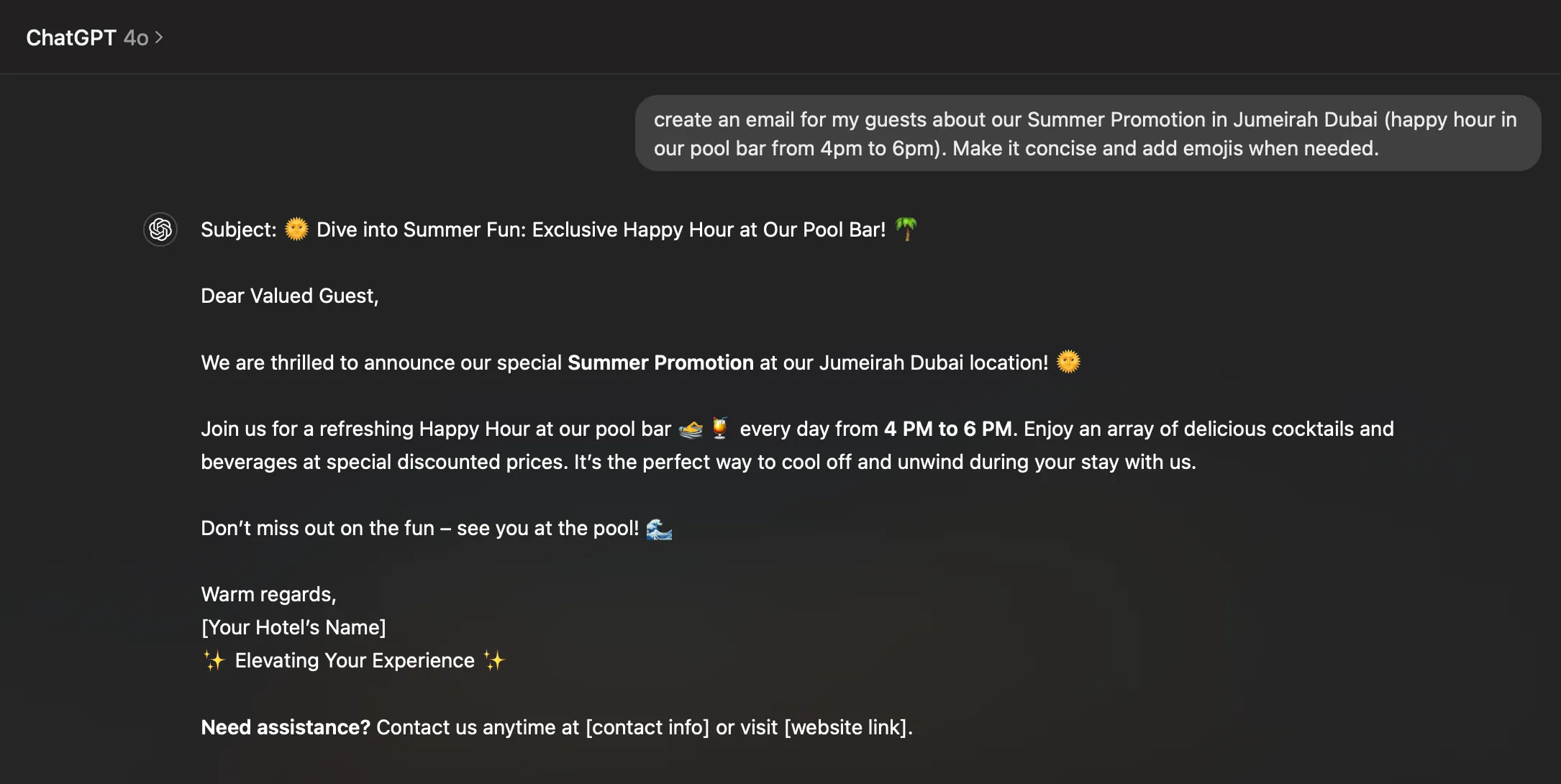
The General Manager's Summer Promotion Email - The hotel's general manager uses ChatGPT to craft a compelling summer promotion email. With the AI's assistance, the email becomes not just informative but also visually appealing, enticing subscribers with vivid descriptions of the hotel's amenities and the limited-time discount offer.
Website Content
ChatGPT is a valuable tool for enhancing a hotel's online presence. It aids in creating informative website content, including FAQ sections and blog posts.
By inputting relevant information, hoteliers can quickly generate content that answers common guest questions and provides engaging articles to attract visitors. This not only improves the website's user experience but also helps in search engine optimisation (SEO).
- Example Scenario
Creating an Informative FAQ Section - The hotel owner collaborates with ChatGPT to create an informative FAQ section for the website. By inputting frequently asked questions and their answers, the chatbot generates a user-friendly FAQ page. This not only enhances the guest experience by providing quick access to essential information but also boosts the website's search engine ranking.
PRO Tip: You can also upload that FAQ section to an AI Chatbot and let it answer any query with that data through any communication channel.
#2: Data Analysis
Customer Feedback
ChatGPT simplifies data analysis by examining customer reviews and feedback to identify recurring themes. This helps hoteliers pinpoint areas for improvement, enhance guest satisfaction, and make informed decisions to enhance the overall guest experience.
- Example Scenario:
Analysing Guest Feedback for Improvement - The general manager inputs guest reviews into ChatGPT, which swiftly identifies common themes such as requests for improved Wi-Fi connectivity or suggestions for expanding the breakfast menu. By analysing this data, the manager gains valuable insights into guest preferences and areas in need of improvement. The chatbot simplifies market research by gathering data on competitors, market trends, and customer preferences. It offers valuable insights that guide strategic decisions and ensure the hotel remains competitive.
- Example Scenario:
Staying Ahead with Market Research - The hotel owner uses ChatGPT to gather data on competitor performance, market trends, and changing customer preferences. The chatbot compiles this information into a comprehensive report, empowering the owner to make informed decisions and stay ahead in a dynamic market.
#3: Decision Support
Budget Planning
ChatGPT streamlines the budget planning process. It assists hoteliers in outlining comprehensive budget plans, including financial projections and justifications. This ensures effective financial decision-making, efficient resource allocation, and alignment with the hotel's goals and financial resources.
- Example Scenario
Budget Planning Made Easy - The general manager collaborates with ChatGPT to outline the hotel's budget for the upcoming fiscal year. The chatbot assists in projecting revenues, expenses, and returns on investment while providing persuasive arguments to justify the proposed budget.
Crisis Management
ChatGPT offers invaluable support during crises. It aids in drafting communication plans and responses, ensuring consistent and empathetic messaging to both guests and staff in critical situations. This helps the hotel navigate crises effectively and maintain its reputation.
- Example Scenario:
Crisis Management Communication - Faced with a crisis, the hotel manager uses ChatGPT to create clear and reassuring messages for guests and staff. The chatbot helps maintain effective communication during challenging times, ensuring that all stakeholders are well-informed and reassured.
#4: Staff Management
Training Material
ChatGPT simplifies staff onboarding by helping hoteliers create training manuals and scripts. It ensures that new employees receive the necessary information to provide exceptional service to guests, maintaining consistent service standards.
- Example Scenario
Onboarding with Training Manuals - The hotel owner uses ChatGPT to develop comprehensive training manuals. The chatbot generates clear and informative content, facilitating the onboarding process for new staff members and ensuring they understand the hotel's policies and procedures.
Scheduling
While ChatGPT isn't specialised scheduling software, it can assist in drafting preliminary staff schedules. By inputting shift details, employee availability, and other relevant information, hoteliers can quickly generate initial schedules, reducing the time and effort required.
- Example Scenario
Simplifying Staff Scheduling - The manager, in need of preliminary staff schedules, uses ChatGPT to expedite the process. The chatbot assists in creating a foundation for the final staff schedules, streamlining the scheduling process and ensuring efficient staff allocation.
#5: Communication
Guest Correspondence
ChatGPT helps streamline guest communication by assisting in drafting personalised emails and messages for various occasions. This not only enhances guest engagement but also contributes to guest satisfaction and loyalty.
- Example Scenario
Personalised Guest Emails - The hotel manager utilises ChatGPT to craft personalised emails, such as thank-you notes or special offers, ensuring that guests feel valued and appreciated. These personalised messages foster a strong connection between the hotel and its guests.
Staff Memos
The chatbot simplifies internal staff communication by aiding in the creation of clear and effective memos or notices. This ensures that important messages are easily understood and consistently delivered to the staff.
- Example Scenario
Effective Staff Communication - The general manager collaborates with ChatGPT to create internal staff memos that convey information and instructions clearly and efficiently. This improves staff understanding and ensures compliance with hotel policies and procedures.
#6: Time Management
Task Lists
ChatGPT aids in managing time effectively by helping hoteliers create organised to-do lists. This ensures that tasks are prioritised, deadlines are met, and important responsibilities are not overlooked.
- Example Scenario
Efficient Task Lists - The manager uses ChatGPT to generate detailed task lists, ensuring that responsibilities are prioritised, organised, and addressed promptly. This time management technique helps maintain efficiency in daily hotel operations.
Meeting Agendas
The chatbot streamlines meeting preparation by assisting in the creation of organised meeting agendas. This ensures that meetings are structured, productive, and time-efficient, allowing for better communication and decision-making among the staff.
- Example Scenario
Streamlined Meeting Agendas - The hotel manager uses ChatGPT to create structured agendas for staff meetings. The chatbot helps ensure that key topics are addressed, discussions stay on track, and meetings are productive. This time-efficient approach promotes effective communication among the team.
#7: Creative Problem-Solving
Brainstorming
ChatGPT serves as a creative brainstorming tool, offering innovative solutions to challenges the hotel might face. Whether it's attracting more guests during off-peak seasons, solving operational issues, or introducing new services, ChatGPT provides creative suggestions supported by data and market trends.
- Example Scenario
Boosting Off-Peak Occupancy with Creative Solutions - The hotel owner collaborates with ChatGPT to brainstorm solutions for increasing occupancy during off-peak seasons. The chatbot suggests creative ideas such as unique package deals, collaborations with local attractions, or hosting special events.
These creative solutions, backed by market research and guest preferences, empower the owner to make strategic decisions and enhance hotel revenue.
Case Studies: What Hotel-Trained AI Achieves
ChatGPT is a general assistant. The results below come from hotels that use chatlyn's AI, which answers guests from each property's own knowledge and hands the rest to the team, as published in chatlyn's case studies.
Case Study 1: IMLAUER Group, Salzburg and Vienna
Scenario: Before chatlyn, the hotel group trialled two well-known chatbot platforms. Both were costly to maintain and accurately resolved just 6% of guest enquiries.
Implementation: chatlyn's AI was set up with the group's own documents: FAQs, property guides, restaurant menus and local recommendations.
Results:
- The resolution rate went from 6% to 93%, without writing code or maintaining a decision tree.
- Staff spend their time on the requests that need a human touch. (case study)
Case Study 2: Hotel Sacher, Vienna and Salzburg
Scenario: The hotel needed to keep its legendary service standards while handling high enquiry volumes across both properties.
Implementation: chatlyn's AI serves as a digital first concierge: it answers routine questions and passes complex requests to the team.
Results:
- 70% more routine enquiries are handled by the AI.
- Brand voice and service quality are preserved in every conversation.
Case Study 3: Hotel Enzian Obertauern
Scenario: Reception at this adults-only boutique hotel spent every shift answering repeat questions, while three restaurants and a weekly events programme held untapped revenue.
Implementation: chatlyn's AI became the first point of contact on webchat and WhatsApp, and precisely timed WhatsApp messages before arrival introduce the restaurants and the weekly programme.
Results:
- The AI handles around 85% of routine enquiries.
- Restaurant reservations from WhatsApp campaigns rose by 38%. (case study)
Conclusion
In conclusion, ChatGPT is a fantastic tool for hoteliers. It is one of the most versatile general AI assistants, and for guest-facing chat it is worth comparing with the best AI hotel chatbots built for hotels. It makes hotel management easier and improves the guest experience. It helps with marketing, guest communication, feedback analysis, and much more. By using ChatGPT, hotels can offer better service, which leads to happier guests, more bookings, and increased income.
What's more, it's a secret weapon to increase hotel revenue. By offering upselling opportunities and improving guest communication, ChatGPT for hotels helps make more money while keeping guests happy.
If you want an AI that answers your guests automatically from your hotel's own knowledge, on WhatsApp, webchat and more, take a look at chatlyn's AI chatbot.
As a hotelier, learning how ChatGPT works and exploring what chatlyn's AI can do for your guests is a sensible step to keep your hotel competitive.
So, if you're in the hotel business, use the ChatGPT Hotel Industry tool to boost your guests' experiences and increase your revenue. Give ChatGPT for hotels and chatlyn's AI a try, and see what they change for your guests and your team.