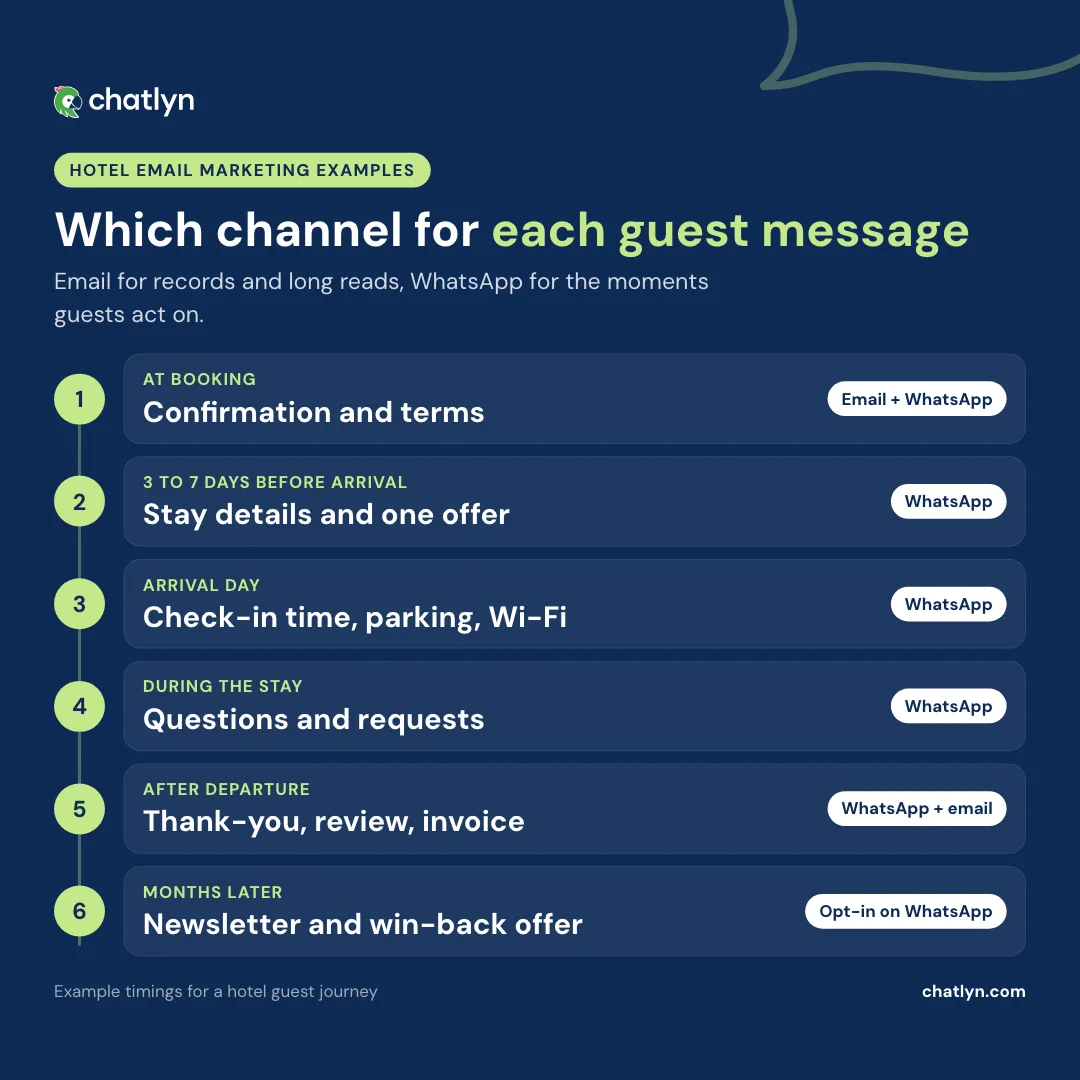
The best hotel email marketing examples follow the guest’s stay: a booking confirmation, a pre-arrival email, an upsell offer, a welcome on arrival day, a check-in during the stay, a thank-you with a review request, a win-back offer, a newsletter, a birthday note and a low-season offer. Each one works when it has a single purpose, a subject line that says what is inside and one call to action. For most of these moments the same message works better on WhatsApp, where guests open it, reply to a person and tap a button. Email remains the right channel for invoices, long newsletters and legal notices. For newsletter design ideas, see our 15 hotel newsletter examples, each shown as an email and on WhatsApp.
This guide gives you ten hotel emails examples with a subject line and body text you can adapt, then shows what changes when the same moment moves to WhatsApp. chatlyn builds guest messaging on WhatsApp and webchat, with messages timed by your PMS, so we will also show where email is still the right channel. If you run a hotel marketing team, this is the practical companion: what to send, when, and on which channel.
Why hotel email marketing still matters, and where it falls short
Email has three strengths no other channel matches. Almost every reservation comes with an email address, so your list grows with every booking. Email carries long content well: a full newsletter, a spa brochure, terms and conditions, an invoice as a PDF. And it is the channel guests expect for anything formal, such as a confirmation they may need to show a travel manager or an accountant.
Its weaknesses show up in the moments that bring in revenue and shape the guest experience. Hotel marketing emails often land in a promotions tab next to dozens of retailers. Many are sent from a no-reply address, so a guest with a question has to find a phone number or start a new email. Timing is usually a batch send, not the evening before the guest’s own arrival. And a guest reading on a phone at the airport will not scroll through a long template to find the check-in time.
The difference shows in the opens. Spa Resort Geinberg, a 4-star superior thermal resort in Upper Austria, measured a 95% open rate on its WhatsApp messages against about 20% for email. IMLAUER Hotels reached a 93% open rate on WhatsApp newsletters for seasonal offers, restaurant experiences and in-house services, and Hotel Enzian Obertauern a 92% open rate on its pre-arrival WhatsApp messages. That gap is the thread running through this guide: write the email well, then ask whether the guest would rather receive it as a message.
Hotel email vs WhatsApp at a glance
Before the examples, here is how the two channels compare for guest messages. For short, timely messages that ask the guest to do something, WhatsApp for hotels reaches far more people, while email keeps its place for the rest.
| Where it lands | Inbox or promotions tab, among many senders | The guest’s chat list, next to friends and family |
| Opened | About 20% (Spa Resort Geinberg) | 95% (Spa Resort Geinberg) |
| Replies | Often sent from a no-reply address | The guest answers in the same thread |
| Call to action | Links and banners | Tappable reply buttons or a booking link |
| Timing | Usually batch sends | Triggered by the reservation in your PMS |
| Length | Long content, attachments, PDFs | Short text, one image, one decision |
| Who answers | Whoever reads the mailbox | The AI for routine questions, the team for the rest |
| Rules | Consent for marketing, unsubscribe link | Opt-in, approved templates, a daily cap on marketing messages |
| Best for | Invoices, terms, long newsletters | Pre-arrival, upsells, in-stay, reviews, offers to opted-in guests |
10 hotel email marketing examples, and the WhatsApp version
Each example gives a subject line, body text to adapt and why it works, followed by what changes on WhatsApp. The words in square brackets are merge fields from your PMS or CRM. The pictures follow one guest, Sophie, through a stay at Isla Calma, a fictional resort in Mallorca, so you can compare each email with its WhatsApp version. If you welcome guests from several markets, write each message in your own language first, translate it with a tool such as Lara Translate, then ask a native-speaking colleague to check the tone before it goes live.
1. Booking confirmation email
Subject: Your stay at [Hotel] from [arrival date] is confirmed
Dear [First name], thank you for booking with us. Your reservation [number]: [room type], [arrival date] to [departure date], [number of guests]. Check-in is from [time], check-out until [time]. Your payment details and cancellation terms are below. Should you need anything before you arrive, reply to this email and our reservations team will help.

Why it works: It confirms the facts first, answers the next question (when can I check in?) and invites a reply to a real address. Keep it free of offers: a guest who has just paid wants reassurance, not a sales pitch.

On WhatsApp: Keep this email, because it is the formal record with the terms. Add a short WhatsApp message triggered when the booking is created: “Your stay from 14 May is confirmed. We will send you everything you need a few days before arrival. You can write to us here at any time.” This is a utility message about the booking, not marketing, and it opens the conversation you will use for the rest of the stay.
2. Pre-arrival email
Subject: [First name], your stay begins on [day]: what to know
Dear [First name], we look forward to welcoming you on [day]. Your room is ready from [time]; if you arrive earlier, leave your luggage with us and enjoy [facility]. Here is how to find us and where to park. Would you like to reserve a table or a treatment? Reply and we will arrange it.

Why it works: It arrives while the guest is planning, puts practical information first and offers one or two extras while there is still time to book them.

On WhatsApp: This is the email that gains most from moving. Spa Resort Geinberg sends a pre-arrival WhatsApp message, triggered from its PMS a few days before arrival, with the guest’s name, stay dates, reservation number, check-in at 16:00, thermal baths from 08:00 and three quick-reply buttons: “Enjoy arrival breakfast”, “Massages & Treatments” and “Arrival & Parking” (Geinberg case study). The guest taps what they need instead of searching an email for it. Hotel Enzian Obertauern uses its pre-arrival messages to confirm the stay details, introduce its three restaurants and share the weekly programme for the guest’s exact days.
3. Upsell email before arrival
Subject: Make your first evening at [Hotel] special

Dear [First name], you arrive on [day]. Our [restaurant] has a table by the window at 19:30 on your first evening, and our spa team still has treatment times on [day]. Would you like us to reserve one for you?

Why it works: One offer, tied to the guest’s own dates, with a reason to decide now. Offers that name a day and a time sell better than a list of everything the hotel has.
On WhatsApp: The same offer becomes a message with a photo and two buttons (“Reserve a table”, “Not this time”). The guest’s tap arrives in your inbox and the restaurant or spa team confirms. Hotel Enzian saw restaurant reservations from WhatsApp campaigns rise by 38%. For more on what to offer and when, see how chatlyn helps hotels increase hotel revenue from the guests they already have.
4. Arrival day welcome email
Subject: Welcome to [Hotel], [First name]
Good morning, [First name]. Today is the day. Your room is ready from [time], breakfast is served until [time] and the Wi-Fi network is [name]. Our front office is here for anything you need.

Why it works: It answers the three questions every guest asks on arrival day before they have to ask them.

On WhatsApp: On the morning of the check-in day, Spa Resort Geinberg sends an automatic WhatsApp message with a greeting, the room from 16:00, the thermal baths from 08:00, the Wi-Fi details and buttons for “Arrival & Parking”, “Luggage storage”, “Culinary” and “Good to know”. A guest in the car reads a message; very few open an email on the motorway.
How hotels message guests on WhatsApp
5. In-stay email
Subject: How is your stay so far?
Dear [First name], we hope you have settled in well. If anything in your room is not as it should be, or you would like a recommendation for dinner, reply to this email and we will take care of it.
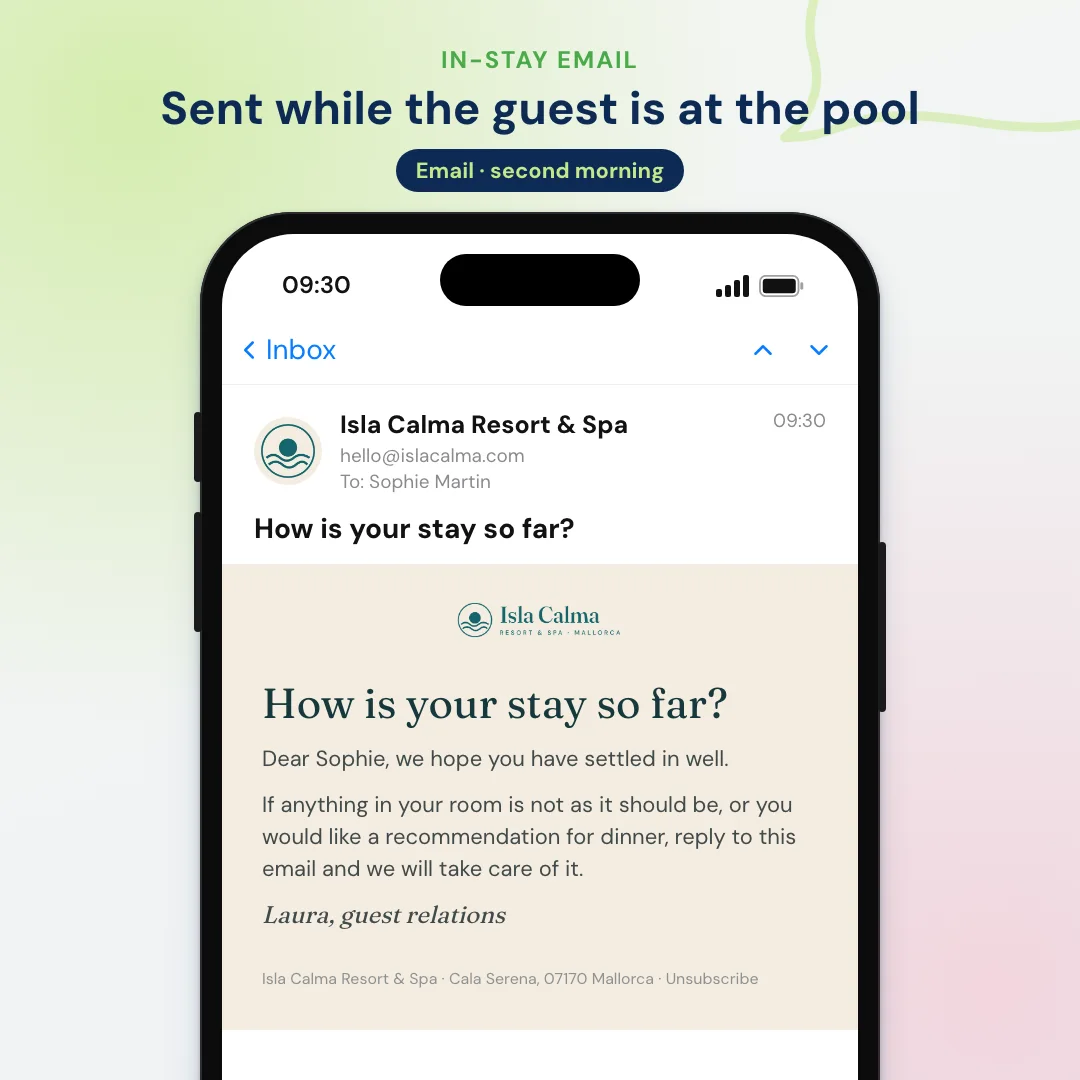
Why it works: It catches problems while you can still fix them, before they turn into a review.

On WhatsApp: Email is the wrong channel during the stay: the guest is at the pool, not in their inbox. A WhatsApp message on the second morning, with buttons such as “All good” and “Something to fix”, lets the guest answer in seconds, and the front office sees it straight away. Send your digital guest directory the same way: guests ask about opening hours, menus or the spa in the same thread, and the AI answers from your own information.
6. Post-stay thank-you and review request
Subject: Thank you for staying with us, [First name]
Dear [First name], thank you for choosing [Hotel]. We hope you had a lovely stay. Would you share your experience? It takes two minutes and helps other travellers find us. If anything was not right, reply to this email: it goes straight to our guest relations manager.

Why it works: It thanks first, asks once and gives unhappy guests a private route to you before they post publicly. Send it within a day or two of departure, while the stay is fresh. Your invoice can travel in a separate email, where it belongs.

On WhatsApp: The post-stay event in your PMS triggers a thank-you with two buttons, “Leave a review” and “Share feedback”. Guests who had a good stay reach the review page in one tap; guests with a comment write it in the thread, and a person answers. Offer both buttons to every guest rather than sending only happy guests to review sites.

7. Win-back email to past guests
Subject: It has been a while, [First name]
Dear [First name], it has been [time] since your last stay at [Hotel]. Our autumn menu has just started and the spa is quiet on weekdays. As a returning guest, you receive [benefit] when you book directly with us before [date].

Why it works: It is personal, gives a reason to come back now and rewards booking direct instead of through an online travel agency. A benefit (a dinner, a late checkout, a treatment) protects your rate better than a percentage off.
On WhatsApp: Past guests who opted in receive the same offer with a photo and two buttons, “See the offer” and “Ask a question”. The difference is what happens next. The guest asks whether the spa is open or whether the dog can come, the AI answers what it knows from your information, and reservations takes over for the rest, in the same thread. Our WhatsApp campaign ideas give you more offers to start from.
8. Hotel newsletter
Hotel newsletter examples that guests read have one theme per issue and three or four short items, each with a photo and a link:
- Seasonal news: the winter programme, a new spa treatment, the summer terrace opening.
- Events calendar: the wine evening, the Advent weekends, a concert in the garden, each with a date.
- The restaurant: the new menu, the chef’s seasonal ingredient, a table for two on a named evening.
- Local guide: three things to do nearby this month, written by your own team.
Subject: Winter at [Hotel]: the new sauna, the Advent evenings and a table by the fire

Why it works: Specific items with dates give readers a reason to act; a generic “news from the hotel” does not. One newsletter a month is plenty.
On WhatsApp: A WhatsApp newsletter is shorter: one offer, one image, one button, sent to guests who opted in, at most every one to two weeks. IMLAUER Hotels used WhatsApp newsletters for seasonal offers, restaurant experiences and in-house services and reached a 93% open rate. Keep the long-form newsletter by email for subscribers who never gave you their WhatsApp opt-in, and send the one offer that matters most on WhatsApp.

WhatsApp newsletters for hotels
For 15 complete designs, from a Paris palace to a hostel in Lisbon, each shown as an email and as a WhatsApp message, see our hotel newsletter examples.
9. Birthday and anniversary emails
Subject: Happy birthday, [First name]

Dear [First name], all of us at [Hotel] wish you a wonderful birthday. If you would like to celebrate with us this year, a glass of champagne will be waiting for you on your next stay.

Why it works: It is personal and asks for nothing. The anniversary version (“one year ago you stayed with us”) works well for couples and for guests who came for a special occasion.
On WhatsApp: Birthday messages only work if the data is right. A hotel CRM that combines stays and spend from your PMS with every conversation gives you the birthday, the last stay and what the guest enjoyed, so the message can mention the spa afternoon they booked last time. In chatlyn, a live list shows the birthdays of the week, and your team decides who receives a message and what it says.
10. Low-season offer email
Subject: Three quiet nights in November, with dinner
Dear [First name], November is our quietest month and one of the most beautiful: the spa is calm, the fire is lit and the restaurant serves its autumn menu. Stay three nights with dinner on the first evening, bookable until [date].

Why it works: It sells a reason to travel rather than a discount, and it speaks to guests who can travel outside the holidays: couples, retired guests, returning guests.

On WhatsApp: Send it as a campaign to a segment (couples who stayed with you in autumn, for example) with a photo and a booking button. Spa Resort Geinberg runs campaigns like this with an image, a short text and a direct booking button, for offers such as its Karibik-Lagune Chalet and reservations in the Relax! sauna lounge.
When email is still the right channel
Being fair to email makes the case for WhatsApp stronger. Keep email for:
- Invoices, folios and receipts. Guests and their accountants need a document they can file.
- Terms, cancellation policies and legal notices. Changes to your terms or privacy information belong in a durable, formal channel.
- Long-form newsletters to your whole list. Many subscribers never gave you a WhatsApp opt-in, and you cannot send them promotions there.
- Corporate bookers and travel agents. They work from their inbox and often book for someone else.
- Marketing to guests with US phone numbers. Meta, the company behind WhatsApp, has paused marketing templates to US (+1) numbers; booking-related utility messages still arrive.
WhatsApp has rules of its own, and they are worth respecting:
- Opt-in first. Promotional messages need the guest’s consent to hear from your hotel on WhatsApp. Ask for it at booking, at check-in or with a QR code in the room.
- Utility versus marketing templates. Messages about an existing booking (confirmation, check-in details) are utility templates. Offers, upsells, newsletters and win-back messages are marketing templates. Marketing language inside a utility template gets it rejected or reclassified by Meta.
- A daily cap. Each WhatsApp user receives only about two marketing templates per day from all businesses combined, and messages over the cap are dropped. Segment and send rarely: about one marketing message every one to two weeks is a healthy rhythm for hotels.
- The 24-hour window. To start a conversation you need an approved template. Once the guest replies, your team can answer freely for 24 hours.
Our free playbook of 30 WhatsApp templates for hotels covers approval, categories and wording in detail.
How to move hotel marketing emails to WhatsApp
You do not have to switch everything at once. Most hotels move in this order:
- Collect opt-ins. Add a WhatsApp consent checkbox to the booking engine and the registration form, and a QR code at reception and in the rooms.
- Start with utility messages. The booking confirmation and the pre-arrival details go to every guest, they help, and they open the conversation.
- Add one offer to the pre-arrival message. A table, a treatment or an arrival breakfast, as a button.
- Move the in-stay and post-stay messages. The second-morning check and the thank-you with the review request.
- Run campaigns to segments. Win-back, low-season and seasonal offers to guests who opted in, every one to two weeks at most.
- Keep email for what it does best. Invoices, terms and the monthly long-form newsletter.
How chatlyn helps hotel marketing teams choose the right channel
chatlyn is the AI-Native GRM (guest relationship management). Proactive messages go out on WhatsApp, timed by your PMS, and replies from every channel land in one inbox where your team works.
Messages triggered by the stay. PMS events (booking created, before arrival, check-in day, check-out, after departure) send WhatsApp templates at the right moment for each reservation, in the guest’s language. You chain messages into a guest journey, test it before it goes live and see clicks and conversions for each step.
One profile for every guest. Stays and spend from your PMS sit next to every conversation, and the AI labels guests from both. Live lists (arriving today, in-house, departing tomorrow, recently checked out, birthdays this week) and custom segments decide who receives which offer.
Answers in the same thread. When a guest replies, the hotel chatbot answers routine questions on WhatsApp, webchat, Facebook Messenger, Instagram and newly created Booking.com inboxes from your own information, in the guest’s language, and hands everything else to your team. Your reservations, spa and restaurant teams confirm bookings and changes. At Spa Resort Geinberg, the AI webchat handled 86% of enquiries without staff, and the other 14% went to the team. See where this fits in AI for hotels across the whole stay.
Email in the same inbox. Connect your reservations mailbox (Gmail, Microsoft 365 or IMAP) and email replies arrive next to WhatsApp, webchat, Booking.com, Messenger and Instagram. On email, the AI drafts replies for your team to check and send.
Bernhard Sänger, Director of Operations at Spa Resort Geinberg: “With chatlyn, we turned guest communication into a revenue driver in our Spa, 95% open rates on WhatsApp campaigns and 86% of enquiries handled without staff involvement.”
What to measure
- Open and read rates per channel, for the same message sent by email and on WhatsApp.
- Replies: how many guests answered, and how quickly your team responded.
- Clicks and conversions per message or journey step, to see which offer works at which moment.
- Extras booked (tables, treatments, upgrades), recorded in your own systems.
- Reviews and private feedback after departure.
- Opt-outs and spam reports, your early warning that you are sending too much.
FAQ
What are good hotel email marketing examples?
Booking confirmations, pre-arrival emails, upsell offers before arrival, arrival day welcomes, in-stay check-ins, post-stay thank-you and review requests, win-back offers, newsletters, birthday notes and low-season offers. Each works best with one purpose, a clear subject line and one call to action.
What should a hotel newsletter include?
One theme and three or four short items with dates and photos: seasonal news, events, the restaurant and local tips. Send it monthly by email, and send the single most important offer on WhatsApp to guests who opted in. Our hotel newsletter examples show 15 designs side by side with their WhatsApp versions.
Is WhatsApp better than email for hotel guest messages?
For short, timely messages, usually yes. Spa Resort Geinberg measured a 95% open rate on WhatsApp against about 20% for email, and guests can reply and tap buttons. Email remains better for invoices, terms and long newsletters.
Can hotels send marketing messages on WhatsApp without consent?
No. Promotional WhatsApp messages need the guest’s opt-in and an approved marketing template. Messages about an existing booking use utility templates.
Should hotels stop sending marketing emails?
No. Keep email for subscribers without a WhatsApp opt-in, for long-form content and for formal documents. Move the moments where guests need to act or reply (pre-arrival, upsells, in-stay, reviews) to WhatsApp.