Mews has changed what hoteliers expect from a property management system. Guests check in on their phone, cut their own key at a kiosk and pay without queuing at the desk. That is a real step forward for operations. But a guest experience is more than a smooth transaction: it is every question answered, every recommendation that lands at the right moment and every guest who feels remembered.
This guide walks through the Mews guest experience from end to end: who Mews is, how the guest journey in Mews works stage by stage, what the Advanced Guest Experience module means, how Mews pricing works, where guests most often drop off, and how hotels on Mews add the conversation that turns a smooth stay into a memorable one.
What “Mews guest experience” means
When hoteliers talk about the Mews guest experience, they usually mean the guest-facing side of the Mews platform: everything a guest touches without speaking to your team. Mews groups these tools under Guest Experience on its own product pages. They include the booking engine, the online check-in and check-out flow in the Guest Portal, the self-service kiosk and digital keys.
Together they cover the transactional side of a stay: booking, registration, payment, keys. What they are built to do is remove friction. What they leave to the hotel is the human side: the questions guests ask before they arrive, the restaurant tip on the first evening, the spa they did not know about, the follow-up after check-out. That second half is where most of a guest experience is won or lost, and it is where this guide spends most of its time.
The Mews brand at a glance
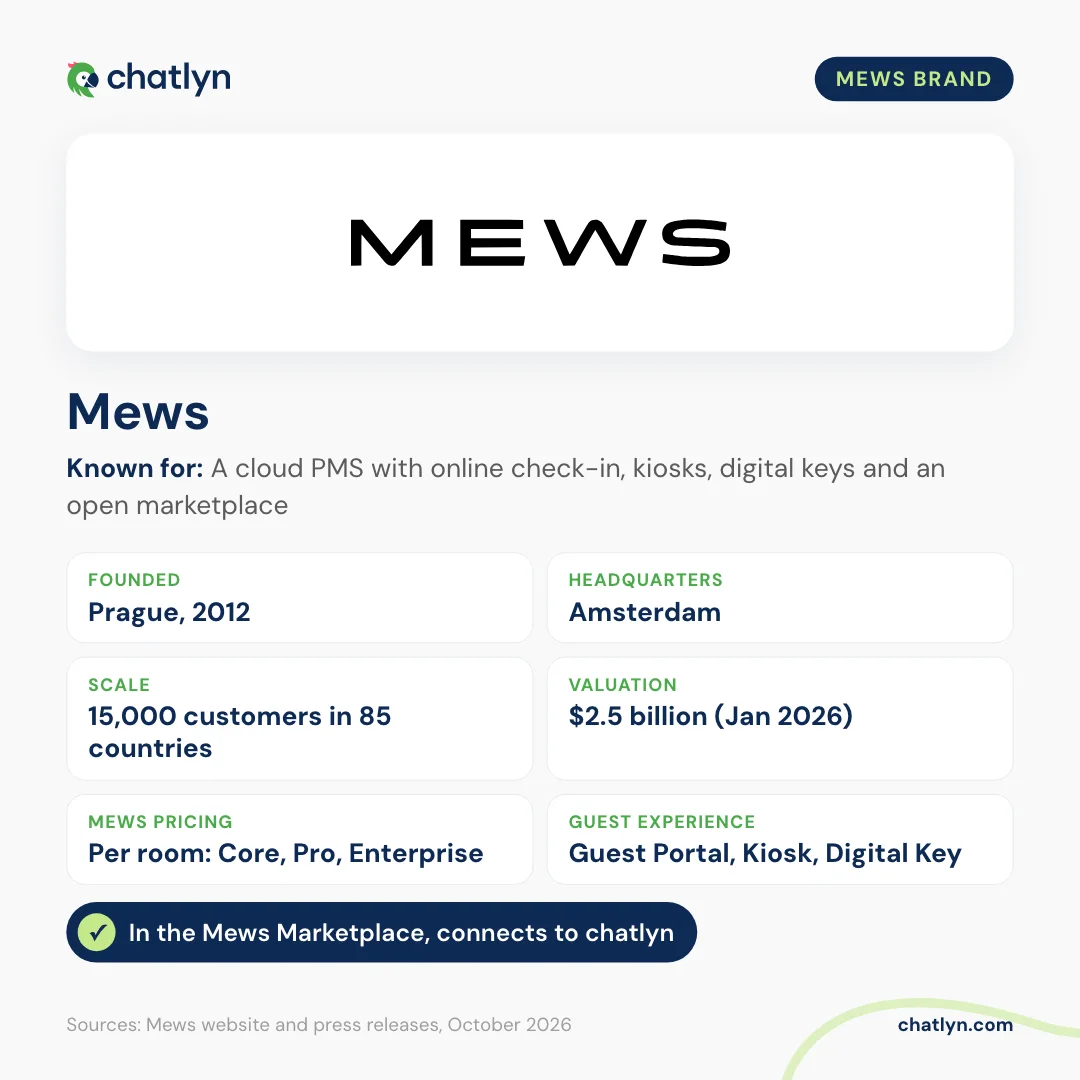
Before looking at the guest journey, it helps to know who you are working with. A few facts about the Mews brand, as published by Mews:
- Founded in 2012 in Prague by Richard Valtr, a former hotelier who wanted a PMS built for the cloud from day one. The company later moved its headquarters to Amsterdam, and Matt Welle is CEO.
- Scale: in January 2026 Mews reported around 15,000 customers in 85 countries and more than 42 million checked-in reservations in 2025.
- Funding: a $300 million Series D in January 2026 at a $2.5 billion valuation, led by EQT Growth, after earlier rounds in 2024 and 2025.
- Acquisitions: Mews has bought companies across the hotel stack, among them the revenue management system Atomize, the housekeeping tool Flexkeeping and the quoting tool Quotelo.
- Product names: the core PMS, once known as Mews Commander, is now Mews Operations. Older reviews still use the old name.
- An open platform: Mews publishes its APIs openly, and the Mews Marketplace lists a large catalogue of certified integrations, from revenue management to guest messaging.
That last point matters for the guest experience. Mews was designed to be the system of record that other tools connect to. Hotels on Mews rarely run it alone: they pick the specialist tools that fit their guests and connect them through the Marketplace.
The guest journey in Mews, stage by stage
Here is the guest journey in Mews as most properties run it, with the questions guests ask at each stage.
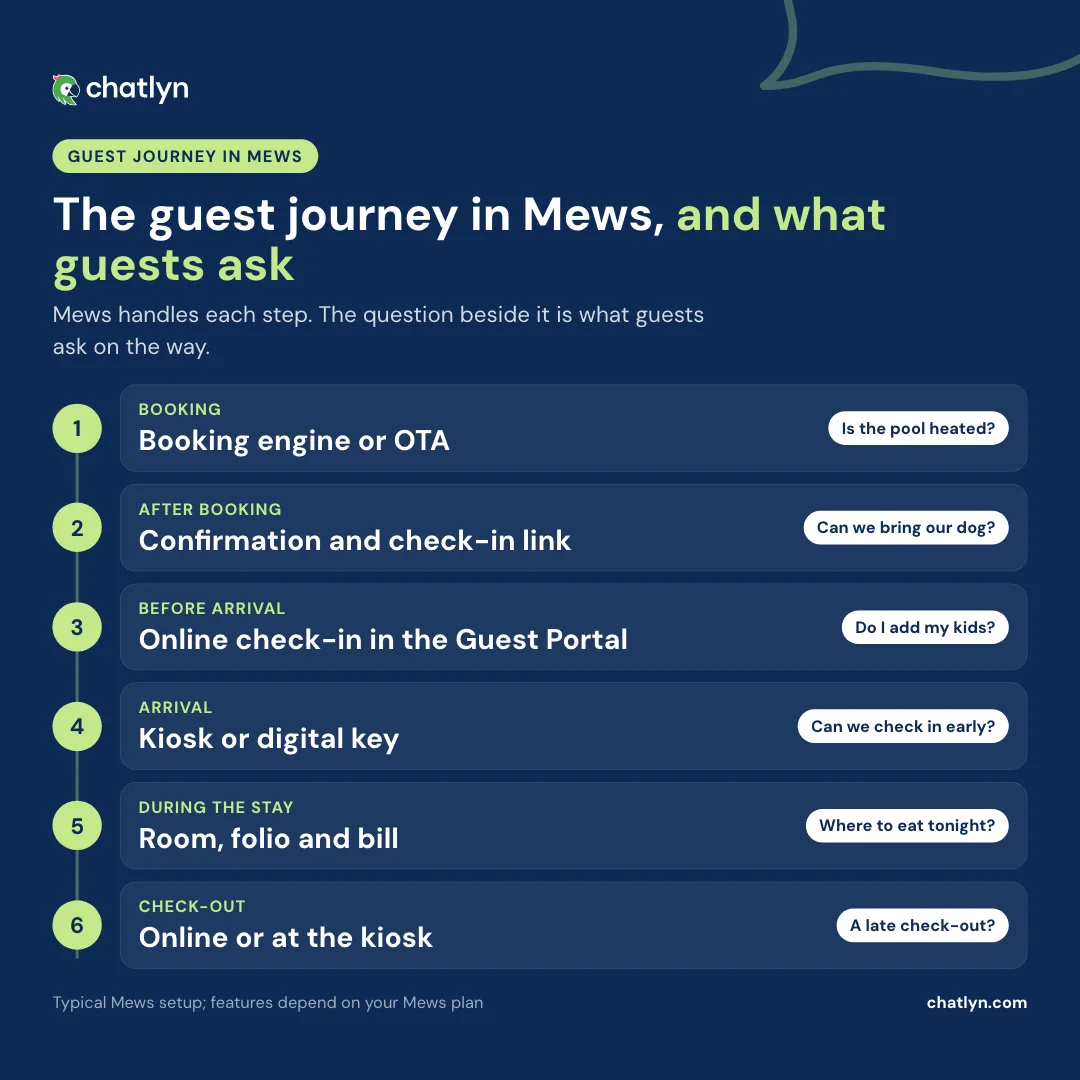
1. Booking
Guests book through the Mews booking engine on your website, through an OTA or through your reservations team. The reservation lands in Mews with the booker, the stay dates, the room and the rate.
What guests ask at this stage: “Is the pool heated in June?”, “Can we bring our dog?”, “Is there parking?”. These questions come before the booking, often late in the evening, and an unanswered question is the most common reason a website visitor leaves to compare prices on an OTA.
2. Pre-arrival and online check-in
After booking, Mews sends a confirmation email with a link to online check-in in the Guest Portal. There, guests can fill in their details, scan an ID document, add the people travelling with them, sign the registration card, buy upgrades and pay. Mews can also send a reminder shortly before arrival.
What guests ask at this stage: “How do we get there from the airport?”, “Can we check in early?”, “Can you book us a table for the first night?”. These are the questions that otherwise end up as phone calls to reception.
3. Arrival
On arrival, guests who checked in online can go straight to the kiosk to pick up or cut a key, or use a digital key, while the desk team focuses on the guests who need them. Mews says a kiosk check-in takes under three minutes.
4. During the stay
The stay itself is where Mews steps back: it holds the folio, the room and the bill. The guest experience during the stay happens in conversations: where to eat tonight, what to do tomorrow, a late check-out, a pillow menu, a complaint that needs to be handled quickly.
What guests ask at this stage: everything, at any hour, in their own language.
5. Check-out and after the stay
Guests can check out online or at the kiosk and pay the balance themselves. The reservation closes in Mews. What happens next, the thank-you, the review request, the invitation to come back, depends on what the hotel has set up around it.
What the journey tells you
Read the stages again and a pattern appears. Mews handles the transactions of the guest journey extremely well. Every stage also produces questions and moments, and those need a conversation: an answer in seconds, in the guest’s language, from someone (or something) that knows your hotel and knows this guest. That is the layer to add on top of Mews.
Mews Advanced Guest Experience: what it is
“Advanced Guest Experience” is the name Mews has used for a module that bundles its more advanced guest-facing features on top of the core PMS. Third-party reviews have described it as including things like a booking engine on your own domain, branded guest communications, check-in reminders, digital keys and AI summaries of guest preferences.
Two practical points if you are evaluating it:
- Packaging changes. Mews’ current pricing page presents three plans, Mews Core, Mews Pro and Enterprise, and no longer uses the module names. If a feature matters to you, ask your Mews account manager which plan includes it today rather than relying on older lists.
- It is still a toolkit for the transaction. The module makes check-in, keys and payment smoother. The questions guests ask, the recommendations that sell your spa and restaurant, and the follow-up that brings guests back are still yours to run, and that is where a dedicated conversation layer earns its keep.
Mews pricing: how it works
Mews does not publish prices. Its pricing page lists the three plans and asks you to request a quote. A few things are clear from it:
- Pricing is per room, so the monthly cost scales with the size of the property.
- Plans build on each other: Core covers the PMS essentials, Pro is presented as the most popular plan, and Enterprise adds what groups and larger properties need.
- Add-ons are priced separately, for example point of sale, spaces and payment processing fees.
Third-party sites quote estimates, often in the range of about $8 to $25 per room per month depending on plan and add-ons, but these come from competitors and directories rather than Mews, so treat them as a rough orientation only. The only reliable number is the quote you get for your property.
When you compare quotes, ask three questions that affect the guest experience directly:
- Which guest-facing features (online check-in, kiosk, digital key, booking engine) are in my plan, and which are add-ons?
- Which integrations will I connect from the Marketplace, and what do they cost?
- What does it cost to message guests on the channels they actually read?
Where guests drop off, and how to fix it
Hotels on Mews tend to see the same weak spots. None of them are failures of the PMS. They are moments where the guest needs a nudge, an answer or a person.
The online check-in link that never gets opened
Online check-in only saves your desk time if guests complete it. Mews delivers the link by email, and hotel emails compete with everything else in the inbox. For OTA bookings it is harder still, because the OTA’s own confirmation emails can break or hide the link.

The fix: send the check-in link where guests actually read. At Spa Resort Geinberg, 95% of WhatsApp messages are opened, against about 20% for email. A WhatsApp message two days before arrival, with the guest’s own Mews check-in link as a button, turns a forgotten email into a completed check-in.
Guests who stop halfway through check-in
Hoteliers on the Mews community report that some guests abandon online check-in at the step where they have to add their travel companions. A form cannot answer “do I need to add my children?”.
The fix: make sure every pre-arrival message can be answered. When the guest can reply “do I need to add the kids?” and get an answer in seconds, they finish the form.
Questions that become phone calls
Every “can we check in early?” and “is there parking?” that is not answered in writing becomes a call to reception, usually at the busiest moment of the day.
The fix: answer them before they are asked, and answer the rest instantly. A message timed by the Mews reservation that covers check-in time, parking and directions removes most of them. An AI that answers the remaining questions from your own information, in the guest’s language, takes care of the rest.
Recommendations that never reach the guest
Your spa, your terrace restaurant and your boat trip are in a brochure or on a page of the Guest Portal that few guests browse. Offers sold in a newsletter mostly go unread.
The fix: offer them in conversation, at the right moment. “Any ideas for tomorrow?” is the best sales opening a hotel will ever get. Answer it with three experiences as buttons, and let your team confirm the booking.
Guests nobody remembers
A guest who emailed about an anniversary, booked through an OTA and wrote on WhatsApp is three separate threads in three separate tools in most hotels. The next colleague on shift starts from zero.
The fix: one guest profile that holds every conversation next to the stays from Mews, so whoever replies knows who they are talking to.
Adding the conversation: Mews and chatlyn
This is the layer chatlyn adds to the Mews guest journey. chatlyn is listed in the Mews Marketplace under Guest Experiences, and the Mews integration works like this:

- Mews tells chatlyn about every reservation. Created, updated, cancelled, checked in, checked out or no-show: Mews notifies chatlyn by webhook, with the booker, the stay, the room, the booking source and the guest’s language. Mews stays your system of record.
- The Mews check-in link goes out on WhatsApp. chatlyn adds each guest’s Mews online check-in link every day, and short-lead bookings get theirs soon after they are made. Your pre-arrival message carries it as a button, in the guest’s language.
- The guest journey runs on Mews events. With guest journey automation you choose the moments: after booking, a few days before arrival, on arrival day, after check-out. A cancellation stops the messages that no longer apply, and only room reservations start journeys, so car parks and meeting rooms stay quiet.
- The AI answers, day and night. chatlyn’s AI hotel chatbot answers on WhatsApp and the chat on your website from your own knowledge, in the guest’s language, and passes anything personal to your team with the whole conversation. Website visitors who have not booked yet get their answer too, and the chat opens your booking engine with their dates filled in.
- Every conversation shows the stay. WhatsApp, email, your website chat and Booking.com arrive in one inbox, on one guest profile with the stays from Mews, translated both ways for your team.
- Offers go to the right guests. Because every stay comes from Mews, you can send a WhatsApp offer to the guests who opted in, by arrival date, length of stay or room.
The effect on the guest journey is simple to describe. Mews makes the transaction effortless. chatlyn makes sure every question in between gets an answer, every moment gets the right message, and every guest is remembered. Hotels that run their guest communication this way see it in their numbers: Hotel Enzian Obertauern has 92% of its pre-arrival messages opened, and Spa Resort Geinberg’s AI answers 86% of its webchat enquiries without staff.
If you are comparing tools for this layer, our guide to hotel guest experience software explains what to look for and how chatlyn approaches it.
A checklist for a better Mews guest experience
Use this to review your own setup:
- Online check-in: is the link reaching guests on a channel they read, including OTA guests?
- Pre-arrival: does one message, timed by the reservation, cover check-in time, parking and directions?
- Answers: can a guest get an answer at 11 pm, in their language, without calling?
- Website visitors: is there someone, or something, answering questions before the booking?
- Recommendations: are your spa, restaurant and experiences offered in conversation at the right moment?
- Handover: when a guest needs a person, does your team get the whole conversation and the stay?
- Memory: does the next colleague, or the next stay, start where the last one ended?
- After the stay: is there a thank-you, a review request and a reason to come back?
If most answers are yes, your Mews guest experience is in very good shape. Each “no” is a conversation waiting to happen.
Frequently asked questions
What is the Mews guest experience?
It is the guest-facing side of the Mews platform: the booking engine, online check-in and check-out in the Guest Portal, the kiosk and digital keys. It covers the transactional steps of a stay, and hotels add a conversation layer for questions, recommendations and service.
What does the guest journey in Mews look like?
Booking, a confirmation email with the online check-in link, online check-in in the Guest Portal, arrival at the kiosk or with a digital key, the stay, and online or kiosk check-out. Each stage can trigger a message to the guest through integrations such as chatlyn.
Is Mews Advanced Guest Experience still sold?
Mews has used the name for a module of advanced guest-facing features. Its current pricing page presents the Core, Pro and Enterprise plans instead, so ask Mews which features your plan includes.
How much does Mews cost?
Mews prices per room and quotes each property individually, with add-ons such as point of sale and payment processing priced separately. Third-party estimates exist, but only a Mews quote is reliable.
Can I send the Mews check-in link on WhatsApp?
Yes, with an integration. chatlyn adds each guest’s Mews online check-in link to the reservation every day, so your WhatsApp message before arrival can carry it as a button. See the Mews integration for the details.