To increase hotel occupancy in low season, give guests a specific reason to travel in the quiet weeks, invite the people most likely to say yes (past guests and travellers within a few hours’ drive) weeks before those dates, and answer every enquiry while the guest is still deciding. Packages, local events, longer stays and a direct invitation to returning guests fill more room nights than a lower rate on its own.
Every hotel has weeks when the car park is half empty and the team is fully staffed. The instinct is to drop the rate and wait. But low-season guests rarely stay away because of price alone: they stay away because nobody gave them a reason, or a reminder, at the moment they were planning. This guide covers ten ways to increase hotel occupancy in low season, when to start each one, example messages to adapt and what to measure. It focuses on filling room nights. For what each of those stays is worth (packages instead of discounts, extras sold before arrival, spa and restaurant in quiet hours), read our sister guide on how to increase hotel revenue in low season.
Why hotel occupancy drops in low season, and why discounts rarely fix it
Low season is not a lack of travellers. It is a lack of reasons. In the high season the destination sells itself: snow, beaches, summer holidays. In November or late spring, the guest needs a plan they can picture: a quiet spa weekend, the first autumn menu, a hiking week with the paths to themselves, a wine harvest, a local festival.
A deeper discount does not create that plan. It tells guests who would have come anyway that they can pay less, and it trains returning guests to wait for the next offer. Rate strategy belongs to your revenue manager; the question for this guide is how to create and capture demand. Three things decide most low-season occupancy:
- Who you invite. Past guests, the regional market and groups with fixed dates convert better than cold audiences.
- When you invite them. Low-season rooms are sold weeks ahead. An offer sent ten days before the dates reaches guests whose calendars are already full.
- How fast you answer. An enquiry at 22:40 about “rooms mid-November” is a booking in progress. If the answer comes the next afternoon, the guest has often booked elsewhere.
10 strategies to increase hotel occupancy in low season
Each strategy covers who it reaches, when to start and what the guest sees.
1. Know who already travels in your low season
Start with your own data, not a persona workshop. Pull last year’s low-season stays from your PMS and look at who came: couples without school-age children, guests over 55, remote workers staying a week, wellness guests, business travellers on weekdays, guests from within a two or three-hour drive. Note the length of stay, the day of arrival and the booking lead time.
Most hotels find two or three clear groups. Those are the guests to design for, because they already chose your quiet weeks once. A couple who came for a spa weekend last November is a better starting point than a new market you have never reached. Your hotel revenue team and your hotel marketing team should agree on these groups together: revenue knows which dates need filling, marketing knows which guests respond.
2. Give guests a reason to come, not just a lower price
A low-season package answers the question “why now?”. Build it around what the season does well at your property:
- Wellness weeks. Quiet saunas, treatments at good times, longer spa hours in the evening.
- Food and wine. The new seasonal menu, a harvest dinner, a cookery class with the chef, a wine tasting in the cellar. A stay with half board turns “a room in November” into three evenings planned.
- Nature and activity. Hiking with empty paths, cycling, golf in mild weather, guided walks.
- Culture and calm. A reading weekend, a photography course, a Christmas market nearby.
Keep it to three packages at most, each with a clear name, a photo and what is included. Give the guest a concrete value (“the third dinner is on us”) rather than a percentage. The value of each package, and how to protect your rates while you sell it, is the subject of our sister post on low-season revenue.
3. Invite past guests first, six to eight weeks ahead
Guests who have stayed with you already trust the house. They need no convincing about the rooms or the kitchen, only a reason and a date. Invite them before anyone else, six to eight weeks before the quiet period, when calendars are still open.
WhatsApp works well here because messages are read. At Spa Resort Geinberg, WhatsApp campaigns with an image, a short text and a direct booking button reached a 95% open rate, against about 20% for email (Geinberg case study). The message should look like an invitation, not a newsletter: one photo, two lines, two buttons.

In the example, the guest taps “See dates”, asks whether 14 to 17 November works for two, and receives the booking page with the dates already filled in. Two things matter: only guests who agreed to hear from the hotel on WhatsApp receive the message, and the offer goes to a segment (guests who stayed in autumn or winter, couples, returning guests), not to everyone on file. Our WhatsApp campaign ideas include more seasonal formats to adapt.
4. Win the regional market three to four weeks ahead
Guests within a two or three-hour drive decide late and travel on short notice. They are your best source of weekend and midweek stays in the low season, because a Thursday-to-Sunday trip needs no flight and no annual leave planning.
Reach them three to four weeks ahead with offers built for short trips: two nights with dinner, a spa day with an overnight stay, a Friday arrival with late check-out on Sunday. Local residents also come for the restaurant or the spa without staying, and many of them book a room the next time. Those day guests are covered in more detail in our revenue guide. For occupancy, the point is to be the obvious weekend option for the region, with a clear offer on your website and in your channels.
5. Build stays around events and groups
Events turn a vague “sometime in autumn” into fixed dates. Look at the calendar around you: trade fairs, concerts, marathons, harvest festivals, Christmas markets, school holidays in neighbouring countries. Write to guests about the event, not the room: “The Christmas market opens on 28 November. We are a ten-minute walk away and have kept rooms for that weekend.”
Create your own events where there are none. Hotel Enzian Obertauern runs a weekly events programme and shares it before arrival, for each guest’s exact days (Enzian case study). The same idea works as an occupancy tool in quiet weeks: a wine weekend, a chef’s table evening, a yoga retreat.
Groups fill several rooms with one decision: seminars, company retreats, clubs, choirs, hiking groups, small weddings that cannot afford a Saturday in June. Midweek low-season dates are exactly what these planners look for. Give your sales team a short, ready-made offer for them.
6. Turn one-night stays into longer ones
A guest already in the house is the easiest room night to add. Send in-house guests the day before departure a short message: “The weather looks lovely for the weekend. Would you like to stay one more night? Your room is available.” Only send it when the room is actually free, and let the team confirm.
Extend at booking too: packages built for three nights, a Sunday night offer for weekend guests, a remote-work week for guests who can take their laptop. Each extra night lifts occupancy without finding a new guest. Look at length of stay by segment in the guest profile, so you know which guests are open to it; our guide to the personalised guest journey shows how to structure those segments.
7. Answer enquiries in minutes, day and night
Low-season guests compare several hotels in the same evening. The first hotel that answers clearly, with a way to book, usually wins. Enquiries arrive at 22:40 on a Sunday, not during office hours.

An AI assistant trained on your hotel’s own information (spa hours, packages, house rules, directions) can answer these questions immediately, in the guest’s language, and pass anything unusual to the team. At Hotel Enzian, the AI handled about 85% of routine enquiries, with an average response time of about three seconds, at any hour. The AI sends the guest to your booking engine, where live prices and rooms are always current.
8. Bring more low-season bookings direct
Online travel agencies are useful in the low season: they bring guests who have never heard of you. Keep your listings, photos and reviews current. But every returning guest who books through an OTA costs you commission, and you lose the conversation.
Make the direct path clear for guests who already know you: a returning-guest offer that is only available when booked with you, a booking link in every message, a webchat on your website that answers questions before the guest leaves to compare. Reply to guests who message you on Booking.com just as quickly as on WhatsApp, and after the stay invite them to book direct next time.
9. Sell the next quiet season at departure
The best moment to fill next year’s low season is the end of this year’s. The guest has just enjoyed the quiet weeks and knows what they are like. In the thank-you message after departure, invite them back for the same season: “Thank you for staying with us in November. If you would like the same weeks next year, reply and we will keep your favourite room in mind.”
Repeat business compounds. Each returning low-season guest is one less room night you need to find from scratch, and one more guest you can invite first next time.
10. Plan the season twelve weeks ahead, with one team
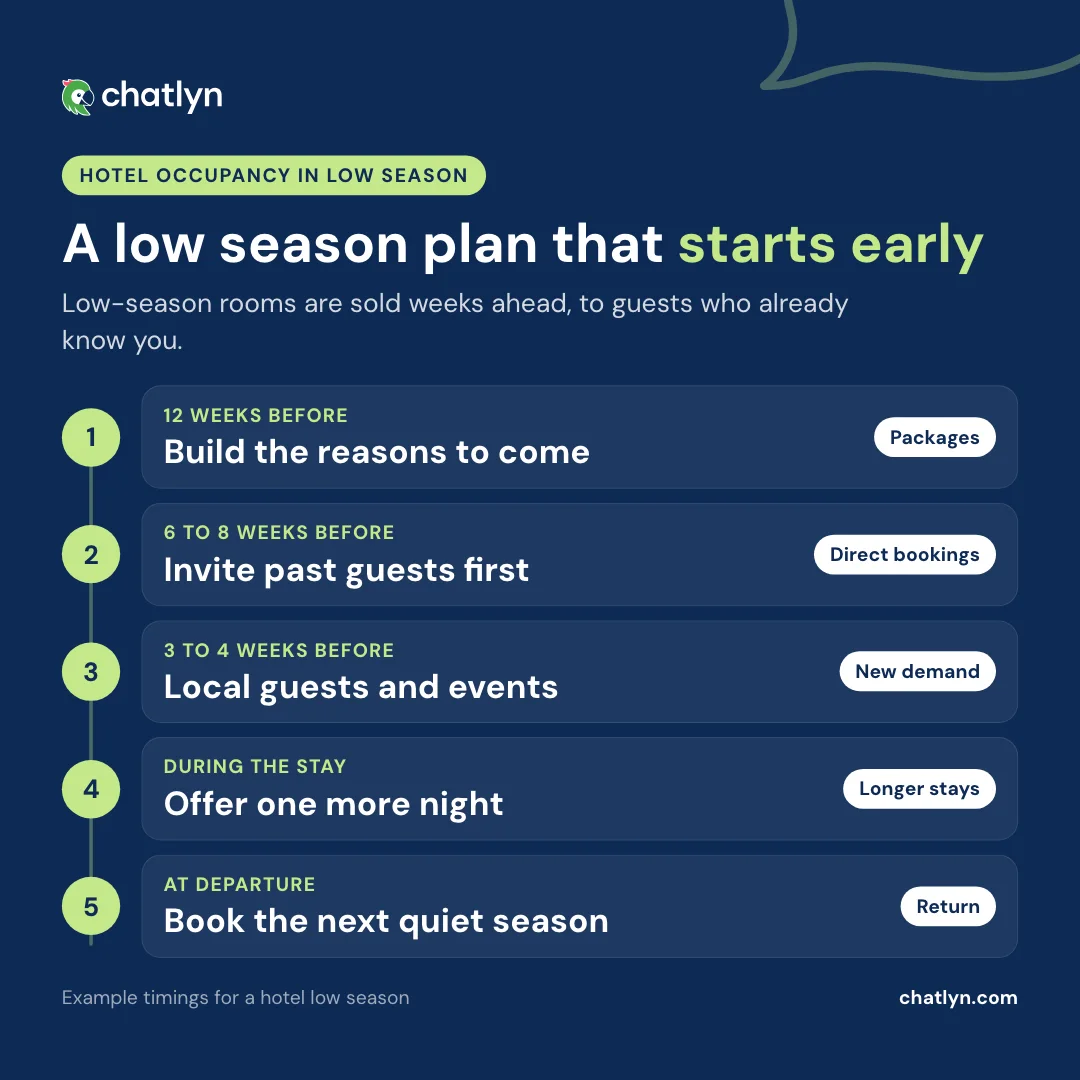
The strategies above only work in sequence. Twelve weeks before the quiet period, decide the packages and the events. Six to eight weeks before, invite past guests. Three to four weeks before, reach the regional market and groups. During the stay, offer the extra night. At departure, invite the next visit.
Put one person in charge of the calendar, and have revenue, marketing, reservations and front office agree on it once. Your general manager should see the plan too: low-season occupancy is a whole-house decision, from staffing to the restaurant opening days.
Low-season hotel occupancy strategies at a glance
The example messages are templates to adapt, not scripts to copy.
| Strategy | Who it reaches | When | Example message |
|---|---|---|---|
| Low-season packages | All low-season segments | Ready 12 weeks before | ”Three nights, our autumn menu and a quiet spa. The third dinner is on us.” |
| Invitation to past guests | Guests who stayed before and opted in | 6 to 8 weeks before | ”November at our hotel: warm days and a quiet pool. See dates?” |
| Regional short breaks | Guests within a few hours’ drive | 3 to 4 weeks before | ”Two nights with dinner, arrive Friday, leave late on Sunday.” |
| Events and groups | Event visitors, clubs, companies | As soon as dates are fixed | ”The Christmas market opens on 28 November. We have kept rooms for that weekend.” |
| One more night | In-house guests | Day before departure | ”Would you like to stay one more night? Your room is available.” |
| Instant answers | Anyone enquiring | Whenever they ask | ”Yes, the spa is open every day in November. Here is the booking page with your dates.” |
| Next quiet season | Guests who just left | After departure | ”If you would like the same weeks next year, reply and we will note it.” |
How chatlyn helps hotels fill low-season rooms
Filling low-season rooms needs the right invitation to reach the right guests weeks ahead, and every enquiry to get a fast answer. chatlyn, the AI-Native GRM, helps your team with both; the increase hotel bookings page shows how.
Segments of past guests you can actually reach. The hotel CRM combines stays and spend from your PMS with every conversation on every channel, and the AI labels guests from both. Build custom segments such as “stayed in autumn”, “couples” or “returning guests”, and invite them first. chatlyn can message guests who stayed since your PMS was connected and who opted in on WhatsApp. Re-targeting guests who enquired but never booked is coming.
Campaigns with a booking button. WhatsApp for hotels sends interactive messages with an image, a short text and buttons. IMLAUER Hotels in Salzburg and Vienna use WhatsApp newsletters for seasonal offers, restaurant experiences and in-house services, with a 93% open rate (IMLAUER case study).
Journeys triggered by the reservation. PMS events (booking created, before arrival, check-in day, check-out, after departure) trigger WhatsApp templates. Build the “one more night” message and the post-stay invitation once as a guest journey, test it, and see clicks and conversions for each step. Live lists (in-house, departing tomorrow, recently checked out) keep each message to the right guests.
Answers at 22:40. The hotel chatbot answers on WhatsApp, webchat, Facebook Messenger, Instagram and newly created Booking.com inboxes from your own website, packages and house rules, in the guest’s language, and hands special requests to the team. On your website, the hotel live chat shows an in-chat date picker for your booking engine; on WhatsApp, the AI sends a link to the finished search (depending on your booking engine). The guest books in your engine, where rates and availability are always current, and your team handles everything else. chatlyn works alongside the systems you already use.
The Enzian example. Hotel Enzian Obertauern runs WhatsApp pre-arrival messages (92% open rate) and campaigns, and an AI that answers about 85% of routine enquiries around the clock. The hotel also measured 22% more bookings in its low season. The messages are one part of that result: guests come for the hotel’s restaurants, events programme and team, and the messages make sure they hear about them at the right time.
The same approach suits a single-property hotel with a small team, and hotel clusters that share a low season across several properties and can invite guests of one house to another. Once the rooms are filling, the next step is what each stay is worth: see how chatlyn helps hotels increase upsell revenue, for example with the treatments covered in our guide to hotel spa upselling techniques.
What to measure for hotel occupancy in low season
Track these weekly from twelve weeks before the quiet period:
- Occupancy on the books for each low-season week. Compared with the same point last year, not only with the final figure.
- Pickup after each invitation. How many bookings for the target dates arrived in the days after each campaign.
- Conversion per journey step. How many taps on “See dates” became a booking. Compare steps, not just campaigns.
- Share of direct bookings. Especially among returning guests.
- Average length of stay. Whether the “one more night” offer and three-night packages move it.
- Share of returning guests. The number that tells you whether the post-stay invitation works.
- Response time to enquiries. If questions wait until the next morning, fix that before sending more offers.
FAQ
How can I increase hotel occupancy in low season?
Give guests a reason to travel (packages, events, seasonal food, wellness), invite past guests six to eight weeks ahead, reach the regional market three to four weeks ahead, offer in-house guests one more night and answer every enquiry quickly. A lower rate on its own rarely fills the gap.
What is the best way to increase hotel occupancy without discounting?
Add value rather than cutting the price: a package with dinner, a spa treatment or an experience gives guests a reason to come and protects your rate. Invite guests who already know you first, because they need a reason and a date more than a discount.
Who should a hotel target in low season?
Past guests, travellers within a two or three-hour drive, couples without school-age children, guests over 55, wellness guests, remote workers and groups such as seminars, clubs and small weddings. Your own PMS data from last year’s low season shows which of these already come to you.
When should a hotel start marketing its low season?
About twelve weeks before the quiet period, with packages and events ready. Invite past guests six to eight weeks ahead and the regional market three to four weeks ahead. Offers sent a week before the dates reach guests who have already made plans.
Can WhatsApp help increase hotel occupancy?
Yes, with the guest’s consent and approved templates. WhatsApp messages are read: Spa Resort Geinberg’s campaigns reached a 95% open rate. Buttons let guests ask for dates with one tap, and an AI assistant can answer questions and send the booking page at any hour.