Luxury hotel email marketing is how a high-end property stays close to past and future guests without ever sounding like a sale: few emails, each with a real reason to write, signed by a person and built on what the hotel remembers about the guest. It is one part of hotel marketing, and it covers the same moments as any set of hotel email marketing examples, from the booking confirmation to the win-back, with the hotel newsletter as one format among them. What changes at this level is the register: recognition instead of promotion, access instead of discounts, restraint instead of volume.
This guide starts with the strategy: what makes luxury email different and nine strategies that protect your rate. Then it looks at what houses such as Rosewood, The Ritz-Carlton, Four Seasons and Aman actually do, and shows 10 luxury hotel email marketing examples, one for each moment of the relationship, each with a subject line, a template you can adapt and the same message on WhatsApp, where the guest can simply answer. If you market a luxury hotel brand, use it as a swipe file.
The 10 hotels in the examples, with their logos and photos, are fictional and were created for this guide with AI image tools. The houses we discuss by name are real, and we only call one a chatlyn customer where we say so.
What makes luxury hotel email marketing different
A mid-market hotel can win with a good offer at the right moment. A luxury hotel sells something else: the feeling of being known. Every email either adds to that feeling or takes away from it, which is why the habits that work elsewhere often backfire here.
| Standard hotel email | Luxury hotel email | |
|---|---|---|
| Goal | Fill rooms this month | Keep the relationship, and the rate |
| Sender | The hotel, often a no-reply address | A named person who reads the answer |
| Offer | A percentage off | Access, first refusal or something added |
| Frequency | Weekly or more | Rarely, and only with a reason |
| Personal detail | First name and stay dates | The room, the table, what the guest asked for |
| Design | Several offers, bright buttons | One photo, one idea, a lot of space |
| Success | Opens and clicks | Direct bookings, repeat stays, replies |
9 luxury hotel email marketing strategies
1. Send less, and always with a reason
Before every send, finish this sentence: “We are writing to you because…”. A season opening, your own room becoming available or a table on the night of your arrival all finish it. “Our latest news” does not. For a single property, one or two marketing emails a month to your engaged guests is a good starting point, on top of the messages tied to a stay. A large group can send more (see Four Seasons below), as long as each email still has its own reason.
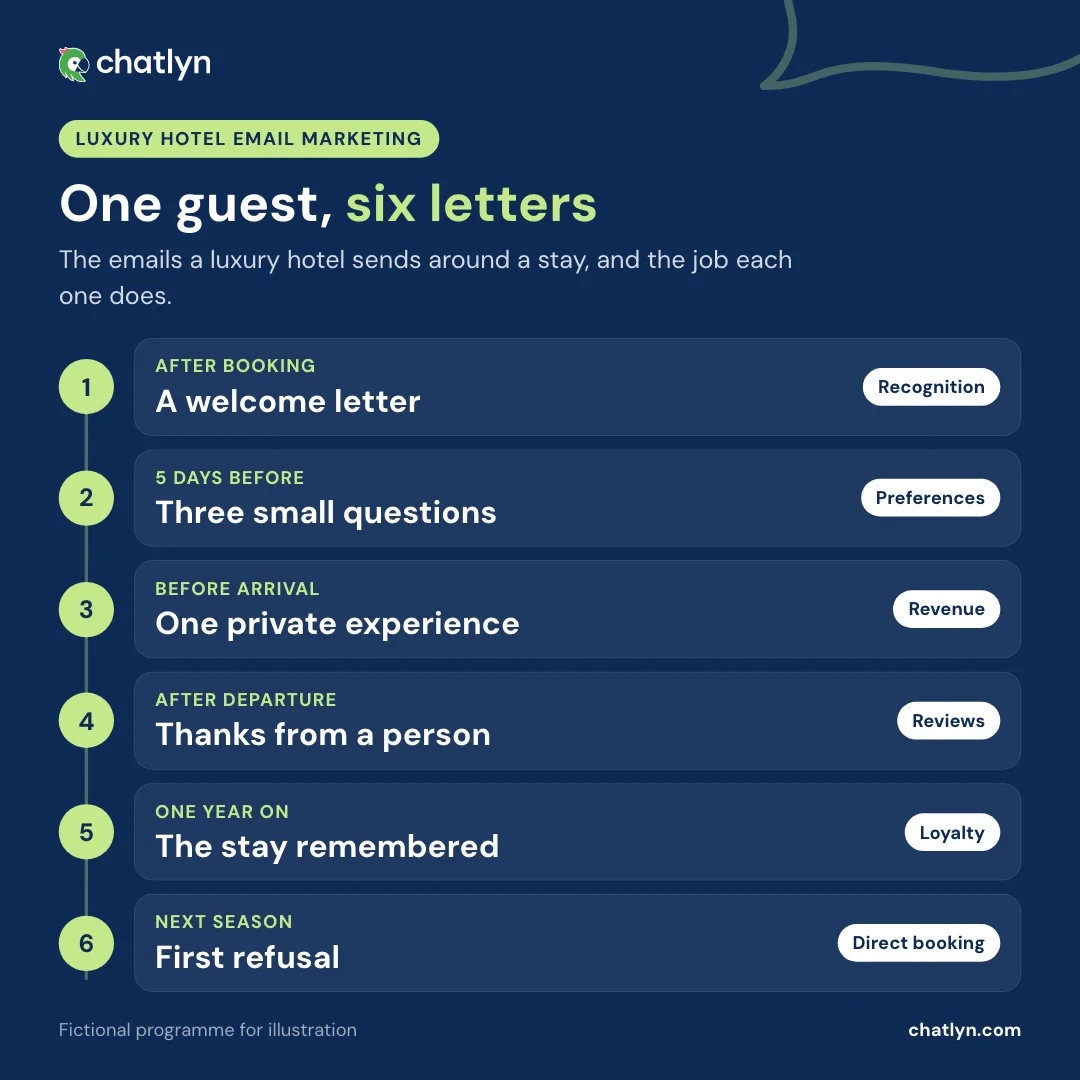
2. Segment by what the guest did, not by who you think they are
Age and income tell you little that is useful. Stay history tells you almost everything.
| Segment | What you know | What to write about |
|---|---|---|
| Returning guests | The room, the dates, the table | First refusal on the same room next season |
| Booked and arriving soon | The dates and the reason for travelling | Transfers, preferences, one experience |
| Celebrations | The honeymoon or anniversary from the last stay | The date itself, with a gift |
| Spa and wellness guests | Treatments booked, therapist, morning routine | A programme that continues the last stay |
| Direct bookers | They already came to you | Benefits kept for direct guests |
| Long silent | Last stay two or more years ago | What changed since, in a personal voice |
| Source market | Country, language and holidays | The right season, in the guest’s language |
A small list that fits beats a large one that does not. Three hundred returning guests who hear about their own room are worth more than thirty thousand who hear about the spa.
3. Personalise with memory, not merge fields
“Dear [First name]” is not personalisation. “You asked for the orange tree to stay lit after midnight” is. A useful test: only write what a good concierge would say aloud at the door. “Your usual table by the window” passes. “We noticed you viewed our suites three times this week” does not. Guests at this level notice when data is used well, and they notice faster when it feels like surveillance.
4. Sell access and added value, never a percentage
A discount tells the guest what your room is really worth, and trains them to wait for the next one. Offer something that costs you less than the rate you would have given away, and that money could not otherwise buy.
| Instead of | Write |
|---|---|
| 20% off in May | Stay four nights in May and one day at sea is ours |
| Book now, limited availability | Sixty places, returning guests until 15 November |
| Early bird rate | Room 214 is yours until 30 November |
| Last-minute deal | The only table at low tide on your dates |
| We miss you: 15% off | Come back this year and the canoe morning is on the house |
5. Let a person sign it, and read the reply
Luxury is personal service, so a no-reply address breaks the promise in the sender line. Sign with a real name and role: the general manager on the welcome, the concierge on the pre-arrival, the owner on the thank-you. Then make sure that person, or someone who answers for them, reads what comes back. A reply to a luxury hotel email is often the start of a booking.
6. Design with restraint
- One column, 600 to 650 pixels wide, because most guests will read it on a phone.
- One real photograph of the moment you want the guest to imagine. Never stock.
- Text at 16 pixels or more, and buttons at least 44 pixels high, so it reads and taps easily.
- One action per email, with a reply offered as the alternative.
- Live text for anything that matters, so the email still works when images are off.
- A plain-text letter now and then. With your best guests, no design at all can feel like the highest compliment (example 9).
7. Time it to the guest’s planning, not your calendar
Luxury guests plan early, and the moment that matters is when they decide, not when your season opens. Send first refusal before bookings open, the experience offer while there is still time to arrange it and the season programme before your best weeks fill up. Then check it against the time zone: an invitation at 03:00 in New York is not an invitation.
8. Protect your sender reputation and respect consent
A beautiful email in the spam folder is worth nothing, and a luxury guest will not forgive being chased.
- Authenticate your domain. Set up SPF, DKIM and DMARC. Google’s sender guidelines require them for anyone sending more than 5,000 messages a day to Gmail accounts, along with one-click unsubscribe for marketing email.
- Watch your spam rate. Google asks senders to stay below 0.30%, and recommends below 0.10%.
- Make leaving easy. A clear unsubscribe link is better than a spam report.
- Stop writing to people who stopped reading. Try one personal win-back (example 10), then remove them.
- Get consent right. Marketing email to guests in the EU and UK generally needs consent, with narrow exceptions for your own past guests that vary by country. The US expects a clear opt-out and a postal address. Check your own setup with your data protection adviser.
9. Measure stays and replies, not opens
Apple’s Mail Privacy Protection loads images in the background, so an open can be counted whether or not the guest read anything (Litmus explains it). Treat open rates as a rough signal and look at what the emails led to:
- Direct bookings and revenue from each segment, in your booking engine.
- Repeat stays and time between stays.
- Extras booked before arrival: transfers, tables, treatments.
- Replies, and how long your team took to answer.
- Unsubscribes and spam reports, your early warning that you are writing too much.
What the great luxury hotel houses do
Strategy reads differently once you see it in practice. Here is what the public record shows about Rosewood, The Ritz-Carlton, Four Seasons, Aman, Mandarin Oriental, Belmond, The Peninsula, St. Regis, Waldorf Astoria and Dorchester Collection. None of these houses publishes email results, so we cannot tell you what worked for them. We can tell you what they do. The subject lines come from the public Email Love archive, which collects emails from one subscriber’s inbox, so treat them as a sample and not as a full picture of any programme.
Rosewood: one idea, returned to in every subject line
Rosewood’s brand rests on its A Sense of Place philosophy, and its emails in the archive keep coming back to it: “A World of Discovery at Rosewood” in October 2025, “Discover the Art of Place at Rosewood” in February 2026. The mailing list page promotes a guide to its properties published with Monocle rather than a sign-up discount.
What to borrow: choose the one idea your house owns, and let your subject lines return to it. A guest should be able to recognise the sender with the name covered.
The Ritz-Carlton: the memory comes before the marketing
We found no archive of Ritz-Carlton marketing emails we could read, and its best lesson for email starts long before anyone writes one. Its Credo promises to meet wishes guests have not expressed, and Horst Schulze, the company’s founding president, has described giving every employee up to $2,000 to delight a guest, on the reasoning that such a guest may spend $200,000 over a lifetime. A 2000 account describes staff carrying pads to note guest preferences, which then went into a central system. That account is old, but the idea is not.
What to borrow: the details in examples 5, 6 and 9 are only possible if your team writes them down during the stay. Make it someone’s job, and think in lifetime value when you decide what a return is worth.
Four Seasons: a first name, and often
The Email Love archive tracks about nine Four Seasons emails a month, from the group and from individual properties, and the recent subject lines open with the reader’s first name: “Andy, Vail brings winter closer”. So rare sending is not a law of luxury. A group with many properties has many real reasons to write, and each of these names a place. Four Seasons has no points programme, and it runs a magazine that it describes as an editorial concierge. Its Four Seasons Chat, which by 2018 ran on nine channels including WhatsApp, is answered by people.
What to borrow: if you send more often, every email must still be about one specific place or moment. And give guests somewhere to answer.
Aman: almost nothing, on purpose
Aman’s subject lines in the archive carry no name, no offer and no urgency: “A Season Shaped by Water”, “Enveloped by Nature”. Its sign-up page is just as considered. Subscribers choose among Aman, Janu, Aman Interiors, Aman at Sea and Aman Essentials, and consent to personalised communication separately.
What to borrow: a subject line can be a mood if your brand has earned it. And asking what guests want to hear about, at sign-up, is itself a form of service.
Mandarin Oriental: a series guests can recognise
Mandarin Oriental’s archive shows two recurring formats: “Especially for You”, as in “Especially for You: The Season to Retreat”, and UNFOLD. The one percentage among the recent subject lines is 25% off its shop, not its rooms. Its recognition programme, Fans of M.O., has no points, and as described in 2022 lets members choose two privileges per direct stay.
What to borrow: name your email series, so that each one is expected. And if you must use a percentage, keep it away from the rate.
Belmond and Dorchester Collection: the newsletter as a publication
Belmond launched MONDO in 2024 as a monthly newsletter and digital sibling of its print magazine Mondes, with local producers, recipes, artisans and playlists in place of offers. Dorchester Collection publishes Collect twice a year, and Auberge Collection has Auberge Magazine. Dorchester’s chief operating officer told EHL in 2018 that offering points to bring guests back insults them, which is about as clear as a position on recognition gets.
What to borrow: give guests something worth reading between stays. Our hotel newsletter examples show how that format can look.
The Peninsula: the email as the door to a conversation
When The Peninsula launched PenChat in 2020, it put the way in where guests already look: a link in the pre-arrival email and the booking confirmation, or a QR code, opening WhatsApp, Facebook Messenger, WeChat or LINE, with the hotel’s teams on the other end.
What to borrow: this is the idea behind every WhatsApp version below. The email does not have to carry the whole relationship. It can hand the guest to the channel where they can answer.
St. Regis and Waldorf Astoria: a named person from the first email
St. Regis describes its butler service, offered at more than 40 hotels, as reachable at any hour by email and text. Waldorf Astoria’s True Waldorf Service, announced in 2012, opens with a tailored email introducing the guest’s personal concierge, drawing on past stays, and ends with a thank-you note.
What to borrow: that is the structure of examples 1 and 9. Introduce the person before the arrival, and let them close the stay.
Points or recognition: what this means for you
The houses split into two camps, and which one you are in changes your email strategy.
| House | How it recognises guests |
|---|---|
| The Ritz-Carlton, St. Regis | Marriott Bonvoy, a points programme across the group |
| Waldorf Astoria | Hilton Honors, a points programme across the group |
| Raffles | ALL Accor, a points programme across the group |
| Six Senses | IHG One Rewards, at participating resorts |
| Four Seasons | No points: recognition of preferences |
| Mandarin Oriental | Fans of M.O.: privileges, no points |
| Dorchester Collection | Recognition, against points (2018) |
Programmes such as Rosewood Elite and Belmond’s Bellini Club are channels for travel advisors, not clubs for guests, so do not mistake them for loyalty programmes.
A brand inside a big programme has a shared database and a tier to write to. An independent luxury hotel has neither, and does not need them: your PMS already knows who stayed, in which room and how often. That history is your loyalty programme, and first refusal (example 5) is its best benefit.
The 10 luxury hotel email marketing examples at a glance
| # | Hotel | Type of luxury hotel | Luxury email | Idea to borrow |
|---|---|---|---|---|
| 1 | The Aldermere | Private townhouse, London | Welcome letter from the general manager | Introduce the person who will look after the guest |
| 2 | Villa Ardenza | Lake villa, Italy | Pre-arrival preferences | Three small questions, not a form |
| 3 | Nymara Island | Private island resort | One private experience | Tie it to the guest’s own dates |
| 4 | The Valeska | Grand hotel, Budapest | Invitation to returning guests | Ask before the list opens |
| 5 | Hotel Silvrain | Alpine grand hotel | First refusal on the guest’s room | Sell the guest’s own room back to them |
| 6 | Dar Selwane | Riad, Marrakech | Anniversary of the stay | Remember, give and ask for nothing |
| 7 | Aethera Springs | Wellness retreat, Bali | Programme chosen from the last stay | Show the guest what you remember |
| 8 | Kalderi Suites | Cycladic suites | Quiet-season offer | Add a day, leave the rate alone |
| 9 | Thornmere Hall | Country house, Cotswolds | Plain-text thank-you from the owner | No design at all |
| 10 | Kaiva Rainforest Lodge | Rainforest lodge, Costa Rica | Win-back to lapsed guests | What has changed since you left |
Each picture below is a luxury hotel email marketing sample, the email as the guest sees it. Under it you will find the template behind it, with merge fields in square brackets, followed by the same moment on WhatsApp.
1. The Aldermere: a welcome letter from the general manager
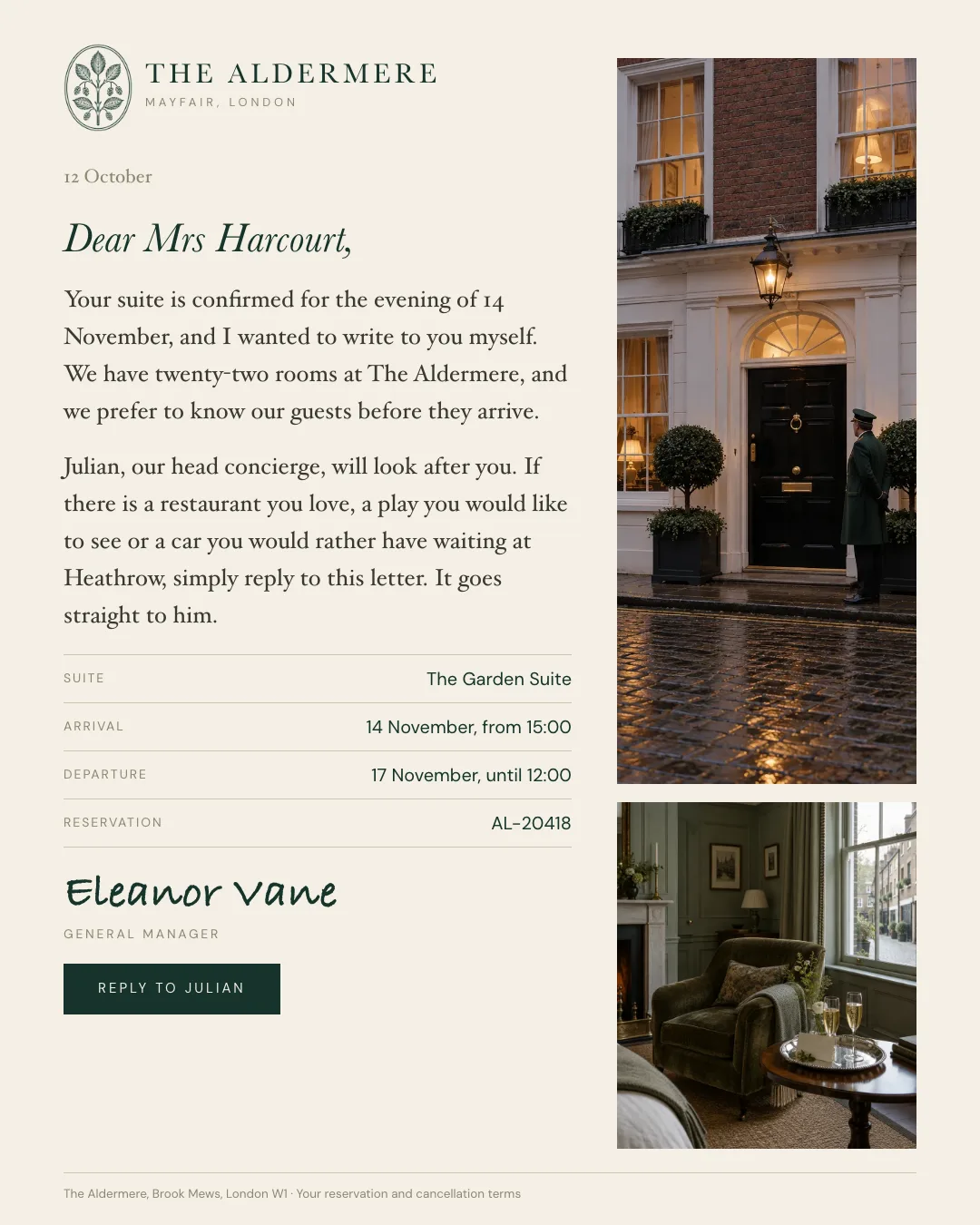
The Aldermere has 22 rooms on a mews in Mayfair, and its booking email reads like correspondence. Eleanor Vane, the general manager, writes to Mrs Harcourt herself, names the concierge who will look after her and invites a reply.
Subject: Your stay at [Hotel], and a note from me
Preview text: [Concierge] will be looking after you.
Dear [Title] [Last name], your [room name] is confirmed for [arrival date], and I wanted to write to you myself. [Concierge name], our head concierge, will look after you. If there is a restaurant you love, a [local experience] you would like or a car you would rather have waiting at [airport], simply reply to this letter. It goes straight to [him/her/them]. [Reservation details.] [Signature, role.]
Why it works: every other hotel sends a confirmation at this moment. This one sends an introduction. By the end, the guest knows the name of the person to ask, and that asking is welcome.
What to borrow: keep the terms and the reservation number, because this is still the formal record, and put a person above them.
On WhatsApp: the letter stays as the formal record. Next to it, a short message about the booking opens the thread the guest will use for the whole stay. Mrs Harcourt gives her flight details on the spot, and Julian arranges the car and confirms a table for Saturday. In an email chain, that takes a day.
2. Villa Ardenza: pre-arrival preferences in three small questions
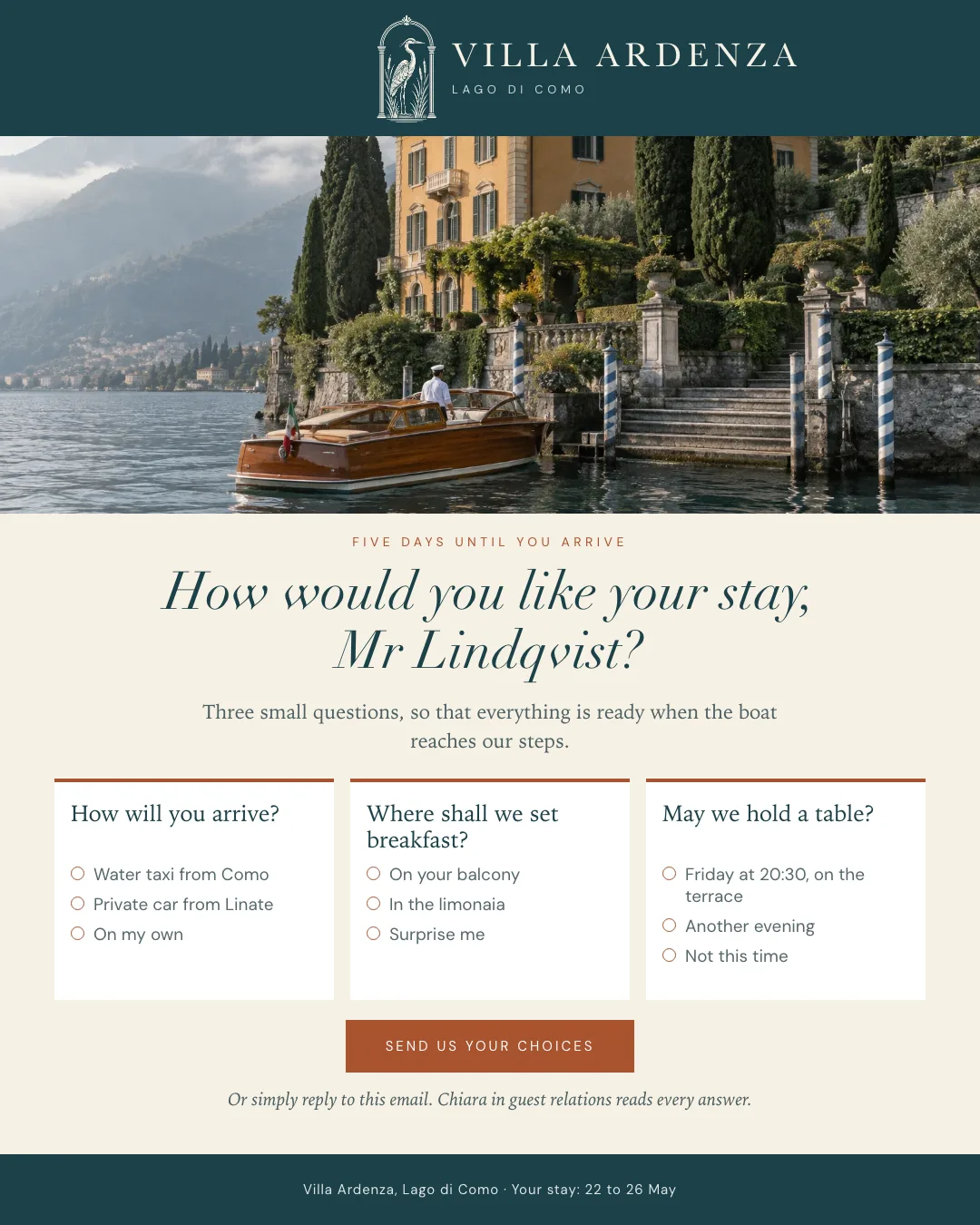
Five days before Mr Lindqvist arrives, Villa Ardenza asks how he would like his stay: how he will arrive, where breakfast should be set and whether it may hold a table on Friday.
Subject: How would you like your stay, [Title] [Last name]?
Preview text: Three small questions, so that everything is ready.
Dear [Title] [Last name], you arrive in five days. Three small questions, so that everything is ready when you reach us. How will you arrive? [Option] / [Option] / [Option]. Where shall we set breakfast? [Option] / [Option]. May we hold a table on [evening] at [time]? Or simply reply to this email: [Name] in guest relations reads every answer.
Why it works: a long preferences form is homework. Three questions, with the answers already written, take ten seconds and still give the team everything it needs. The table is the only thing being sold, and it reads as a courtesy.
What to borrow: offer the likely answers, and always leave the reply open for the guest who wants something else.
On WhatsApp: this is the email that gains most from moving. Your PMS sends the message five days before arrival, the guest taps “Water taxi from Como” and the AI answers the routine question about the crossing from your own information. Chiara confirms the boat and the breakfast, then offers the terrace table in the same chat.
3. Nymara Island: one private experience, tied to the guest’s own dates
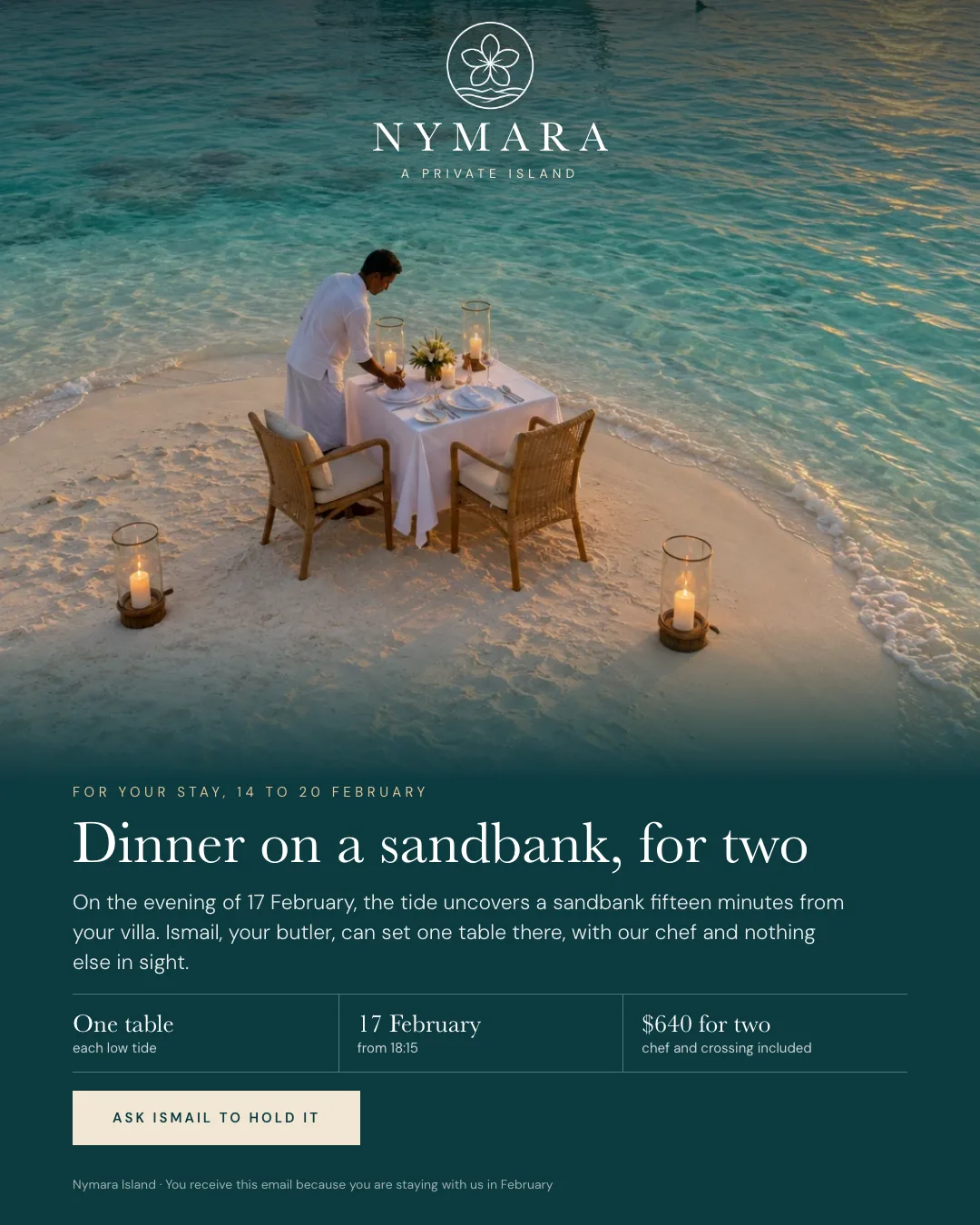
Nymara writes to guests already booked in February about a single evening: the tide uncovers a sandbank fifteen minutes from their villa on the 17th, and their butler can set one table there.
Subject: One table, on 17 February
Preview text: The tide uncovers a sandbank fifteen minutes from your villa.
Dear [Title] [Last name], on the evening of [date in the stay], [what happens only then]. [Butler or host], your [role], can arrange [the experience] for you. [How many], from [time]. [Price], [what is included]. [Ask name to hold it.]
Why it works: it is only possible on the guest’s own dates, and only once. That is real scarcity, which a luxury guest respects. Most hotels would send the whole activities brochure at this point.
What to borrow: look for what only your property can do on a particular day, then write to the guests who will be there. State the price: hiding it reads as uncertainty.
On WhatsApp: the guest taps “See the menu”, not “Hold it”. On email, that is the end of the journey. Here the AI describes the menu, the guest mentions a pescatarian wife with no shellfish, and Ismail, the butler, confirms the table personally.
4. The Valeska: a private invitation to returning guests
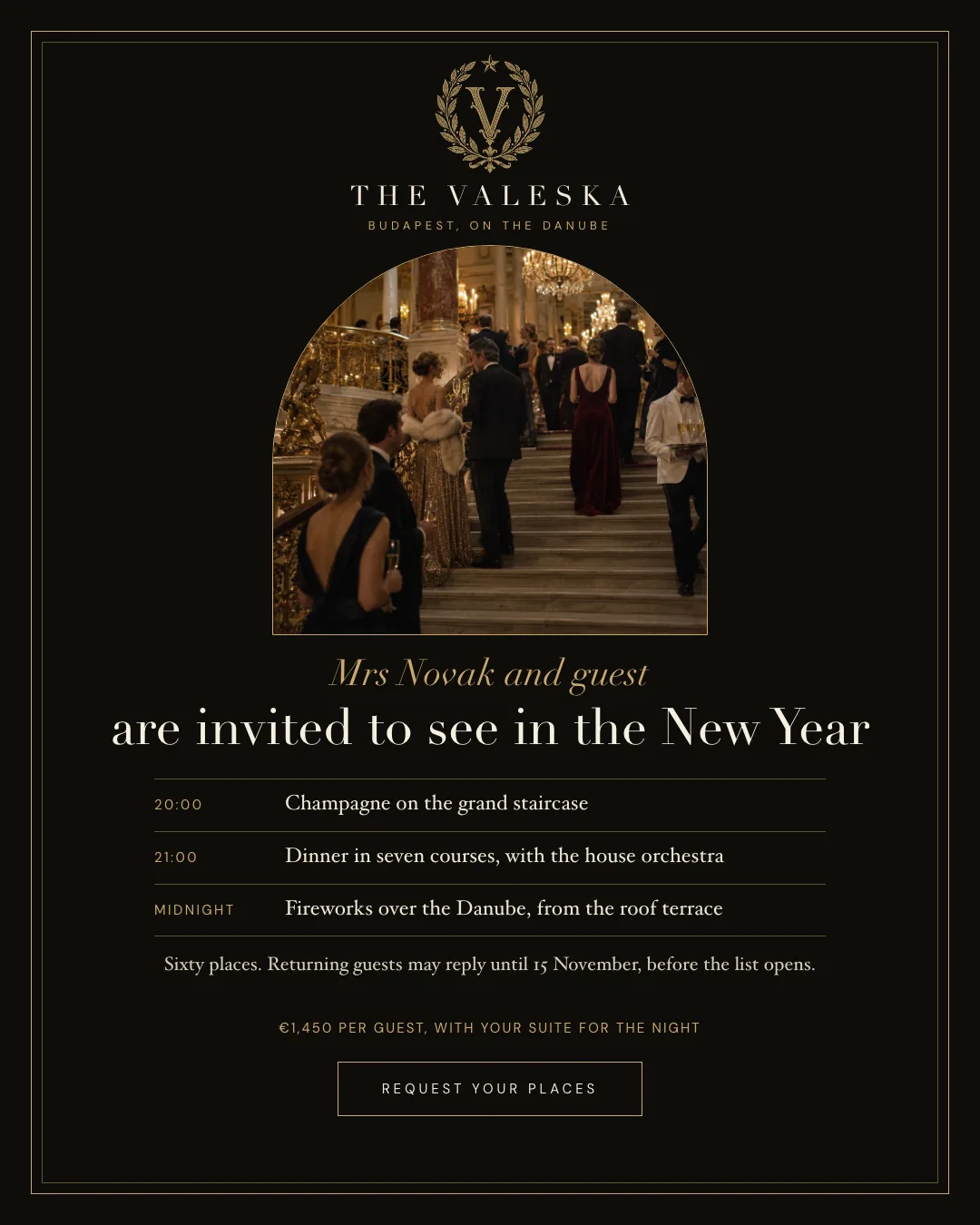
The Valeska invites returning guests to New Year’s Eve before the list opens to everyone: champagne on the grand staircase at 20:00, seven courses, then fireworks over the Danube from the roof.
Subject: [Title] [Last name] and guest are invited
Preview text: Sixty places. Returning guests may reply until [date].
[Title] [Last name] and guest are invited to [event] at [Hotel]. [Time]: [moment]. [Time]: [moment]. [Time]: [moment]. [Number] places. Returning guests may reply until [date], before the list opens. [Price per guest], [what is included]. [Request your places.]
Why it works: the hierarchy is the message. A returning guest learns they come first, and “invited” does what “book now” never could. The programme, in three lines with times, does the selling.
What to borrow: give your best guests a date of their own, even for an event you will sell out anyway. It costs nothing, and it is the most valuable thing you can offer.
On WhatsApp: the only question between Mrs Novak and a yes is what to wear. The AI answers it, and when she asks for two places and last year’s river suite, Péter the concierge confirms them himself.
5. Hotel Silvrain: first refusal on the guest’s own room
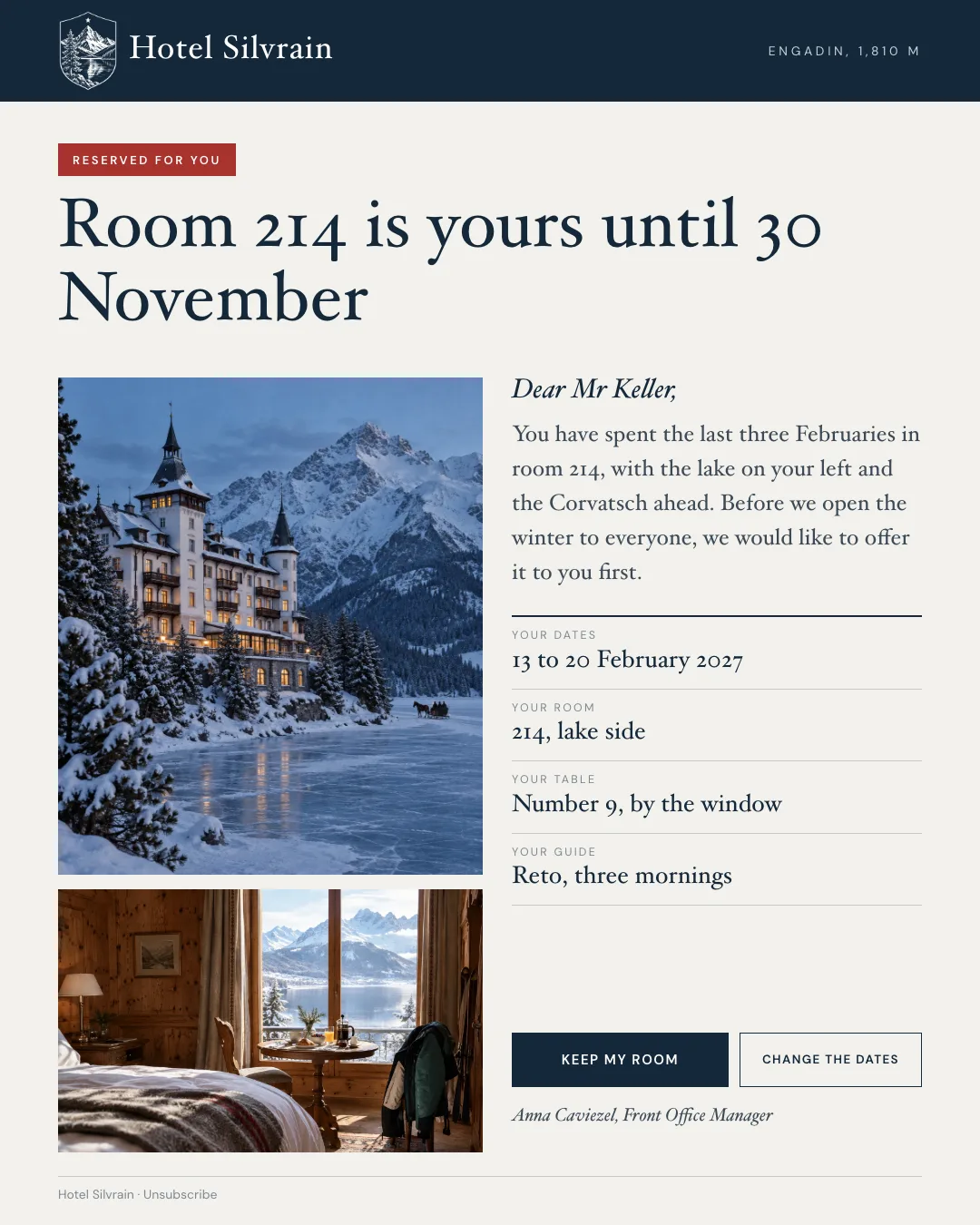
Mr Keller has spent the last three Februaries in room 214. Before the winter opens to everyone, Hotel Silvrain offers it to him first, with his dates, his table and his ski guide.
Subject: Room [number] is yours until [date]
Preview text: Before we open the winter to everyone.
Dear [Title] [Last name], you have spent the last [number] [seasons] in room [number]. Before we open [season] to everyone, we would like to offer it to you first. Your dates: [dates]. Your room: [room]. Your table: [table]. Your [guide or therapist]: [name]. [Keep my room] [Change the dates]
Why it works: it costs the hotel nothing, it books the room months early and direct, and the guest feels looked after rather than sold to. The word “your”, four times in the rows, is the whole strategy.
What to borrow: this is the highest-value email in this guide. Pull every guest with two or more stays from your PMS and send it before bookings open.
On WhatsApp: the school holidays have moved, so the guest taps “Change the dates”. Anna from the front office finds the same room a week later, with the same mornings with the guide. On email, this request can sit for a day while the room is still open to everyone else.
6. Dar Selwane: the anniversary of the stay
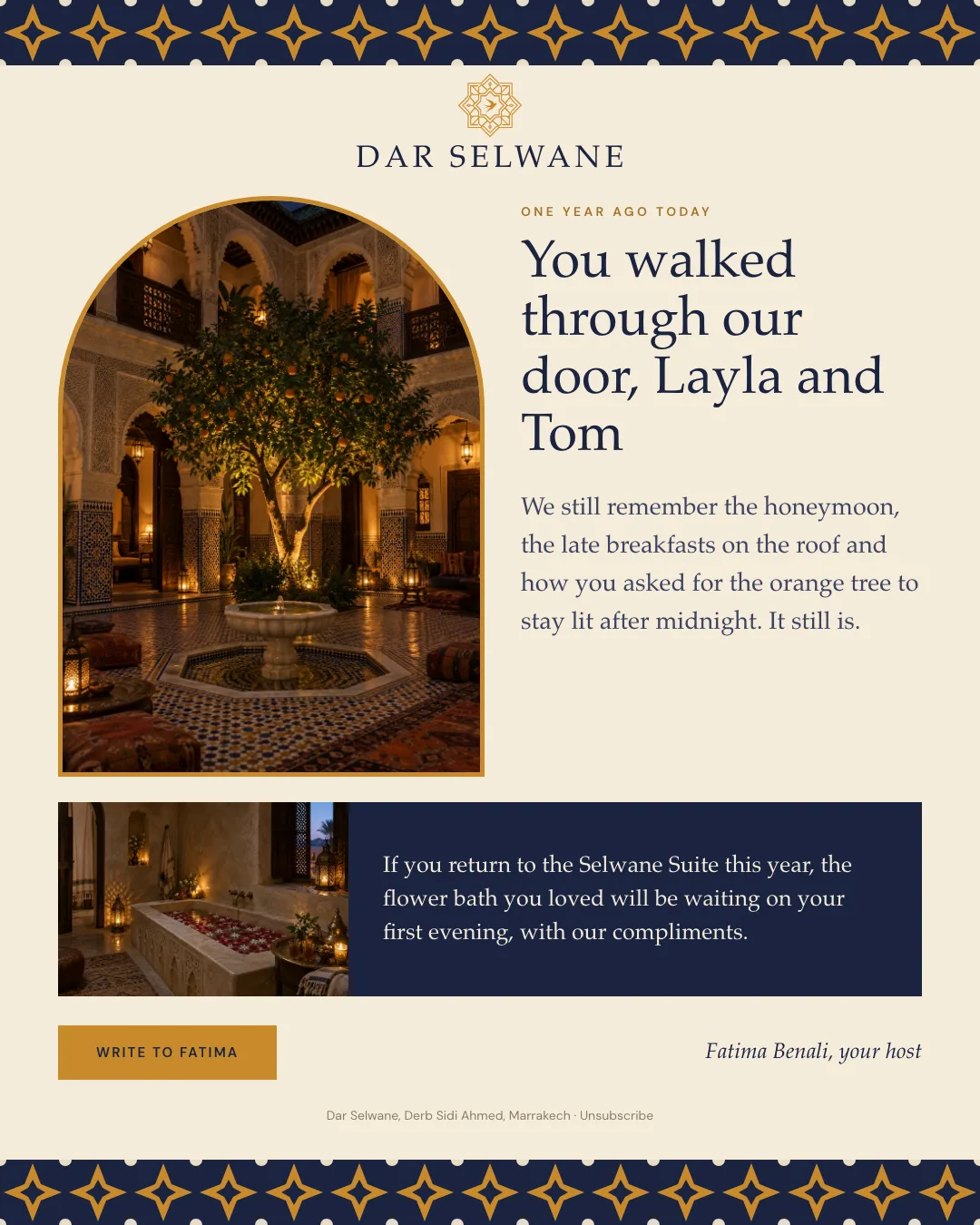
One year after their honeymoon, Fatima writes to Layla and Tom. She remembers the late breakfasts and the orange tree they asked to keep lit, and offers the flower bath as a gift if they return.
Subject: One year ago today
Preview text: You walked through our door, [First names].
Dear [First names], one year ago today, you walked through our door. We still remember [one true detail from the stay]. If you return to [room] this year, [a gift that recalls that stay] will be waiting, with our compliments. [Signature.]
Why it works: there is no offer and no deadline. It is a true detail, sent on a date that matters to the guest, and a gift as the only commercial idea.
What to borrow: ask your team to note one memorable detail on the guest’s profile at check-out. That note is what makes this email possible a year later, and no merge field can replace it.
On WhatsApp: a thank-you is what an email can never receive in one tap. Layla taps “Thank you”, adds that they were talking about October, and Fatima offers to keep the suite while they decide. Your team chooses who receives a message like this one, and sends it from a person.
7. Aethera Springs: a programme chosen from the last stay
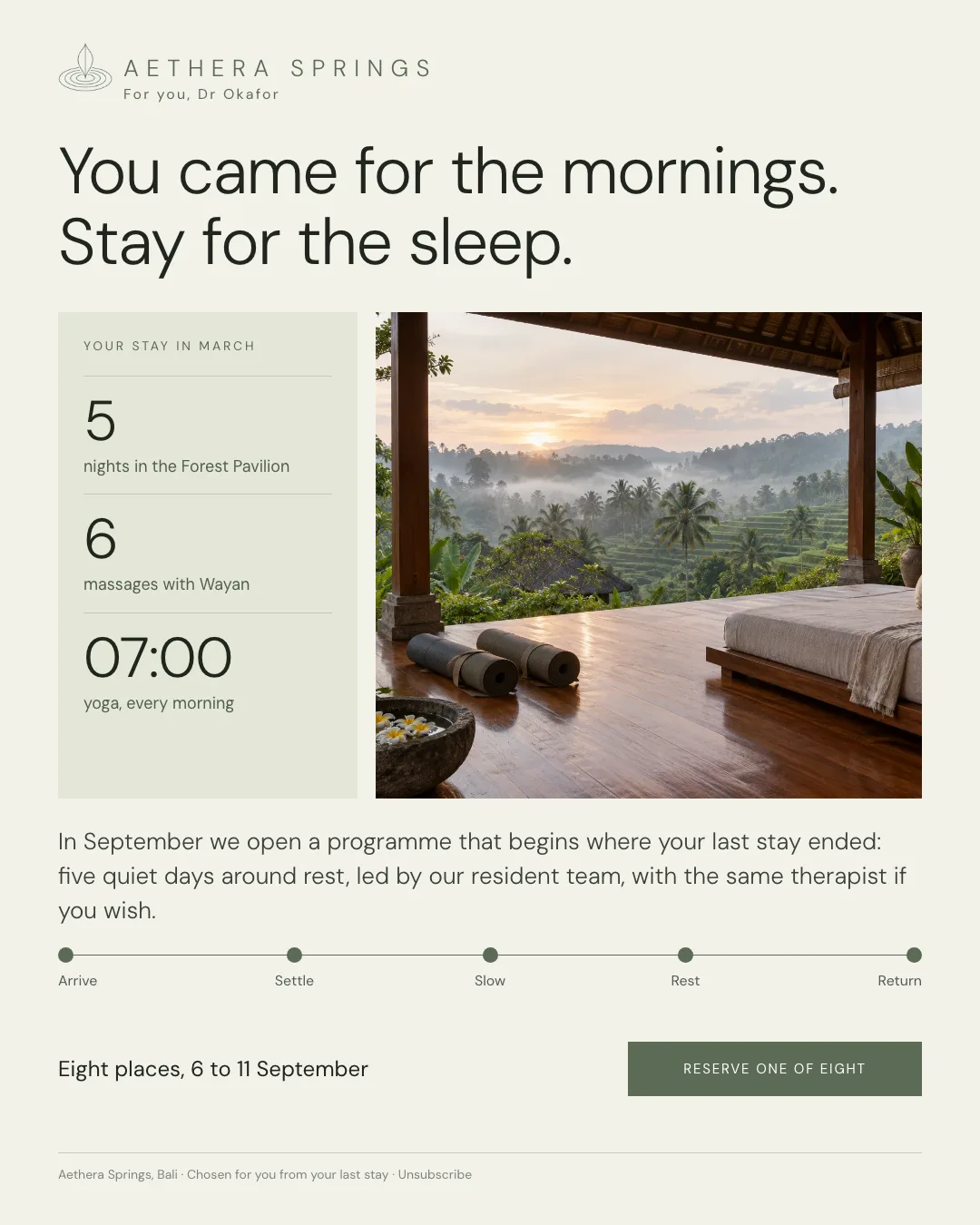
Aethera Springs opens by showing Dr Okafor her March stay: five nights in the Forest Pavilion, six massages with Wayan and yoga every morning at 07:00. Then it offers a September programme that begins where that stay ended.
Subject: You came for the mornings, [Title] [Last name]
Preview text: A programme that begins where your last stay ended.
Dear [Title] [Last name], your stay in [month]: [number] nights in [room], [number] treatments with [therapist], [routine]. In [month] we open a programme that begins where your last stay ended: [number] days around [theme], with the same [therapist] if you wish. [Number] places, [dates]. [Reserve one.]
Why it works: it proves it knows the guest before it asks for anything. One honest number of places adds all the urgency a wellness retreat should ever use.
What to borrow: a short recap of the last stay turns a generic programme announcement into a personal suggestion. Keep it to what the guest would be pleased to see. Treatments and rooms, yes. Anything about their health, no.
On WhatsApp: the guest’s real question is “Is it very structured? I came to you to switch off.” On email, that doubt ends the journey quietly. Here the AI explains which moments are fixed, and Putu, the retreat host, reserves the place and the same pavilion.
8. Kalderi Suites: a quiet-season offer that leaves the rate alone
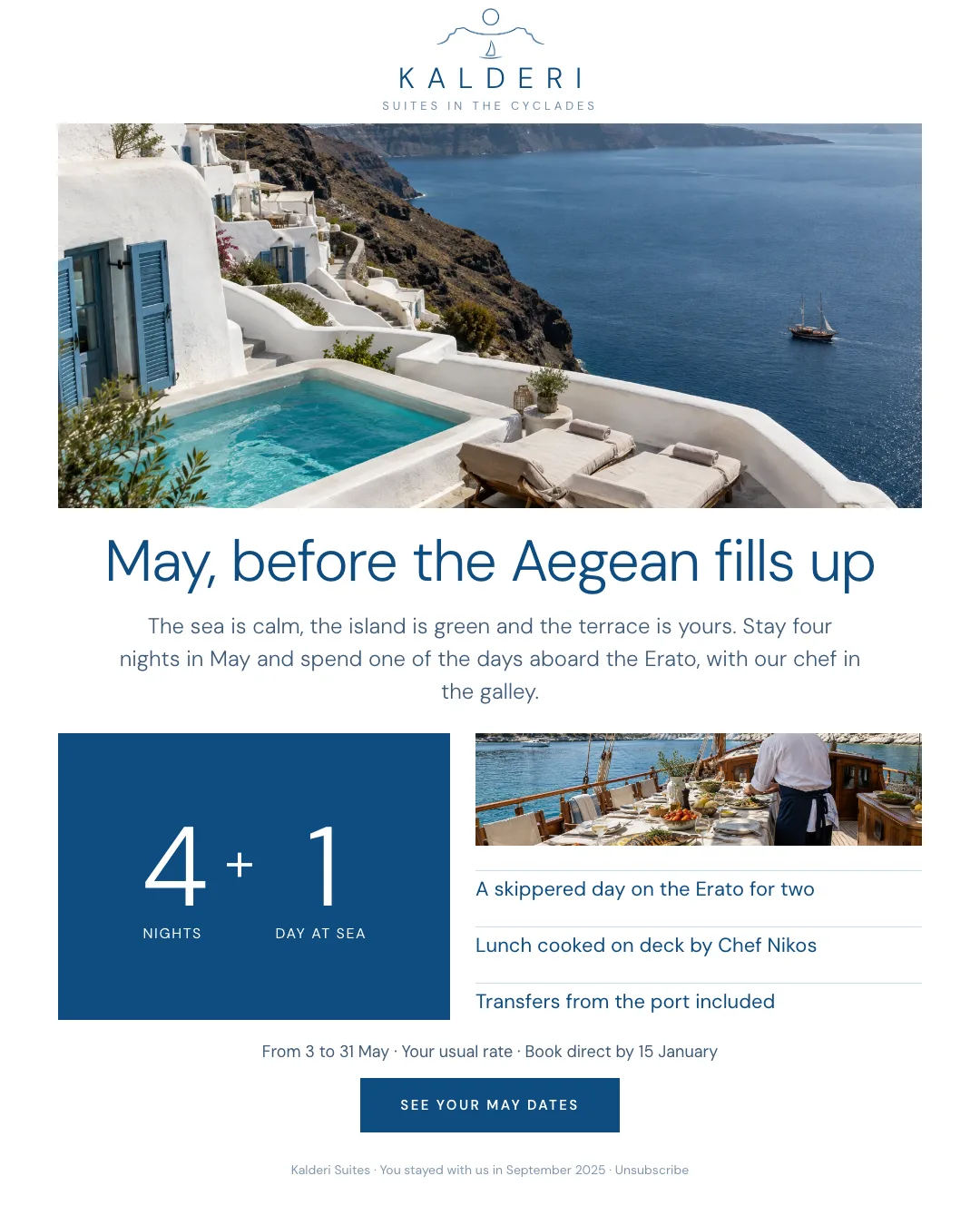
Kalderi Suites needs to fill May. It does not lower the price. It adds a skippered day aboard the Erato, with lunch cooked on deck by the chef, for guests who stay four nights at their usual rate.
Subject: May, before the Aegean fills up
Preview text: Four nights, and one of the days at sea.
Dear [Title] [Last name], [why this quiet moment is a good one]. Stay [number] nights in [month] and [experience you own or control]. [What is included.] From [date] to [date], at your usual rate, booked direct by [date]. [See your dates.]
Why it works: the rate is intact, so no guest who paid full price in August feels foolish. And the offer sells the low season as the better choice, rather than the cheaper one.
What to borrow: add something with a high perceived value and a low cost to you, such as your own boat, your chef or your guide, and keep it for direct bookings.
On WhatsApp: the guest asks about the boat, the AI describes it and the guest then asks for the same suite as last time. Eleni from reservations confirms it at the usual rate and sends the page to complete the booking.
9. Thornmere Hall: a plain-text thank-you from the owner
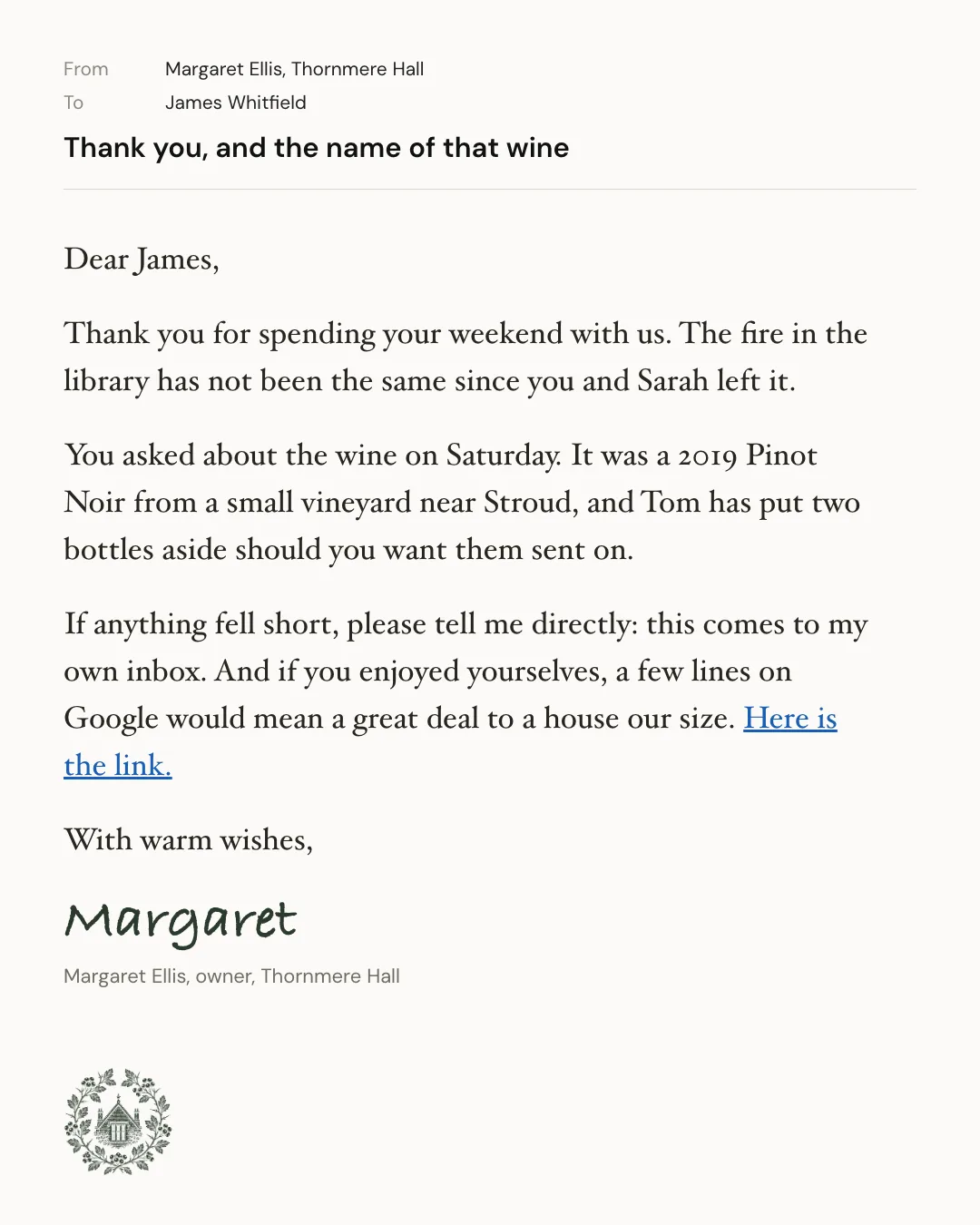
Margaret Ellis owns Thornmere Hall, and she writes the thank-you as an ordinary email. She remembers the wine James asked about, has two bottles put aside and asks for a review once, in one line.
Subject: Thank you, and the name of that wine
Preview text: It was a 2019 Pinot Noir from near Stroud.
Dear [First name], thank you for spending your [weekend] with us. [One true detail.] [Something you remembered or did for them.] If anything fell short, please tell me directly: this comes to my own inbox. And if you enjoyed yourselves, a few lines on [review site] would mean a great deal to a house our size. [Link.] [Signature.]
Why it works: a designed thank-you looks like marketing, and this looks like a letter from someone who was there. It lands more easily in the main inbox too, because it reads like personal mail. The private route for complaints comes before the public request for a review, and both go to everyone.
What to borrow: keep one email in your programme free of any design. Send it from a real mailbox, and make sure someone answers.
On WhatsApp: the post-stay event in your PMS sends the thank-you with two buttons. James taps “Share feedback” and mentions the slow hot water, which Margaret can deal with before it becomes a public review. The same stay can then end with a kind word on both sides.
10. Kaiva Rainforest Lodge: a win-back to lapsed guests, as a postcard
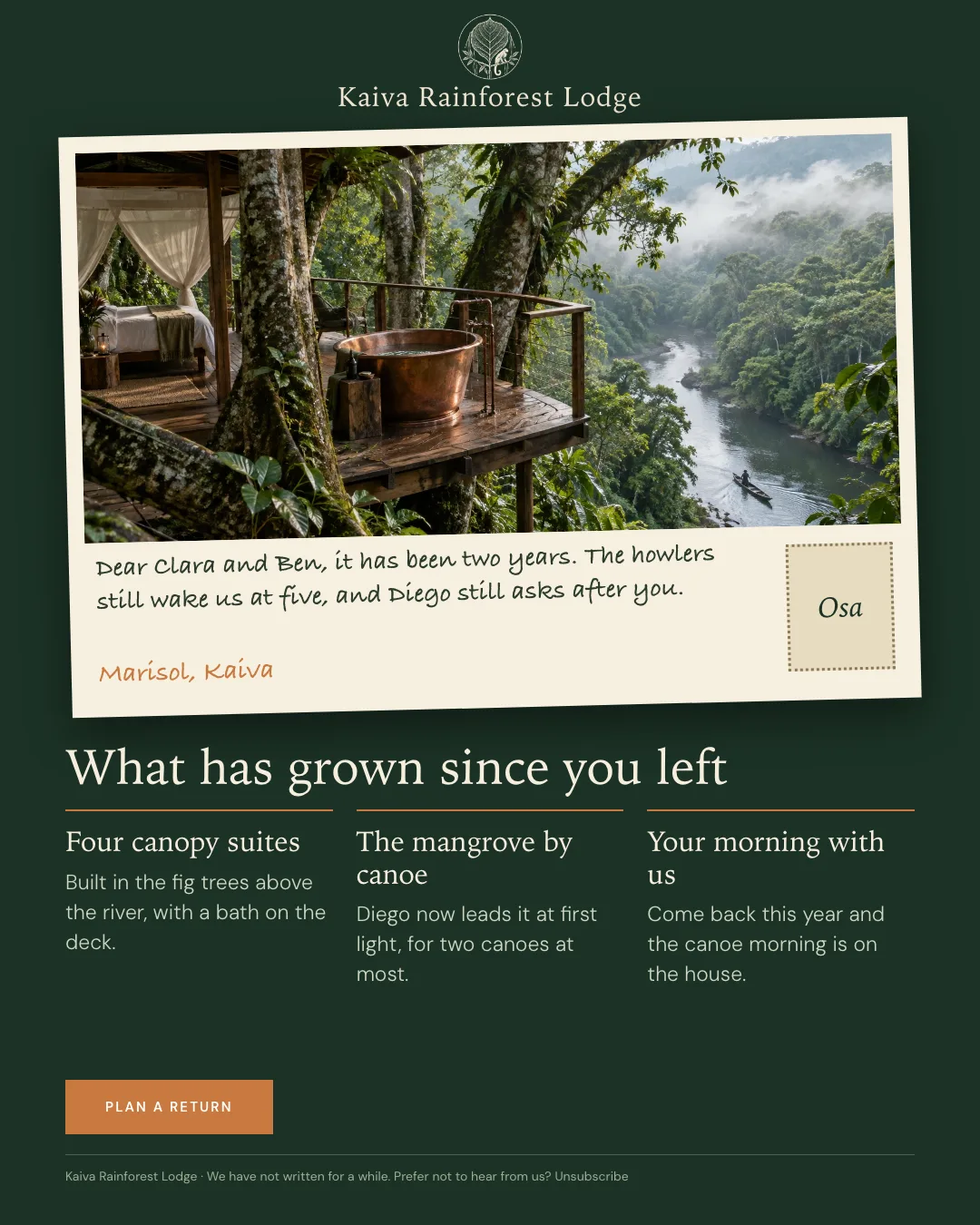
Clara and Ben have not been back for two years. Kaiva does not write “we miss you”. It sends a postcard about the howler monkeys and their old guide, then lists what has changed: four canopy suites, a canoe morning at first light and a gift if they return.
Subject: It has been two years, [First names]
Preview text: [Guide] still asks after you.
Dear [First names], it has been [time]. [Something still true and specific.] What has changed since you left: [new thing]. [New thing]. Come back this year and [experience] is on the house. [Plan a return.] We have not written for a while: prefer not to hear from us? [Unsubscribe.]
Why it works: win-back emails usually apologise or discount. This one gives news, in a voice the guests remember. And the honest unsubscribe line in the footer protects your sender reputation.
What to borrow: give lapsed guests a reason that is new. Send it once or twice, and let those who do not answer go.
On WhatsApp: this goes only to guests who opted in, with a clear “Please stop” button. The AI shows the suites, and when Clara asks for Diego at Christmas, Marisol from reservations holds two connected suites. Our WhatsApp campaign ideas give you more reasons to write.
A luxury hotel email marketing template you can adapt
All 10 examples share one structure.
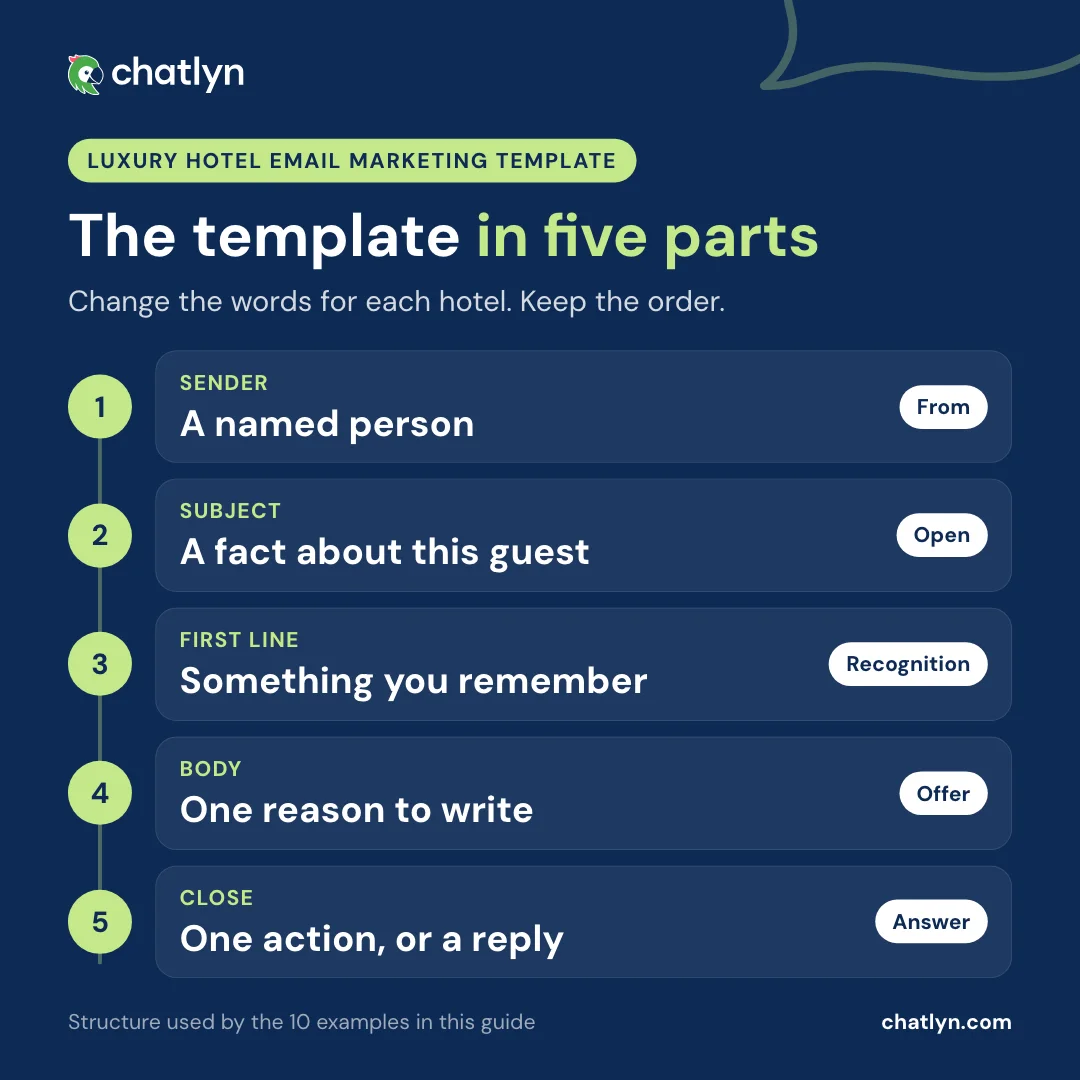
From: [First name Last name], [Hotel]
Subject: [A fact about this guest: their room, their date, their table]
Preview text: [The sentence that makes them open it]
Dear [Title] [Last name],
[One line that shows you remember them.]
[One reason to write: a season, a date, a room or an invitation. Two or three short sentences, with the details that make it real: dates, places, price.]
[One action, or: “Simply reply to this email. It comes straight to me.”]
[Signature: name, role, hotel]
Luxury hotel subject lines to borrow:
| Moment | Subject line |
|---|---|
| Welcome | Your stay at [Hotel], and a note from me |
| Pre-arrival | How would you like your stay, [Title] [Last name]? |
| Experience | One table, on [date] |
| Invitation | [Title] [Last name] and guest are invited |
| Returning guest | Room [number] is yours until [date] |
| Anniversary | One year ago today |
| Quiet season | [Month], before [place] fills up |
| Thank-you | Thank you, and the name of that wine |
| Win-back | It has been two years, [First names] |
Notice what is missing: no capital letters, no exclamation marks, no percentages and no “exclusive”, a word that has never made anything feel exclusive.
Which luxury hotel emails should also go on WhatsApp
Look at the 10 conversations again and one pattern repeats. In each one, the guest had a question: what to wear, whether it is too structured, whether the dates can move, whether their guide is still there. On email those questions mostly end the journey. On WhatsApp they are where the booking starts.
The other difference is whether the message is read. IMLAUER Hotels in Salzburg and Vienna reach a 93% open rate on WhatsApp newsletters (IMLAUER case study), and Spa Resort Geinberg measured 95% on WhatsApp against about 20% on email (Geinberg case study). These are not luxury-only numbers, but they show how far apart the two channels sit.
For a luxury hotel, the question is what stays personal. The St. Regis Le Morne Resort in Mauritius, a chatlyn customer, sends one automated welcome after a guest scans a QR code. After that, 30 butlers answer on one WhatsApp number and write every reply themselves, with an average human reply time under 5 minutes. No AI answers guests there, and that is the house’s choice: with chatlyn, you decide what is automated.
| Luxury hotel moment | ||
|---|---|---|
| Booking record, terms, invoice | Yes: it is the formal document | A short note that opens the thread |
| Pre-arrival preferences | For guests without an opt-in | Best here: taps and replies |
| One experience before arrival | Works, with a photo | Best here: questions get answered |
| Invitation or first refusal | Yes: it can look like a card | Send too, to guests who opted in |
| Season programme, long story | Best here | One offer only, with a link |
| Thank-you and review | Yes: a plain letter | Yes: with a private feedback route |
| Guests with US phone numbers | Best here: Meta has paused marketing templates to +1 numbers | Messages about the booking only |
WhatsApp has rules of its own. Marketing messages need the guest’s opt-in, each template must be approved by Meta first and each person receives only a limited number of marketing messages a day across all businesses. A message about an existing booking is a utility template, and an offer is a marketing template. Our free playbook of 30 WhatsApp templates for hotels covers approval and wording.
How chatlyn fits in
Your email tool sends your email programme. chatlyn runs the WhatsApp side, with replies from every channel in one place.
- Messages timed by the stay. PMS events such as a new booking, the days before arrival and the day after departure send WhatsApp templates in the guest’s language, chained into a guest journey.
- Lists that come from real stays. A hotel CRM combines stays and spend from your PMS with every conversation, and your team builds the segments that decide who hears about what.
- Answers in the same thread. The hotel chatbot answers routine questions from your own information, and hands the rest to your team, who confirm bookings and requests. Or, like The St. Regis Le Morne, your people write every reply.
- Your mailbox in the same inbox. Connect Gmail, Microsoft 365 or IMAP, and email replies arrive next to WhatsApp and webchat in one guest messaging inbox. On email, the AI drafts replies for your team to check and send.
Common luxury hotel email marketing mistakes
- Discounting to fill a gap. One 20% email can undo years of rate discipline. Add something instead.
- Saying “luxury” and “exclusive”. Show it: the room number, the guest’s name, the sixty places.
- A no-reply address. It tells the guest that nobody is listening, at the price of a suite.
- Stock photographs. Guests at this level have seen them. Use one real picture of your own terrace.
- The same email to everyone. A returning guest should never hear about your property as if for the first time.
- Too many emails. If you would not knock on a guest’s door to say it, do not send it.
- Personalisation that feels like watching. Mention what the guest told you, never what you tracked.
FAQ
What is luxury hotel email marketing?
It is the set of emails a high-end hotel sends to past and future guests, built on recognition rather than promotion: letters from named people, invitations, first refusal on the guest’s room and offers that add value instead of cutting the rate.
How often should a luxury hotel send marketing emails?
For a single property, one or two marketing emails a month to engaged guests is a sensible starting point, on top of the messages tied to a stay. Groups with many properties can send more: one public archive tracks about nine a month from Four Seasons. Send each one only when you can finish the sentence “We are writing to you because…” with something specific.
What should a luxury hotel email marketing template include?
A named sender, a subject line with a fact about the guest, an opening line that shows you remember them, one reason to write, concrete details such as dates and places, and one action or an invitation to reply. The template above has all of them.
Should luxury hotels offer discounts by email?
Rarely. A percentage off lowers what guests believe your room is worth and teaches them to wait. Offer access or added value instead, such as first refusal, an extra experience or a benefit for booking direct.
What is a good open rate for luxury hotel emails?
Open rates are less reliable than they were, because Apple’s Mail Privacy Protection can count an open that never happened. Compare your own segments over time, and judge the programme on direct bookings, repeat stays and replies.
Can luxury hotels send these emails on WhatsApp?
Yes, to guests who opted in. Offers are sent as approved marketing templates and messages about a booking as utility templates, with a photo, short text and buttons. Keep long stories and formal documents on email.
Which luxury hotel brands are good email examples to study?
Rosewood for a consistent brand idea, Four Seasons for personal subject lines tied to a place, Aman for restraint, Mandarin Oriental for recognisable series, Belmond for editorial newsletters and The Peninsula for using email as the door to a conversation. The Ritz-Carlton’s lesson comes earlier: recording what guests want so there is something true to write.
Are the hotels in these examples real?
No. The 10 hotels, their logos and their photos in the examples are fictional, created for this guide with AI image tools. The houses in the section on Rosewood, The Ritz-Carlton and their peers are real, as are the figures from IMLAUER Hotels, Spa Resort Geinberg and The St. Regis Le Morne Resort.