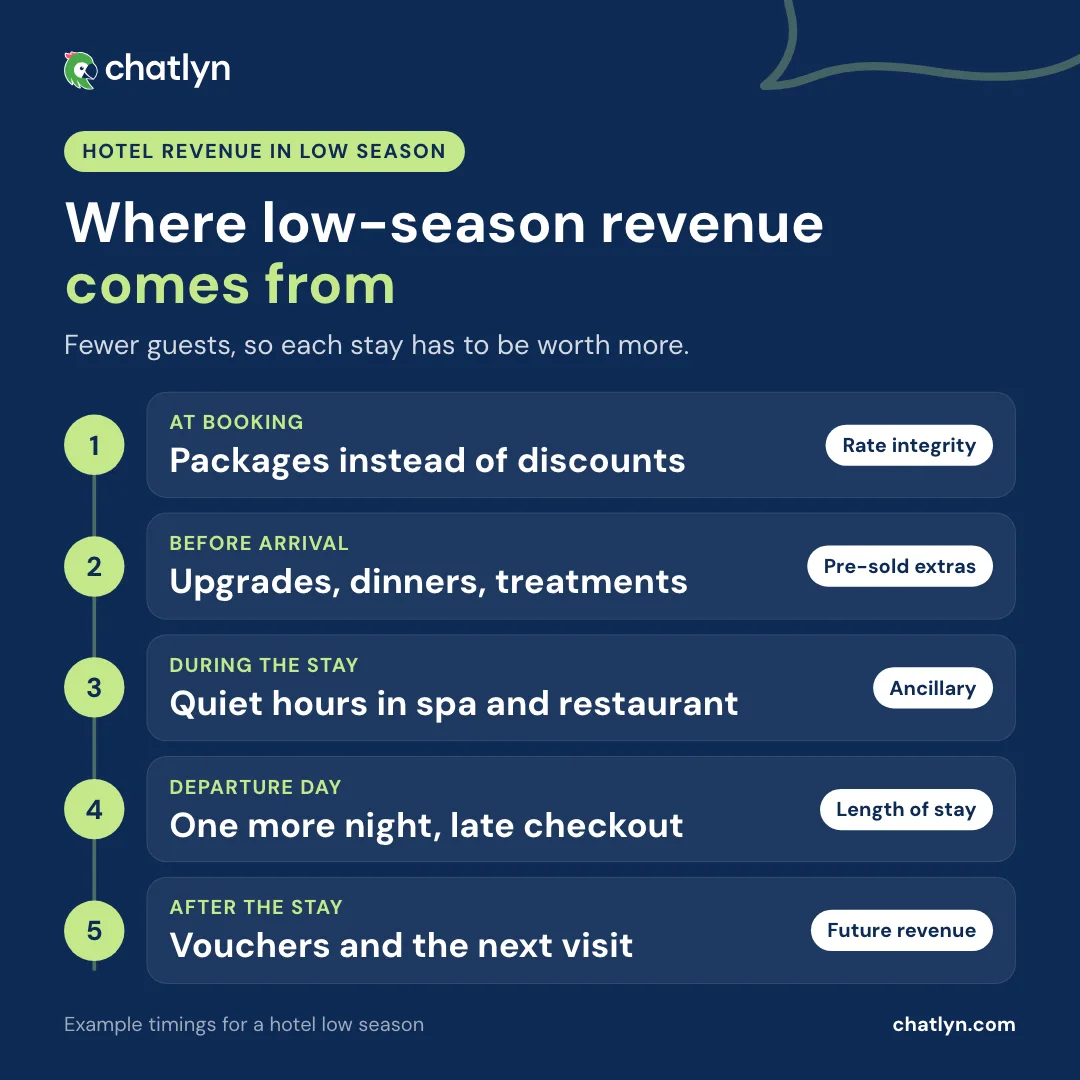
To increase hotel revenue in low season, raise what each stay is worth instead of cutting the room rate: sell packages rather than discounts, pre-sell dinners, treatments and upgrades before arrival, fill quiet hours in the spa and restaurant, offer one more night on the evening before departure, and sell vouchers and the next stay afterwards. When demand is low, the most reliable way to increase hotel revenue is to sell more to the guests you already have, at the moment they decide, usually on WhatsApp, with one clear button and a person who confirms.
In the low season you have fewer guests, the same fixed costs and a team that suddenly has time. Filling room nights is one half of the answer, and our sister guide on how to increase hotel occupancy in low season covers it: who to target, reasons to travel, local markets and groups. This guide covers the other half: what each low-season stay is worth, and how to raise it without training guests to wait for a lower price. You will find eight strategies, example messages, a comparison table and what to measure, with examples from Spa Resort Geinberg and Hotel Enzian Obertauern.
Why low-season hotel revenue depends on the value of each stay
When occupancy drops, the reflex is to drop the rate. It fills a few rooms, but it also tells last year’s guests that patience pays, it lowers the reference price for next season, and it attracts the guests least likely to spend in the spa or restaurant. A discount is the most expensive way to sell a quiet week.
The alternative is to look at revenue per stay rather than rate per night. A guest who pays your normal rate for a package with dinner, books a treatment before arrival and stays one night longer is worth more than two guests on a reduced room-only rate, and costs your housekeeping team less. That is why TRevPAR is the more honest measure for the low season than room revenue alone: it counts the spa, the restaurant and everything else a stay brings in.
Low-season guests also behave differently. They are rarely rushing between sights, the weather sends them indoors, and they have time for a long lunch or a second massage. The spa has free slots and the restaurant has free tables, so every extra they buy is ancillary revenue you can deliver with the team you already have on shift.
The last lever is the cost of each booking. A room night sold through an online travel agency carries a commission, while a repeat guest who books through your own website does not. In a season where every stay counts, selling more to guests you already know is usually the cheapest revenue you can find.
8 ways to increase hotel revenue in low season
Each strategy covers when it works, who sends the offer and what the guest sees. They follow the stay from booking to the next visit.
1. Sell packages instead of cutting the rate
A package gives the guest a reason to choose a quiet week and keeps your room rate intact. Three nights with dinner on the first evening, a winter wellness stay with a treatment each day, or a dinner, bed and breakfast rate with a wine tasting all say “this is a good time to come” without saying “we are cheap”.
Build packages around what the low season does well: quiet, space and time. Add value the guest can feel (a longer spa slot, a table by the window, a late checkout) rather than a lower number. The extras cost you little when the spa and restaurant are half empty, and the guest sees a complete plan instead of a price.
Keep the choice short. Two or three packages per season, described in plain language with what is included and on which days, sell better than a long list. Show them on the booking engine first and again in the confirmation, so guests who booked room only see the alternative while they still plan.
2. Pre-sell dinners, treatments and experiences before arrival
The days before arrival are when guests plan and have time to read. A message three to seven days out, triggered by the reservation in your PMS, reaches every guest without anyone on the team having to remember it. Put the practical information first (arrival time, parking, what to bring) and one or two offers after it, with buttons.
Hotel Enzian Obertauern, an adults-only alpine hotel with three à la carte restaurants and a wine cellar, sends pre-arrival WhatsApp messages that confirm the stay details, introduce the restaurants and share the weekly programme for the guest’s exact days. Those messages reached a 92% open rate, and the hotel saw restaurant reservations from WhatsApp campaigns rise by 38% (Enzian case study). In the low season, a dinner booked before arrival is a table you would otherwise have left empty.
For more ideas on what to offer, see our guides to hotel spa upselling techniques and upselling techniques in food and beverage.
3. Offer upgrades while the better rooms stand empty
In the low season your suites and best-view rooms are often free. An upgrade offered before arrival turns that empty inventory into revenue: “Your stay begins on Thursday. Our suite with the mountain view is available for your dates. Would you like to upgrade for your three nights?” with two buttons, “Tell me more” and “No, thank you”.
Your reservations team decides which rooms to offer and at what price, based on what your PMS shows. Offer one upgrade, not a menu, and send it only to guests whose stay is long enough for the upgrade to matter.
4. Fill quiet hours in the spa and restaurant
A treatment room that stays empty at 15:00 cannot be sold tomorrow, and neither can a table at 19:00. Rather than discounting those hours, send a short offer to guests already in the house, timed for the hour you want to fill: a photo, two lines and one button.
Spa Resort Geinberg sends WhatsApp campaigns with an image, a short text and a direct booking button, promoting reservations for the Relax! sauna lounge and the SPAplus adults-only area. For in-house guests on a grey afternoon, the message might read: “The sauna lounge is quiet this afternoon. Shall we reserve two loungers for you from 15:00?” One offer per stay is service. Three a day is noise.
5. Open the spa and restaurant to local guests
Low-season hotels often forget the people who live nearby. A Sunday lunch, a day-spa ticket on weekdays or a cookery evening brings local guests in when hotel guests are few, and they come back in the high season as ambassadors for the hotel.
Give them a way to stay in touch. A QR code on the restaurant table or at spa reception can open a WhatsApp conversation, and local guests who opt in can receive your next seasonal offer. Keep those messages rare and specific: the new winter menu, the Thursday wine evening, a spa morning for two.
6. Offer one more night on the evening before departure
The best moment to sell a longer stay is while the guest is still enjoying it. On the evening before departure, if the room is free, offer one more night or a late checkout: two buttons, one message, sent to the guests on your departing-tomorrow list after the front office has checked which rooms stay free.

In the example, the guest taps “One more night” and the front office confirms the new departure date, breakfast and a table on the terrace for 20:00. The extra night costs you a room cleaning and earns you a room night, a dinner and a breakfast. A paid late checkout is the smaller version of the same offer for guests who cannot stay longer.
7. Sell vouchers for the months ahead
Vouchers are low-season revenue twice: sold now as gifts, and redeemed later, ideally in weeks you want to fill. In the thank-you message after departure, offer a spa or dinner voucher as a gift for someone at home, and in the weeks before the holidays, send one voucher offer to past guests with a clear button.
You can steer redemption towards quiet periods by describing the voucher as a stay experience (“two nights with dinner and a treatment, valid from November to March”) rather than a sum of money. The guest gives a plan, and you receive guests in the season that needs them.
8. Sell the next stay to guests who already know you
Past guests are the cheapest bookings you can win: they know the hotel, trust it and have already shared their WhatsApp number. A campaign to guests who opted in, with a photo, two lines and one booking button, brings them back without a commission.

Spa Resort Geinberg runs campaigns like this for offers such as its Karibik-Lagune Chalet, and its WhatsApp campaigns reached a 95% open rate against about 20% for email (Geinberg case study). The guest taps “Book the chalet” and reservations sends the booking page. Choose the offer by season and segment: returning couples, families who came in the summer, guests who booked a treatment last time. Our WhatsApp campaign ideas give more starting points.
How to increase hotel sales in low season: speed, packages and the cost of each booking
Low-season sales depend as much on how your team answers as on what you offer. Three habits make the difference.
Answer every enquiry quickly. A guest asking about a winter weekend is usually asking three hotels at once. An AI assistant trained on your own offers, prices and opening hours can answer at night and at weekends, and pass the booking request to reservations with the details collected. At Spa Resort Geinberg, the AI webchat answers questions about opening hours, prices, offers and directions and handled 86% of webchat enquiries without staff, with the other 14% handed to the team.
Quote the package first. When a guest asks for a price, reply with the package that fits their dates and the room-only rate second. Most guests choose between the options you show them.
Know what each booking costs. Compare what you pay per booking on each channel: OTA commission, advertising, and the time your team spends. Direct bookings from past guests and your own website usually cost least, which is why strategies 7 and 8 matter even more in the low season.
Low-season hotel revenue strategies at a glance
The example messages are templates to adapt, not scripts to copy.
| Strategy | Best moment | What the guest sees | What it protects or adds |
|---|---|---|---|
| Packages instead of discounts | At booking | ”Three nights with dinner on the first evening and a treatment.” | Room rate, revenue per stay |
| Pre-sold extras | 3 to 7 days before arrival | ”Our restaurants and the programme for your days. Reserve a table?” | Restaurant and spa revenue |
| Upgrades | Before arrival | ”The suite with the mountain view is free for your dates. Upgrade?” | Revenue from empty premium rooms |
| Quiet-hours offers | During the stay | ”The sauna lounge is quiet this afternoon. Two loungers from 15:00?” | Spa and restaurant utilisation |
| Local guests | Weekends and evenings | ”Sunday lunch in our restaurant. Reserve a table for your family?” | Revenue beyond hotel guests |
| One more night | Evening before departure | ”Late checkout or one more night?” | Length of stay |
| Vouchers | After departure, before the holidays | ”Give two nights with dinner, valid November to March.” | Future low-season revenue |
| The next stay | Campaign to past guests | ”Your own chalet by the lagoon. Book the chalet.” | Direct bookings, lower acquisition cost |
How chatlyn helps you increase hotel revenue in low season
Every strategy above needs the right message at the right moment and a team that answers quickly. chatlyn, the AI-Native GRM, helps your team do both. Your rates stay with your revenue team; chatlyn helps your team reach guests with the offers you decide on, and see who responded. See how it supports hotel revenue teams and general managers.
Messages triggered by the reservation. PMS events (booking created, before arrival, check-in day, check-out, after departure) trigger WhatsApp messages for hotels with images and buttons. You build the sequence once as a guest journey, test it, and see clicks and conversions for each step. Room, spa and restaurant revenue stays in your PMS and your own systems.
Lists for each moment. Live lists (in-house, arriving today, departing tomorrow, recently checked out, birthdays this week) and custom segments send the extra-night offer, the quiet-hours offer and the voucher campaign to the right guests. You can message guests who opted in on WhatsApp and have stayed since your PMS was connected.
One profile per guest. The hotel CRM combines stays and spend from the PMS with every conversation on every channel, so your team knows who booked a treatment last time and who travels as a family.
Answers at any hour. The hotel chatbot answers on WhatsApp, webchat, Facebook Messenger, Instagram and newly created Booking.com inboxes from your own offers and website, in the guest’s language, and hands booking requests to your team. On webchat it can open a date picker for your booking engine; on chat channels it can send a link to the finished search, depending on your engine. The guest books in your own engine, where rates and availability are always current.
What customers measured. Hotel Enzian Obertauern sends pre-arrival WhatsApp messages and runs WhatsApp campaigns, and saw its bookings in the low season rise by 22%. Spa Resort Geinberg reached 10,000+ guests a year on WhatsApp. Bernhard Sänger, Director of Operations: “With chatlyn, we turned guest communication into a revenue driver in our Spa, 95% open rates on WhatsApp campaigns and 86% of enquiries handled without staff involvement.”
The same setup fits a single-property hotel with a small team and a hotel cluster where several properties share one low season. See how chatlyn helps hotels increase direct bookings all year.
What to measure
Compare each low season with the last one, month by month:
- TRevPAR and revenue per occupied room. Whether each stay is worth more, not only whether rooms are full.
- Share of package bookings. How many guests chose a package instead of room only.
- Average length of stay. Whether extra-night offers and length-of-stay packages move it.
- Spa and restaurant revenue from hotel guests and from local guests. Tracked separately in your own systems.
- Clicks and conversions per journey step. Which offer works at which moment. A low click rate usually means an unclear offer or button.
- Direct share and cost per booking. Whether past-guest campaigns replace commissioned bookings.
- Voucher sales and redemption dates. Whether vouchers are redeemed in the weeks you want to fill.
FAQ
How can a hotel increase revenue in low season?
Raise the value of each stay instead of cutting the rate: sell packages, pre-sell dinners, treatments and upgrades before arrival, fill quiet hours with offers to in-house guests, offer an extra night before departure and sell vouchers and the next stay afterwards.
How can I increase hotel sales in low season without discounting?
Add value rather than lowering the price. Packages with dinner or a treatment, a late checkout or a longer spa slot give guests a reason to book a quiet week. Answer enquiries quickly, quote the package first and sell the next stay to past guests directly.
Do discounts increase hotel revenue in low season?
Rarely. A discount can fill rooms, but it lowers revenue per stay, teaches returning guests to wait for lower prices and weakens your rate for the next season. Packages and value-adds usually bring in more revenue per stay.
What should hotels upsell in the low season?
What the low season has in abundance: spa slots, restaurant tables, premium rooms and time. Offer treatments and dinners before arrival, upgrades when the better rooms are free, quiet-hours offers during the stay and an extra night on departure day.
How does WhatsApp help increase hotel revenue in low season?
It reaches guests at the right moment with messages they actually open. Spa Resort Geinberg’s WhatsApp campaigns reached a 95% open rate against about 20% for email, and buttons let guests accept an offer with one tap while your team confirms.