A hotel newsletter is a regular message a hotel sends to past and future guests who have agreed to hear from it: seasonal news, offers, events and the stories that make the place worth coming back to. The best hotel newsletter examples have one reason to write, one strong photo and one clear action, and they sound unmistakably like the hotel that sends them. A luxury palace in Paris and a hostel in Lisbon should never send the same newsletter. Of all the hotel email marketing examples along the guest journey, the newsletter is the one guests judge your brand by.
Below are 15 hotel newsletter examples, one for each kind of property: a Paris palace, a Copenhagen design hotel, a Viennese grand hotel, a Mallorca resort, an airport hotel, a congress hotel, a hostel, a family-run hostal, an Alpine chalet, a thermal retreat, a safari lodge, a family resort, a Berlin lifestyle hotel, a vineyard estate and a Japanese ryokan. Each one comes with what makes it work and what to borrow. Then, for every example, you will see the same newsletter sent on WhatsApp, the way hotels send it with chatlyn, and what happens when guests can simply answer it.
The hotels in this guide are fictional and the newsletters are concept designs we created to show 15 distinct styles. The ideas behind them, and the numbers we quote from real hotels, are not. If you run a hotel marketing team, use this as a swipe file for your next send.
The 15 hotel newsletter examples at a glance
| # | Hotel | Type of hotel | Newsletter style | Idea to borrow |
|---|---|---|---|---|
| 1 | Maison Orsalle | Luxury palace, Paris | Centred editorial with three columns | One offer that bundles three experiences |
| 2 | NOVA/12 | Design hotel | Swiss grid with a numbered list | Three reasons to come, in a numbered list |
| 3 | Grand Hotel Wilhelmina | Historic grand hotel | Newspaper front page | Treat the newsletter as an edition |
| 4 | Isla Calma | Beach resort | Full-bleed photo with a booking bar | A late-season offer with a clear date window |
| 5 | Aerolis | Airport hotel | Departure board and boarding pass | Show services as a timetable |
| 6 | Grand Forum | Congress hotel | B2B layout with key numbers | A named contact with a promise |
| 7 | Bunk & Bloom | Hostel | Collage of photos and stickers | A week of events, day by day |
| 8 | Hostal Dos Lunas | Family-run hostal | Handwritten letter from the owners | Write to one guest, by name |
| 9 | Alpenglüh | Alpine chalet | Season calendar next to an arched photo | Announce the dates of the season |
| 10 | Sereno | Wellness retreat | Minimal three-day timeline | Sell the feeling, then the itinerary |
| 11 | Kora Ridge | Safari lodge | Field journal with a sightings tally | Real data from the place as content |
| 12 | Sunny Cove | Family resort | Rounded blocks of different sizes | Answer the parents’ questions upfront |
| 13 | The Volt | Lifestyle hotel | Dark design with neon and a lineup | The hotel as a venue, not just a bed |
| 14 | Domaine de Vérel | Vineyard estate | Invitation laid out as a menu | An event with a price and a room to follow |
| 15 | Kumo Ryokan | Japanese inn | Asymmetric with vertical type | Restraint: few words, one season |
What makes a good hotel newsletter
Before the examples, five things every strong hotel newsletter in this list has in common.
- One reason to write. A season opening, an event, an offer with dates. “Our latest news” is not a reason. If you cannot say in one sentence why this newsletter exists, the guest will not know either.
- One photo that does the selling. A steaming onsen in red maples sells the ryokan better than six thumbnails of the lobby. Choose the photo of the moment you want the guest to imagine themselves in.
- The hotel’s own voice. A safari lodge writes field notes, a family-run hostal writes a letter, a party hotel shouts. The design and the words should be impossible to swap with a competitor’s.
- A concrete detail. Dates, a price, the number of places left, the name of the room. “Eight places left” moves people, “limited availability” does not.
- One action, and a way to answer. Every example ends with one button. The ones that get the most out of it let the guest reply with a question, because questions are where bookings and upsells start.
That last point is where most hotel newsletters fall short. An email newsletter usually ends at the button: the guest clicks or leaves, and if they have a question they have to find a phone number. Every WhatsApp version below shows the alternative.
1. Maison Orsalle: the classic luxury hotel newsletter
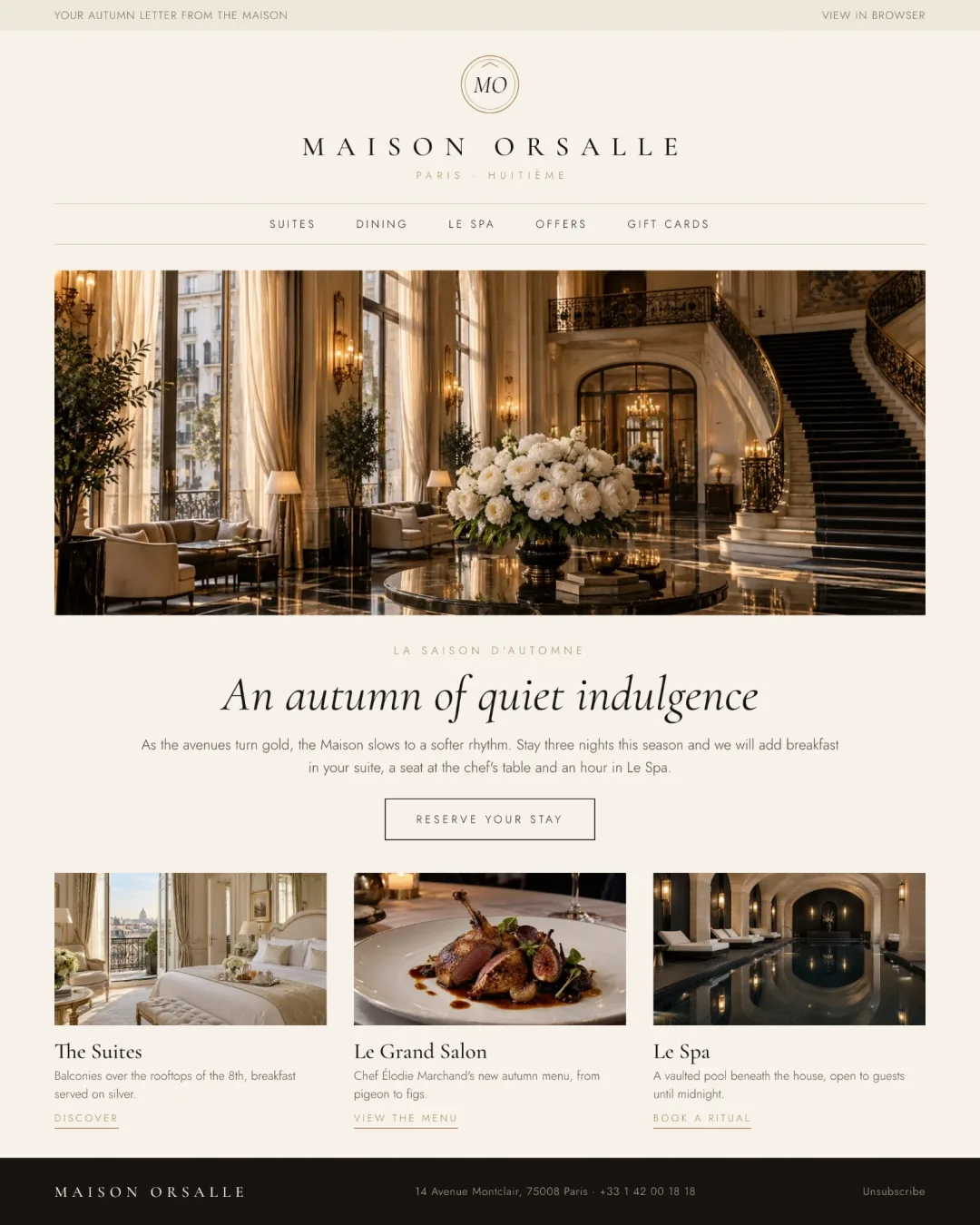
Maison Orsalle, a palace hotel in the 8th arrondissement, sends “An autumn of quiet indulgence”. The layout is the classic luxury newsletter: a monogram crest, a thin navigation bar, a wide photo of the lobby, a headline in an italic serif and three columns for the suites, the restaurant and the spa.
Why it works: the offer is one sentence and bundles three experiences into a single reason to book: stay three nights and breakfast in the suite, a seat at the chef’s table and an hour in the spa are added. Each column then gives the guest a second way in, with its own small call to action. The palette of cream, black and gold says luxury without a single superlative.
What to borrow: build your seasonal offer from things the hotel already does well, instead of a discount. Three nights with three experiences protects the rate and fills the restaurant and the spa.

On WhatsApp: the three columns become three buttons. The guest taps “Reserve your stay” and writes what she actually wants, a suite with a balcony from 13 November. Camille from reservations answers in the same chat and adds the chef’s table on Friday. In an email that request would have become a form, a phone call or nothing at all.
2. NOVA/12: a design hotel newsletter built on a grid
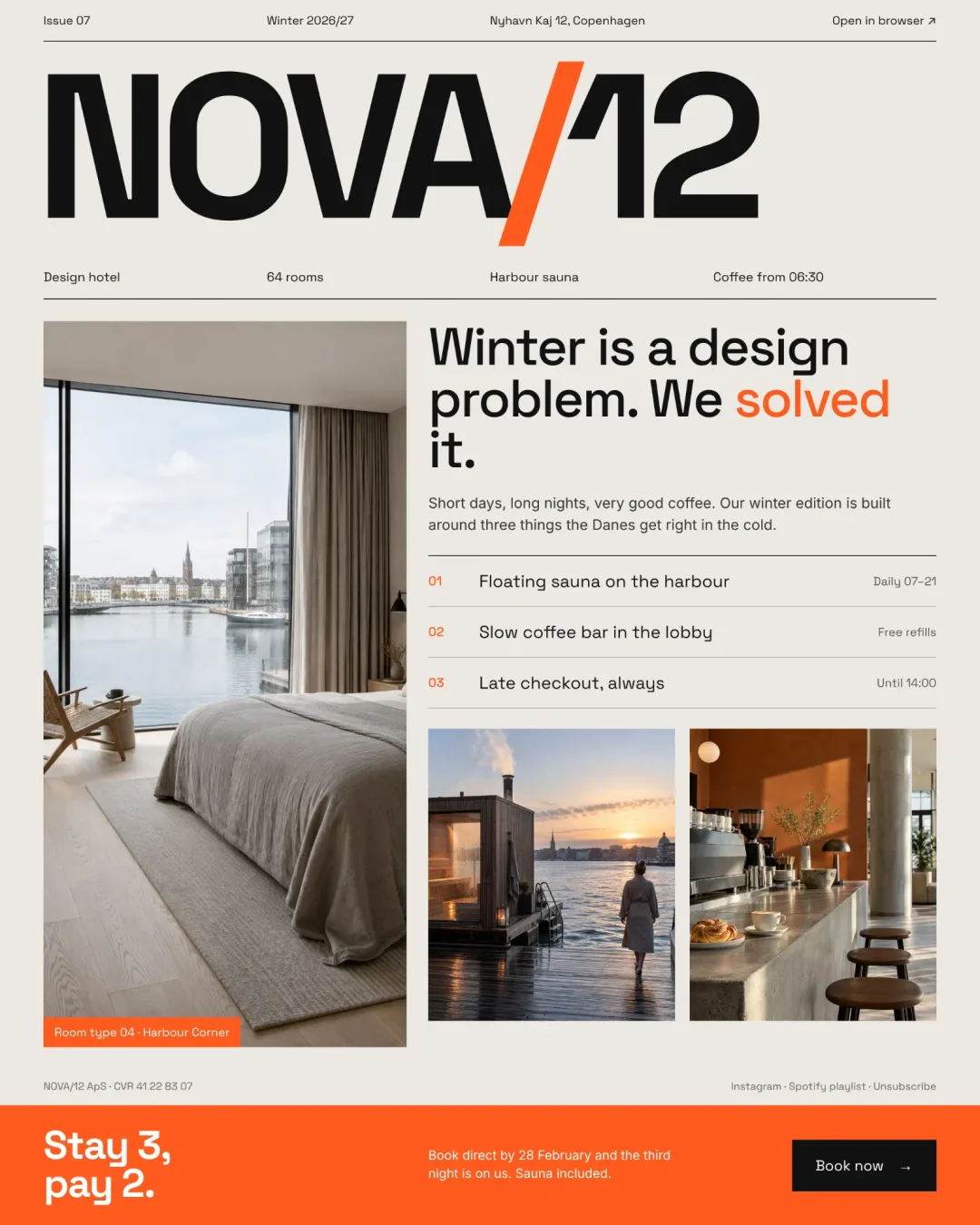
NOVA/12 is a 64-room design hotel on the Copenhagen harbour, and its winter issue looks like a design magazine. A huge black wordmark split by an orange slash, a row of facts (design hotel, 64 rooms, harbour sauna, coffee from 06:30), a confident headline, “Winter is a design problem. We solved it.”, and a numbered list.
Why it works: the numbered list turns a vague promise into three specific reasons to come: a floating sauna on the harbour, a slow coffee bar and late checkout until 14:00, each with a short detail on the right. The offer, “Stay 3, pay 2”, sits alone on an orange band at the bottom, impossible to miss.
What to borrow: answer the objection to your low season in the headline. Winter in Copenhagen is cold and dark; the newsletter says so, then shows exactly how the hotel makes it worth it.

On WhatsApp: the guest taps “Sauna times” instead of “Book now”. On WhatsApp that is not a lost click, it is a conversation: the AI answers with the opening hours, the guest asks about three nights in January and gets the booking page. The guest books on the hotel’s own website, so the third night is free and the booking is direct.
3. Grand Hotel Wilhelmina: the newsletter as a newspaper
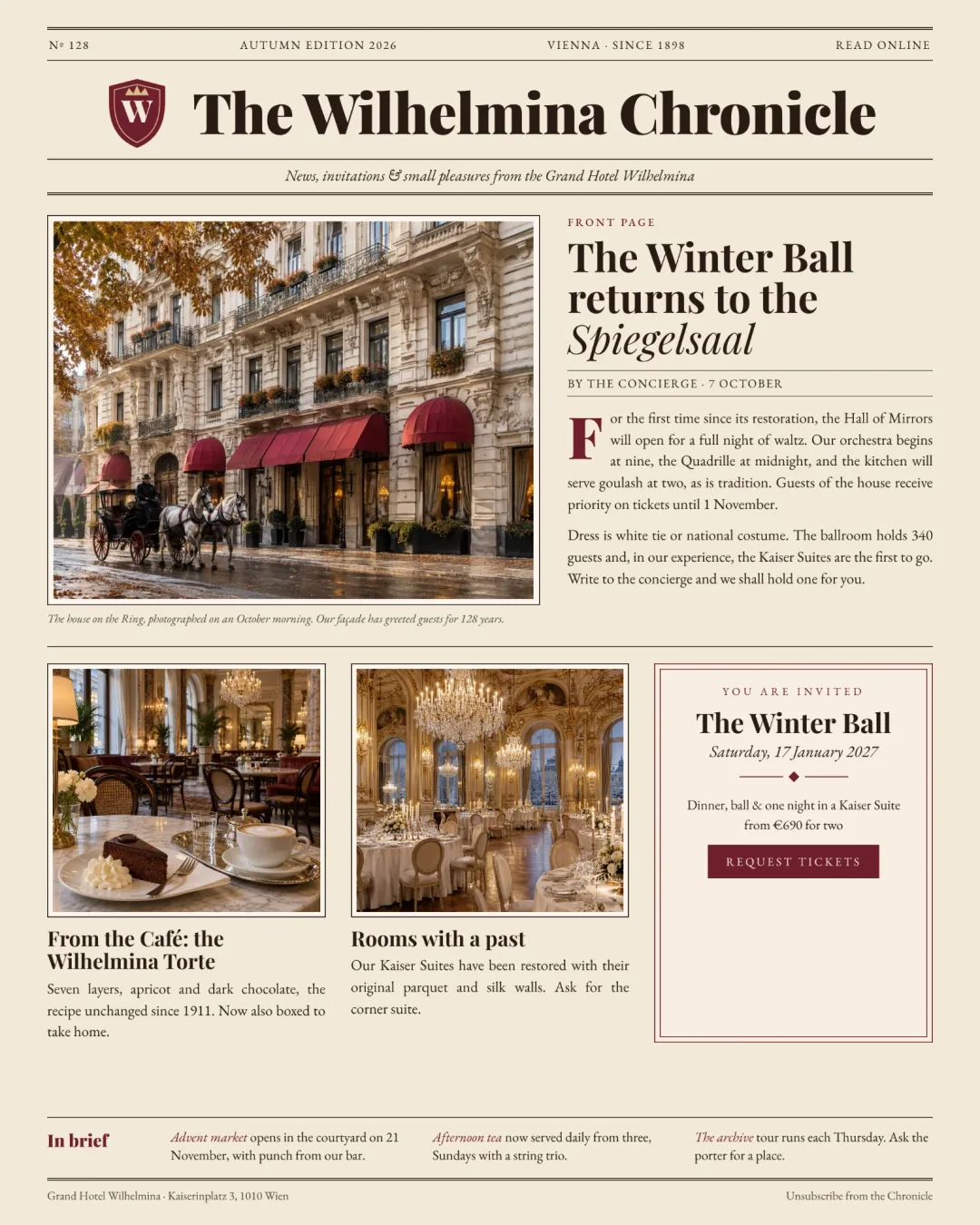
A grand hotel on the Vienna Ring since 1898 sends “The Wilhelmina Chronicle”, edition number 128. Masthead, a front-page story with a drop cap about the Winter Ball returning to the Hall of Mirrors, two smaller stories about the café’s torte and the restored Kaiser Suites, and an “In brief” row at the bottom.
Why it works: the format matches the hotel’s history, and it gives the team a reason to send something every season without inventing a promotion each time. The story does the selling: the orchestra begins at nine, the quadrille at midnight, goulash is served at two “as is tradition”, and guests of the house have priority on tickets until 1 November. The invitation box on the right holds the price, €690 for two with dinner, ball and a Kaiser Suite.
What to borrow: if your hotel has a history, give the newsletter a name and an edition number. Readers come back to a publication, not to a promotion.

On WhatsApp: a newspaper does not fit on a phone, but its front-page story does. The guest asks about the dress code, the AI answers from the hotel’s own information, and when the guest asks for tickets and a suite the concierge confirms them personally, remembering which suite the guest had last spring. That is what guests expect from a grand hotel.
4. Isla Calma: a resort newsletter that lets the photo talk
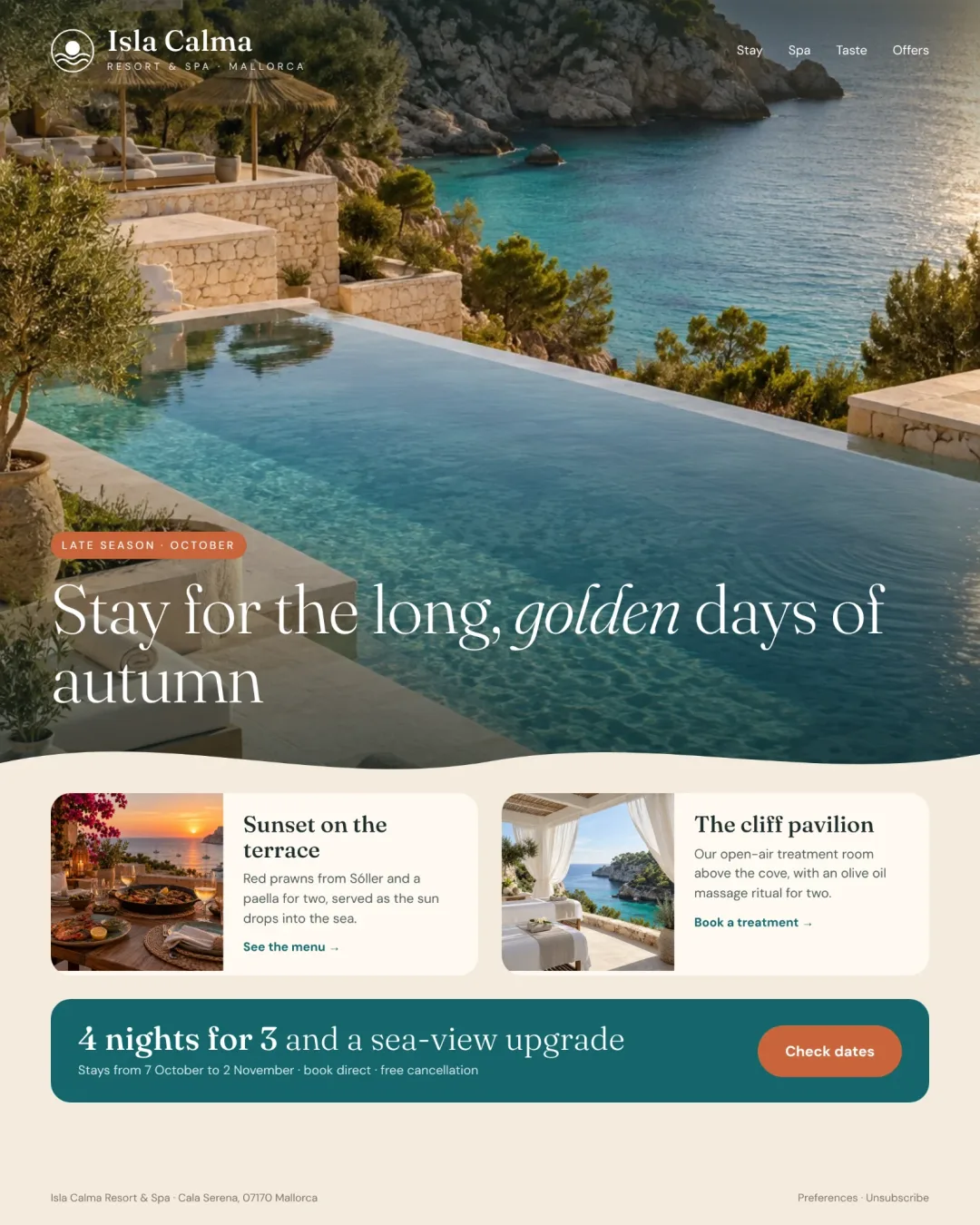
Isla Calma, a resort and spa in Mallorca, sends a late-season newsletter: “Stay for the long, golden days of autumn”. Almost half the newsletter is one photo of an infinity pool above the sea. Below a soft wave divider sit two cards, a sunset dinner on the terrace and an open-air treatment room above the cove, and a booking bar with the offer.
Why it works: the offer is specific and safe to say yes to: 4 nights for 3 and a sea-view upgrade, for stays from 7 October to 2 November, booked direct, with free cancellation. The two cards give guests something to look forward to beyond the room, and each has its own link.
What to borrow: put the date window and the cancellation terms next to the offer. The more specific the offer, the easier the decision.

On WhatsApp: the guest asks whether the cliff pavilion will still be open on her dates. The AI confirms it and sends the offer page. After booking she asks to add the olive oil ritual for two, and Elena from the spa confirms it in the same chat. A newsletter that sells the stay and then the treatment is exactly what increasing hotel upsell revenue looks like in practice.
5. Aerolis: an airport hotel newsletter as a departure board
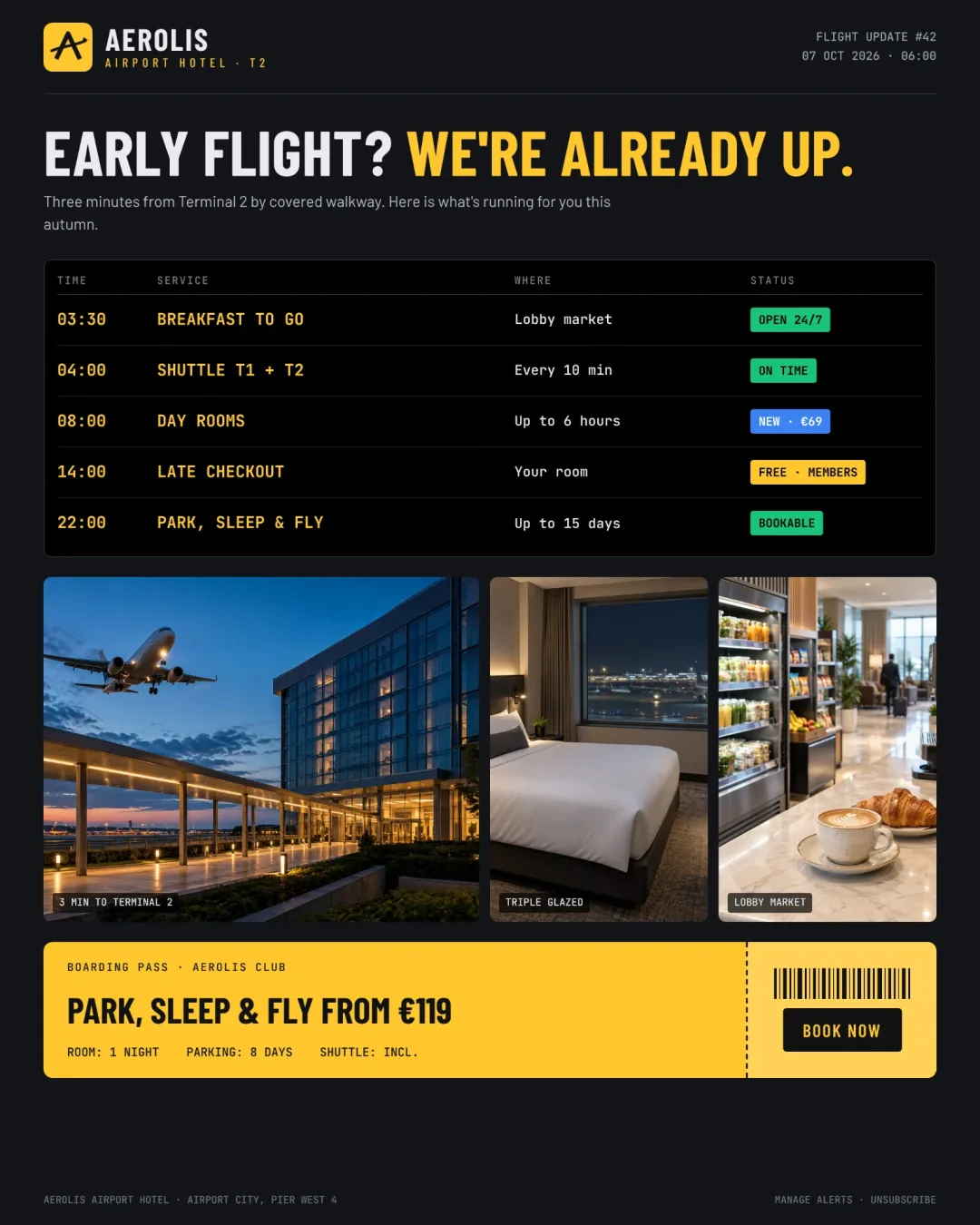
Aerolis, an airport hotel at Terminal 2, sends its “Flight update #42” at 06:00. The headline is a wink at its guests: “Early flight? We’re already up.” The services are listed as a departure board with times and statuses: breakfast to go from 03:30, shuttle every 10 minutes, day rooms from €69, free late checkout for members, park, sleep and fly up to 15 days. The offer at the bottom is a boarding pass.
Why it works: airport hotel guests do not want atmosphere, they want certainty. The timetable answers the questions they actually have, when, where and how much, in a format they read every week.
What to borrow: if your guests are practical, make the newsletter practical. A table of services with times is more useful than three paragraphs about your lobby.

On WhatsApp: this is where WhatsApp shines. The guest’s flight is at 06:10 on Friday, and the only question is whether breakfast is ready early enough. The AI answers in seconds and sends the package link. On email, that question goes to a mailbox nobody reads at 07:45.
6. Grand Forum: a congress hotel newsletter for event planners
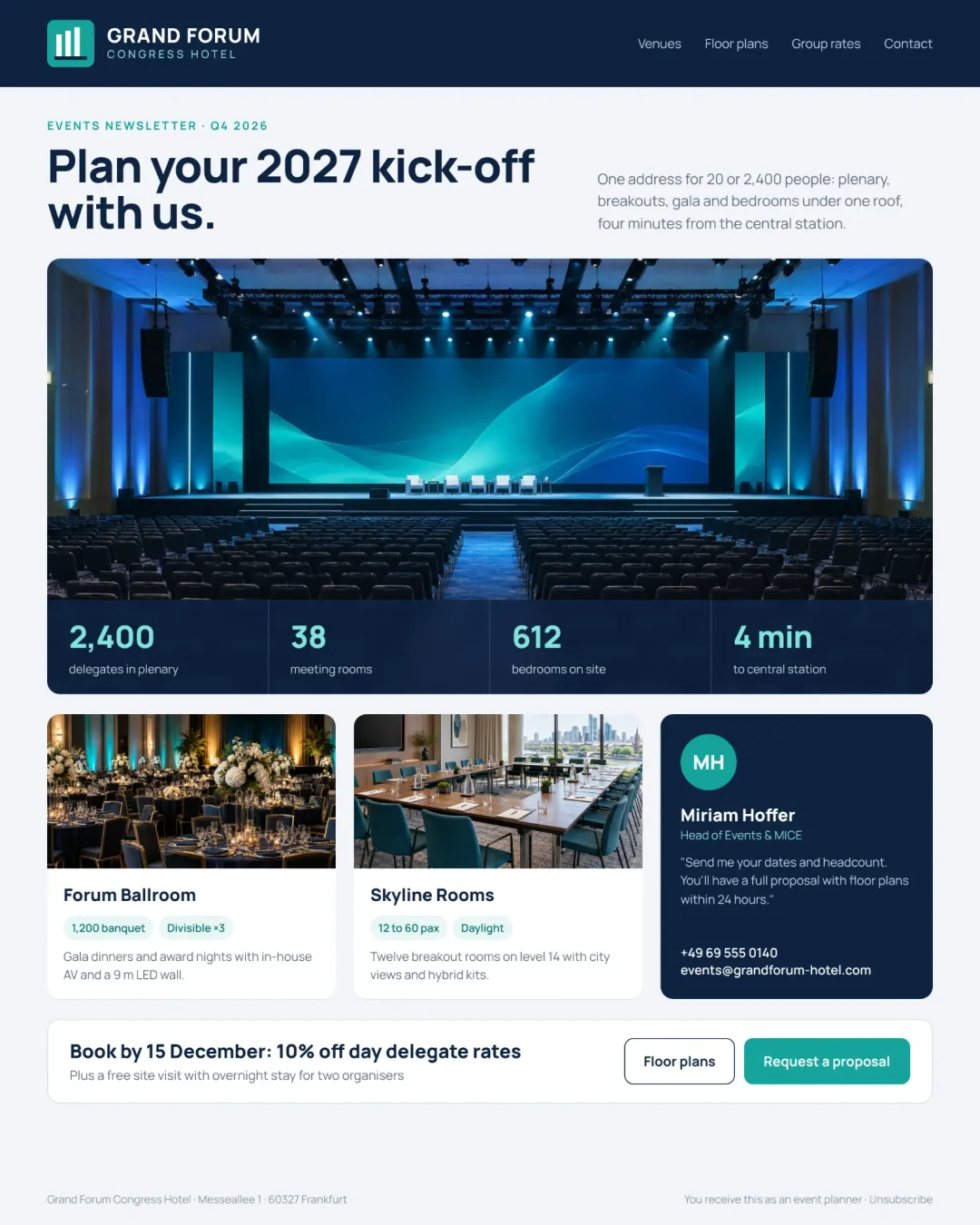
Grand Forum, a congress hotel in Frankfurt, writes to event planners, not holidaymakers: “Plan your 2027 kick-off with us.” Under a photo of the plenary hall sit four numbers (2,400 delegates, 38 meeting rooms, 612 bedrooms, 4 minutes to the central station), two venue cards with capacities, and a card for the head of events with her phone number and email.
Why it works: planners compare venues on capacity, logistics and how quickly they get a proposal. This newsletter answers all three, and the named contact with a promise (“a full proposal with floor plans within 24 hours”) is worth more than any photo. The offer, 10% off day delegate rates and a free site visit for two organisers, has a deadline: 15 December.
What to borrow: for groups and MICE, lead with numbers and a person. Planners buy from people who answer.

On WhatsApp: the planner taps “Request a proposal” and types the brief in two lines: two days at the end of January, 180 people, plenary plus six breakouts, 120 rooms. The head of events replies with the rooms that fit and offers the site visit. No form, no lost email, and a thread the whole events team can see.
7. Bunk & Bloom: a hostel newsletter with a week of events
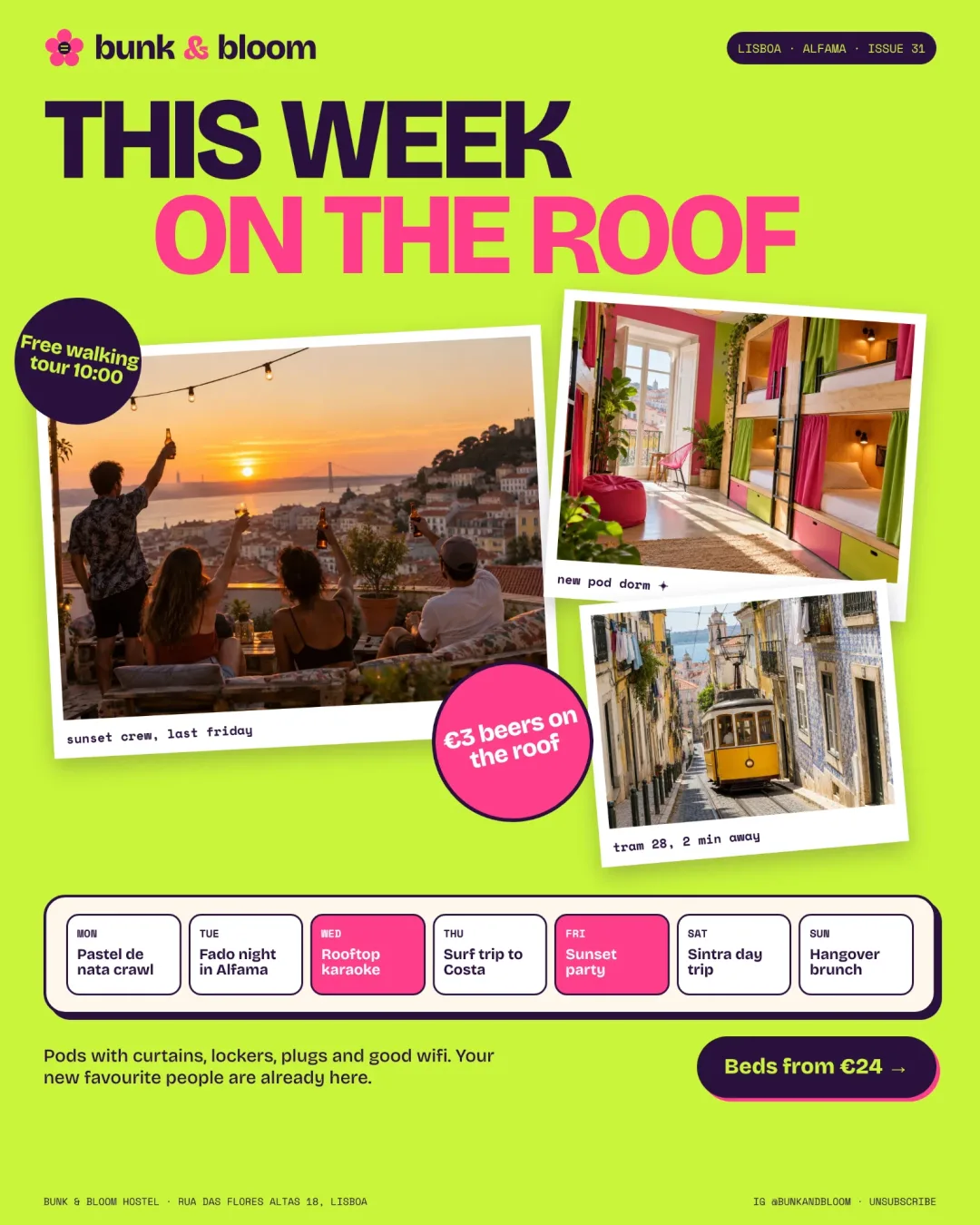
Bunk & Bloom, a hostel in Lisbon’s Alfama, sends issue 31: “This week on the roof”. Lime and pink, tilted photos with handwritten captions (“sunset crew, last friday”), round stickers for the free walking tour and €3 beers on the roof, and a calendar with one event a day, from a pastel de nata crawl on Monday to a hangover brunch on Sunday.
Why it works: hostel guests choose a hostel for the people as much as for the bed. The calendar sells the week, and the copy at the end sells the bed: “Your new favourite people are already here.” The price, beds from €24, is the button.
What to borrow: if your property is social, sell the programme. A week of events gives every reader at least one reason to come.

On WhatsApp: this audience already lives on WhatsApp. The guest asks about the walking tour, then whether there are beds for the sunset party weekend. The AI answers both, with an emoji where it fits, and sends the booking page.
8. Hostal Dos Lunas: a personal letter from the owners
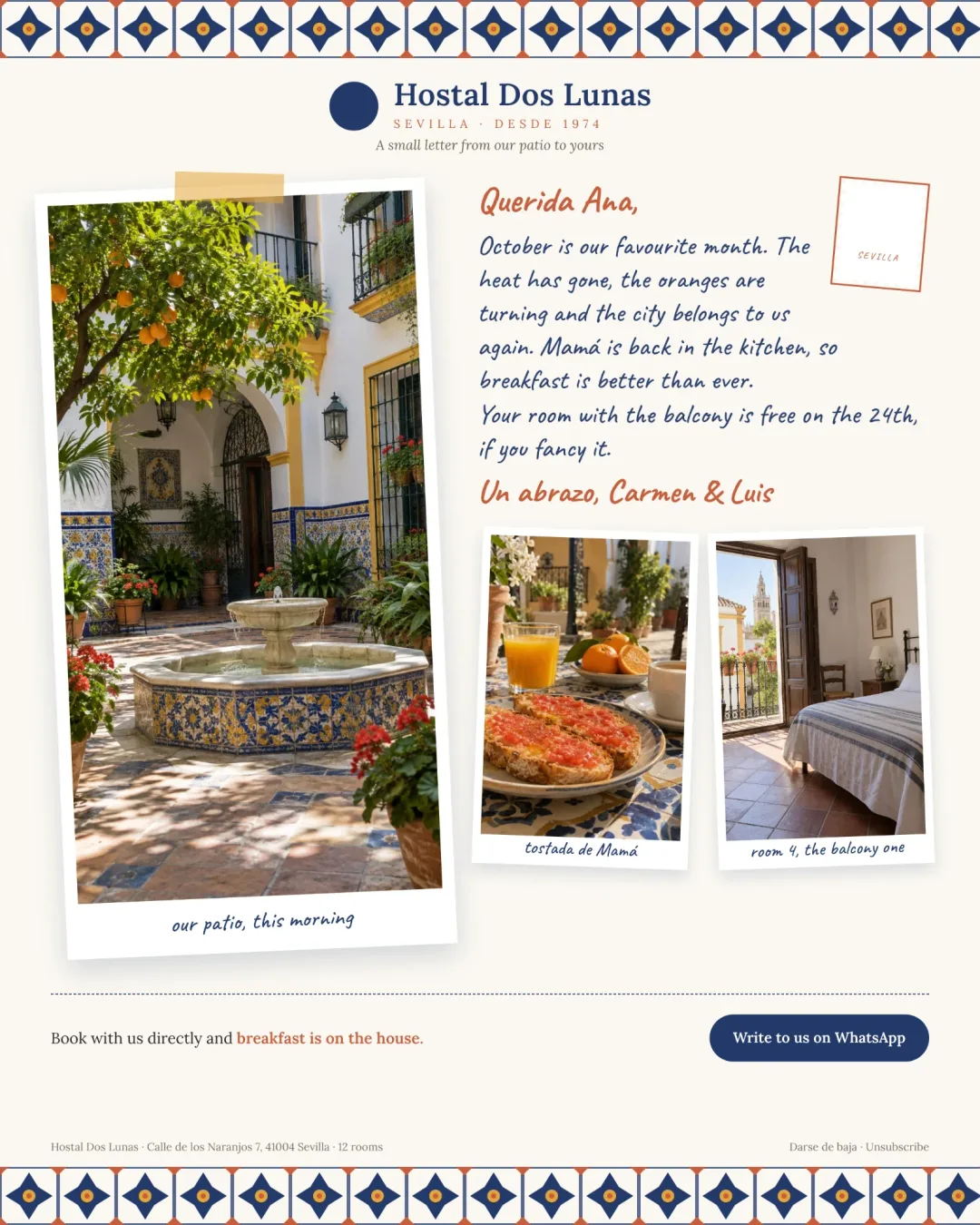
Hostal Dos Lunas is a family-run hostal with 12 rooms in Seville, and its newsletter is a letter. “Querida Ana,” it begins, in handwriting: October is our favourite month, the heat has gone, Mamá is back in the kitchen. And then the line that makes it work: “Your room with the balcony is free on the 24th, if you fancy it.” Signed Carmen and Luis, with three taped photos of the patio, the breakfast and room 4.
Why it works: it is written to one person and it remembers her room. Nothing about it feels like marketing, which is exactly why it works. The call to action is the most honest one in this list: “Write to us on WhatsApp”.
What to borrow: small hotels have something chains cannot copy, the owners. Sign with your names, mention the guest’s room and keep it short.

On WhatsApp: the letter already asked for a WhatsApp reply, so on WhatsApp it simply arrives where the answer happens. Ana taps “I’d love room 4”, asks whether breakfast is still on the house, and Carmen answers personally. A personal letter deserves a person in reply, so this one stays with the owners rather than the AI.
9. Alpenglüh: an Alpine chalet newsletter with a season calendar
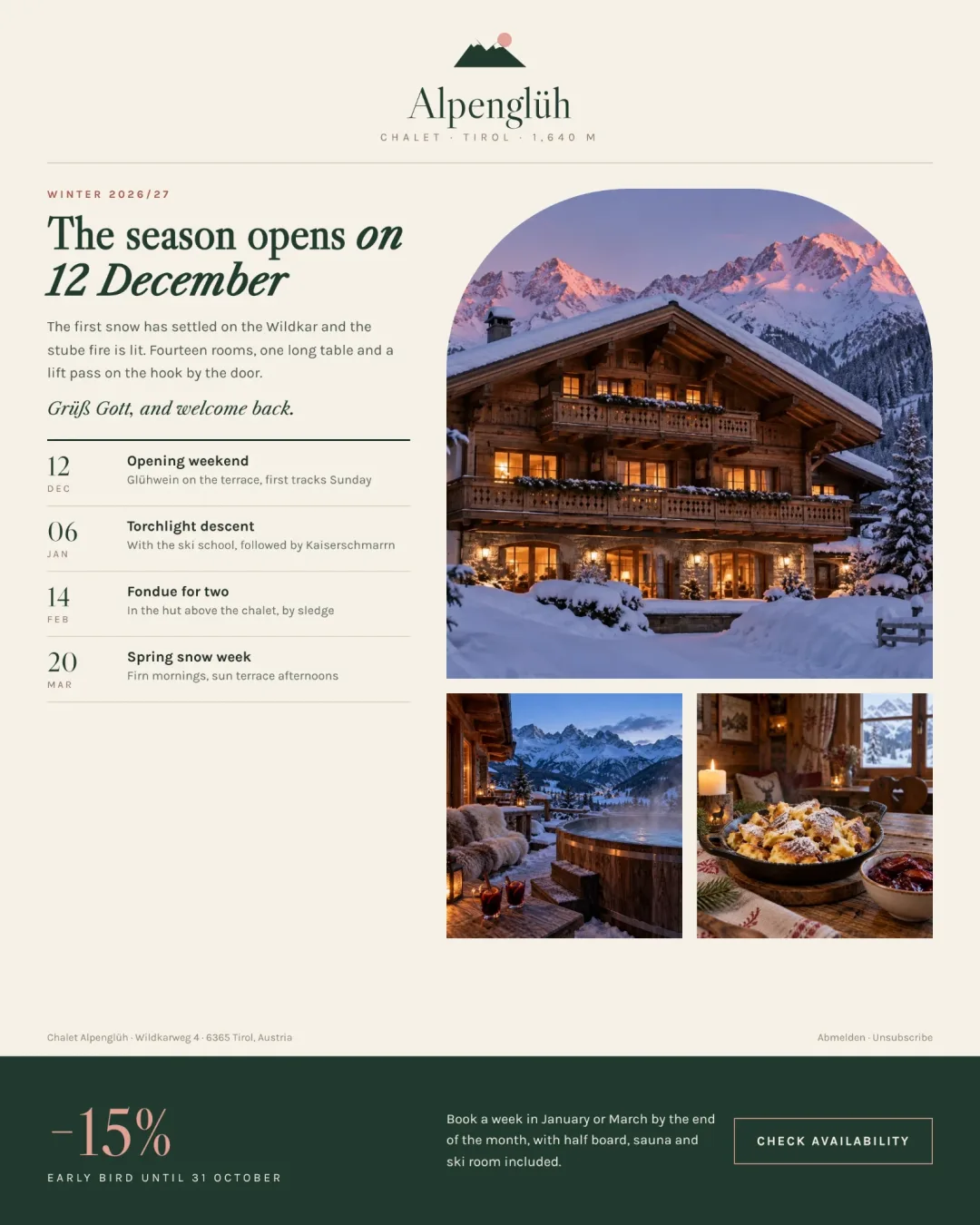
Chalet Alpenglüh in Tyrol, fourteen rooms at 1,640 metres, announces its winter: “The season opens on 12 December”. The left column tells the story in three sentences (first snow on the Wildkar, the stube fire is lit, the lift pass on the hook by the door), then lists four dates: opening weekend, a torchlight descent, fondue for two in the hut, spring snow week. The dark band at the bottom holds the early bird: 15% off a week in January or March, booked by 31 October.
Why it works: returning guests plan their winter around dates, and the calendar gives them those dates in one glance. “Grüß Gott, and welcome back” sets the tone for a newsletter that is clearly written for regulars.
What to borrow: send the season calendar as early as possible, and tie the early bird to the weeks you need to fill, here January and March.

On WhatsApp: the calendar moves behind a button. The guest taps “Season calendar”, the AI lists the four dates, and the family picks the torchlight week. Resi from reservations offers the family room with the early bird price, half board and the ski room included.
10. Sereno: a minimal wellness retreat newsletter
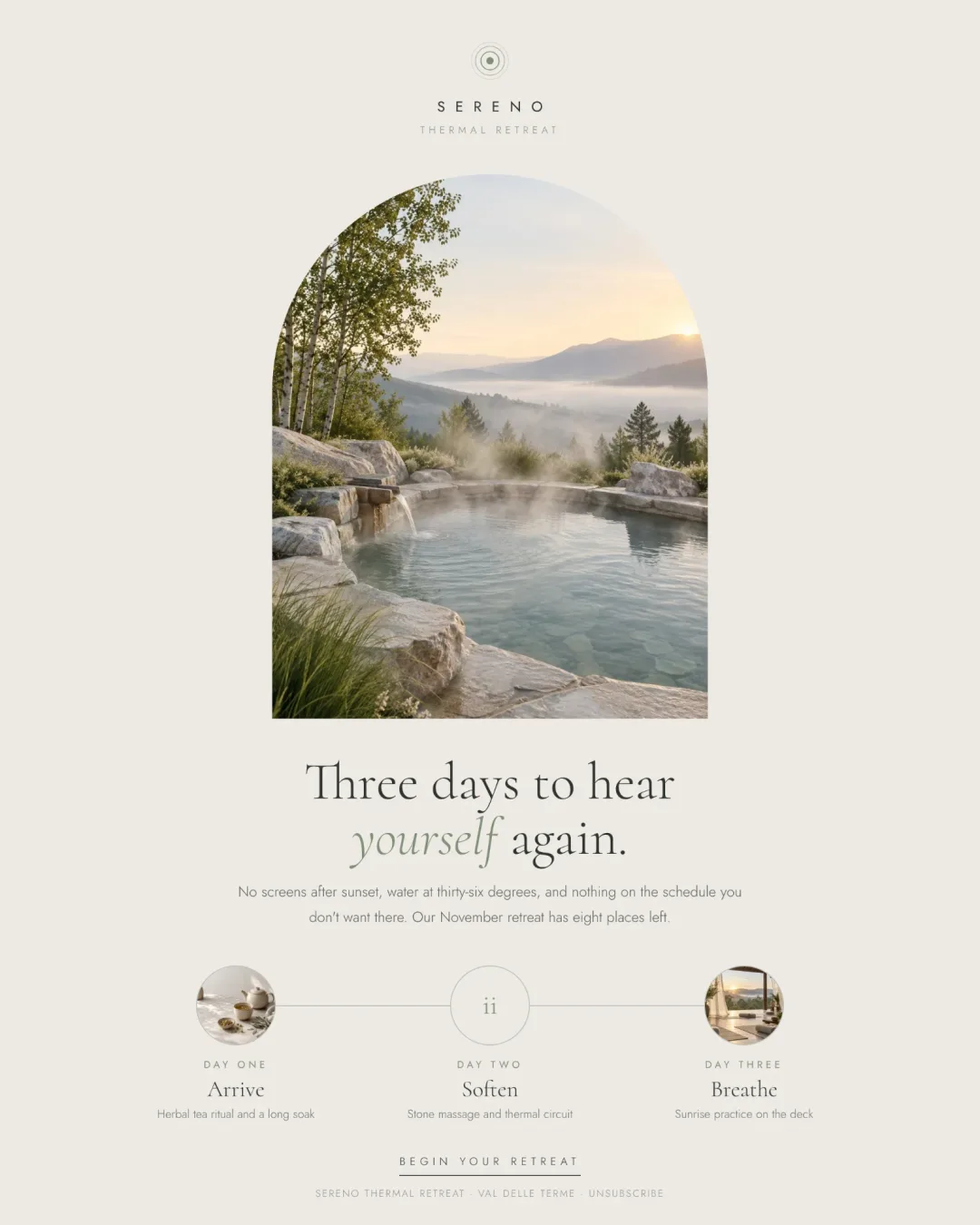
Sereno, a thermal retreat, sends almost nothing, and that is the point. An arched photo of a steaming pool at sunrise, a headline in a light serif (“Three days to hear yourself again”), two sentences and a timeline of three days: arrive, soften, breathe.
Why it works: a wellness newsletter that shouts contradicts what it sells. The copy describes the feeling first (“no screens after sunset, water at thirty-six degrees, and nothing on the schedule you don’t want there”) and then gives the itinerary. The scarcity is quiet but real: “Our November retreat has eight places left.”
What to borrow: for wellness and spa, sell the state of mind, then the programme. One honest number, like the places left, is enough urgency.

On WhatsApp: the most valuable message in this chat is the guest’s doubt: “I’ve never done yoga. Is that ok?” On email, that doubt ends the journey quietly. On WhatsApp, the AI reassures her and offers to pass her request to the team, and the retreat host reserves one of the eight places.
11. Kora Ridge: a safari lodge newsletter written as field notes
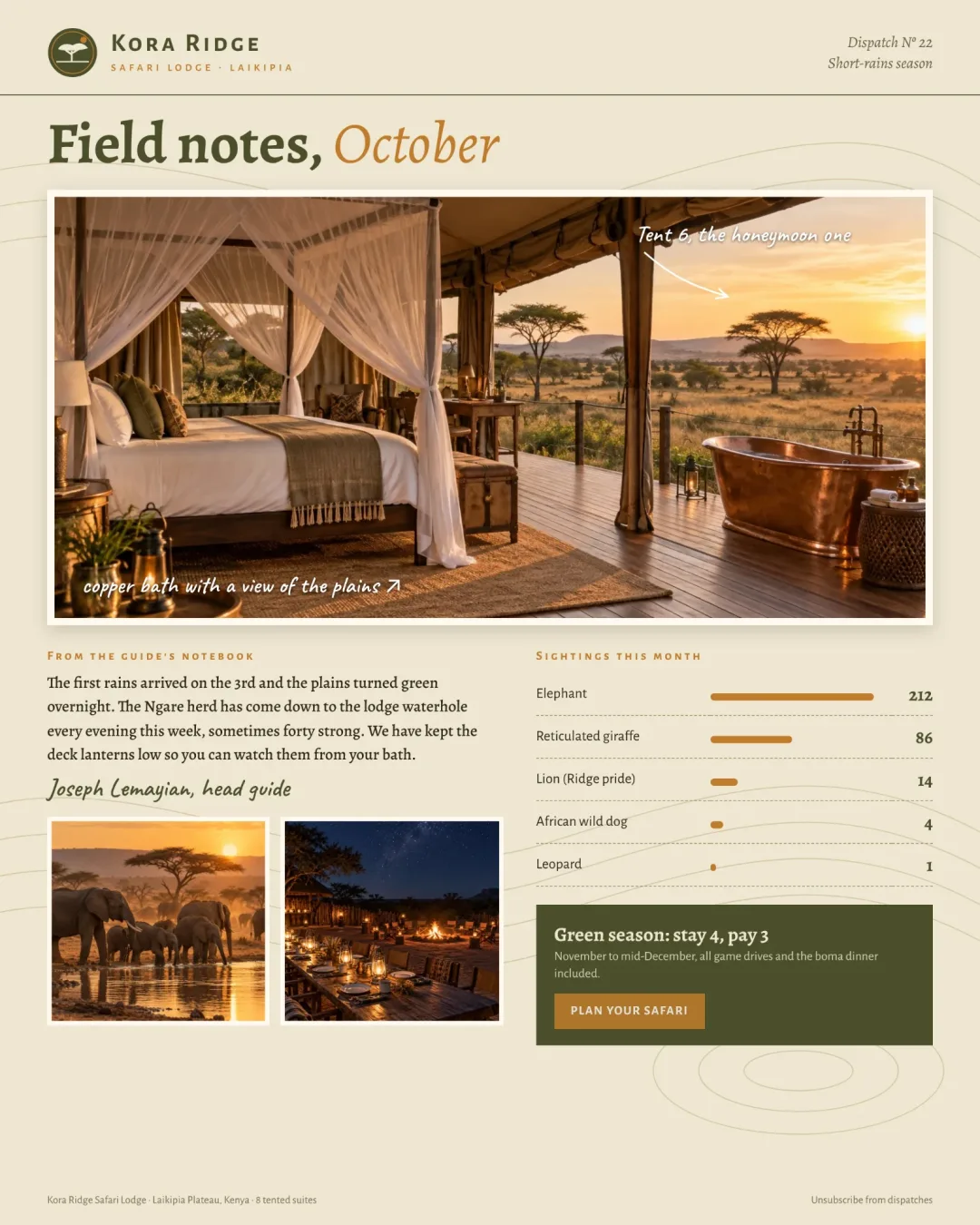
Kora Ridge, a safari lodge with eight tented suites in Laikipia, sends “Field notes, October”, dispatch number 22. A photo of the honeymoon tent with handwritten arrows (“copper bath with a view of the plains”), a note from the head guide about the first rains and the elephant herd at the waterhole, and a tally of the month’s sightings: 212 elephants, 86 giraffes, 14 lions, 4 wild dogs, 1 leopard.
Why it works: the content is real, it could only come from this place, and it changes every month. Past guests read it to relive their stay, future guests read it to imagine theirs. The offer comes last and makes sense in context: green season, stay 4 pay 3, game drives and the boma dinner included.
What to borrow: use data only your hotel has. A ski hotel can share snow depth, a vineyard the harvest, a city hotel the openings in its street.

On WhatsApp: the sightings tally becomes a button. The guest reads the numbers, then asks whether Tent 6 is free for their honeymoon. Reservations holds it, with the green season offer.
12. Sunny Cove: a family resort newsletter that answers parents first
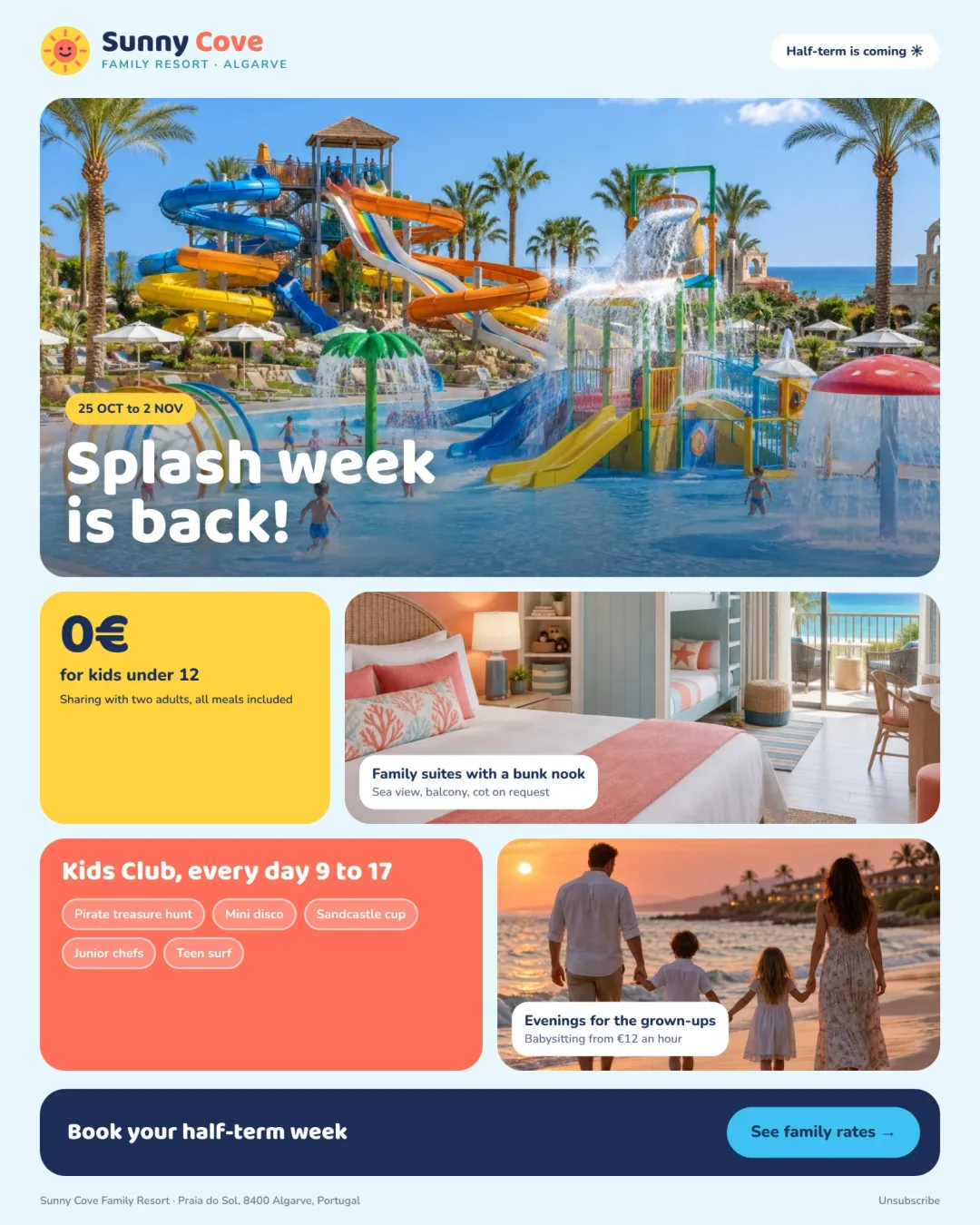
Sunny Cove, a family resort in the Algarve, sends “Splash week is back!” for the half-term holidays. Bright, rounded blocks: a water park photo, a yellow block with “0€ for kids under 12”, family suites with a bunk nook, the kids club programme (pirate treasure hunt, mini disco, junior chefs, teen surf) and, cleverly, “Evenings for the grown-ups” with babysitting from €12 an hour.
Why it works: every block answers a question parents ask before booking. What does it cost for the kids? Where do they sleep? What will they do all day? And will we get any time to ourselves?
What to borrow: list the questions your guests ask before booking, then give each one a block. The newsletter becomes the FAQ they never have to send.

On WhatsApp: parents still have a specific question, here a cot for a four-year-old. The AI answers and sends the family rates. Once booked, they ask for a babysitter, and the kids club replies with the price and asks which evening.
13. The Volt: a lifestyle hotel newsletter with an event lineup
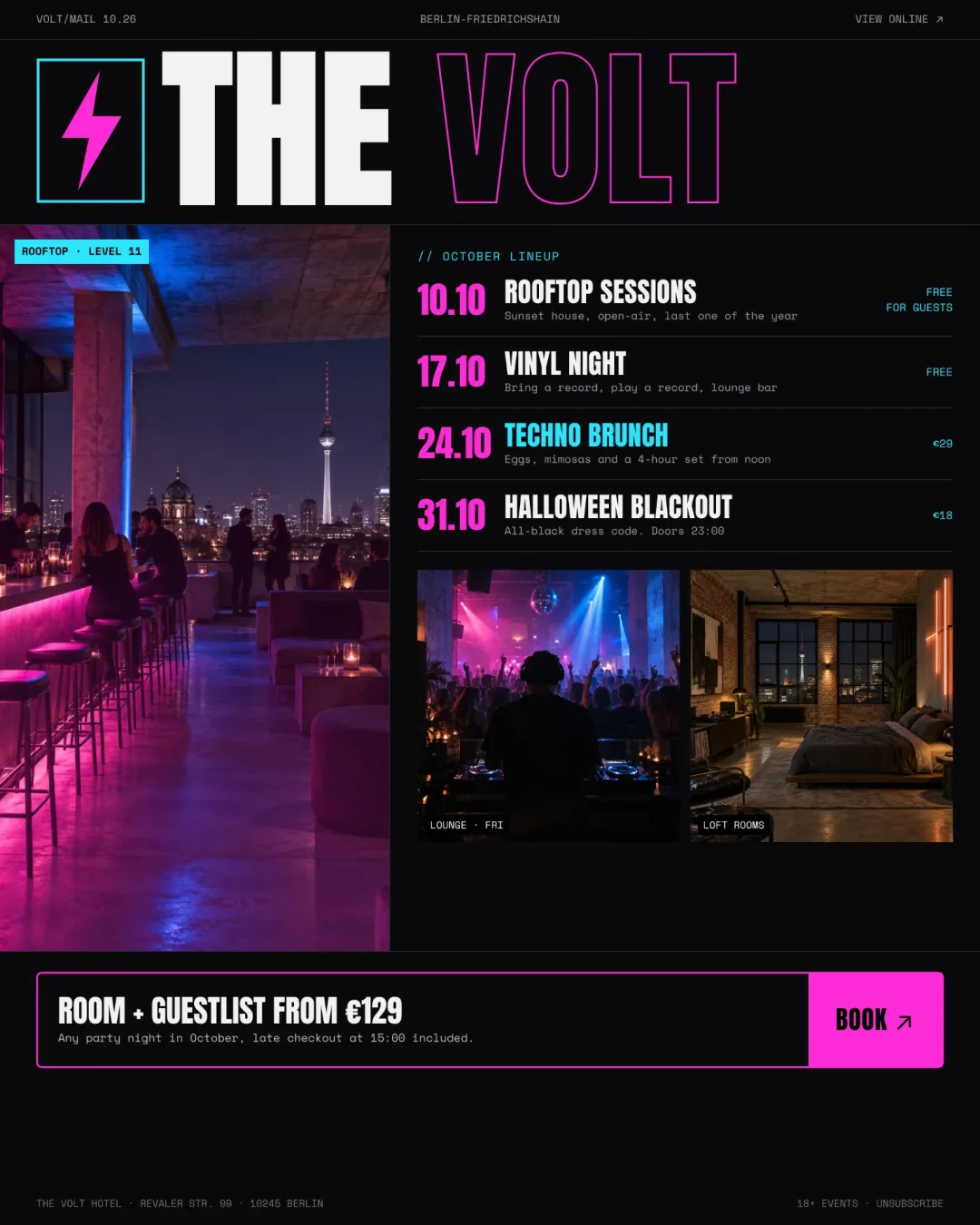
The Volt in Berlin-Friedrichshain sends “VOLT/MAIL 10.26”, in black with neon pink and cyan. The October lineup lists four dates like a club flyer: rooftop sessions, vinyl night, techno brunch, Halloween blackout, each with a price or “free for guests”. The offer: room plus guestlist from €129, late checkout at 15:00 included.
Why it works: for this hotel, the events are the reason to stay, and the offer packages exactly that: the room, the list and the late checkout you will need afterwards.
What to borrow: if your bar, rooftop or restaurant has a programme, put it in the newsletter with dates and prices, and sell the room as part of the night out.

On WhatsApp: the guest asks about brunch tickets, the AI gives the details and offers to pass the request on, and the guest adds a loft room for the night. The front desk confirms tickets, room, guestlist and late checkout together.
14. Domaine de Vérel: an event invitation laid out as a menu
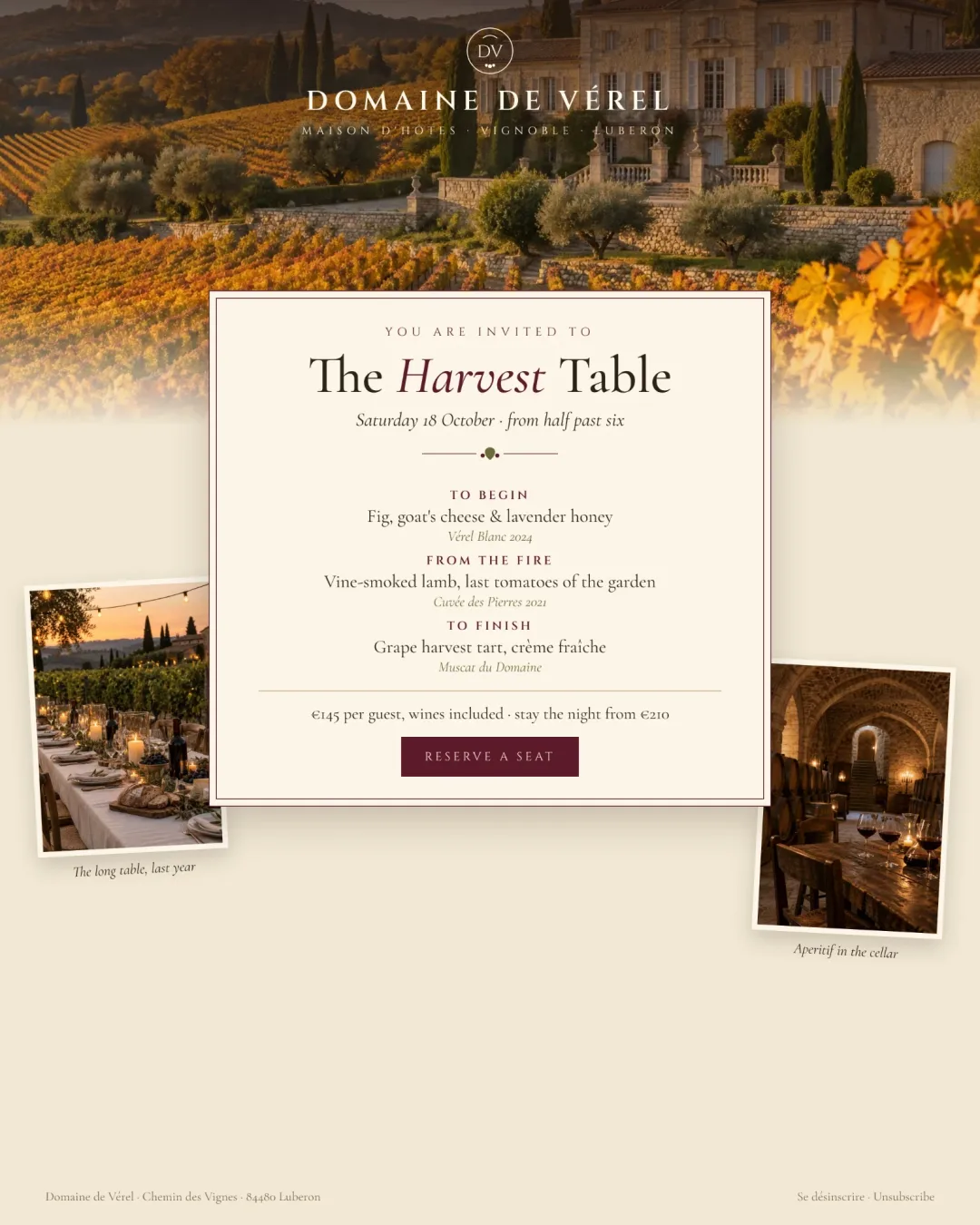
Domaine de Vérel, a maison d’hôtes and vineyard in the Luberon, sends an invitation rather than a newsletter: “You are invited to The Harvest Table”, Saturday 18 October from half past six. The card lists three courses, each paired with a wine from the estate, then the price: €145 per guest, wines included, and “stay the night from €210”.
Why it works: the menu is the copy. Fig with goat’s cheese and lavender honey, vine-smoked lamb, a grape harvest tart: nobody needs adjectives after that. And the second line of the price is the quiet upsell, because nobody wants to drive home after the wine pairing.
What to borrow: for events, show the programme in full and always offer the room after the evening.

On WhatsApp: the guest reserves two seats and asks about the aperitif. Hélène confirms both and offers the room after dinner, and the guest says yes, because it saves the drive home. One message, two sales.
15. Kumo Ryokan: a seasonal newsletter that says almost nothing
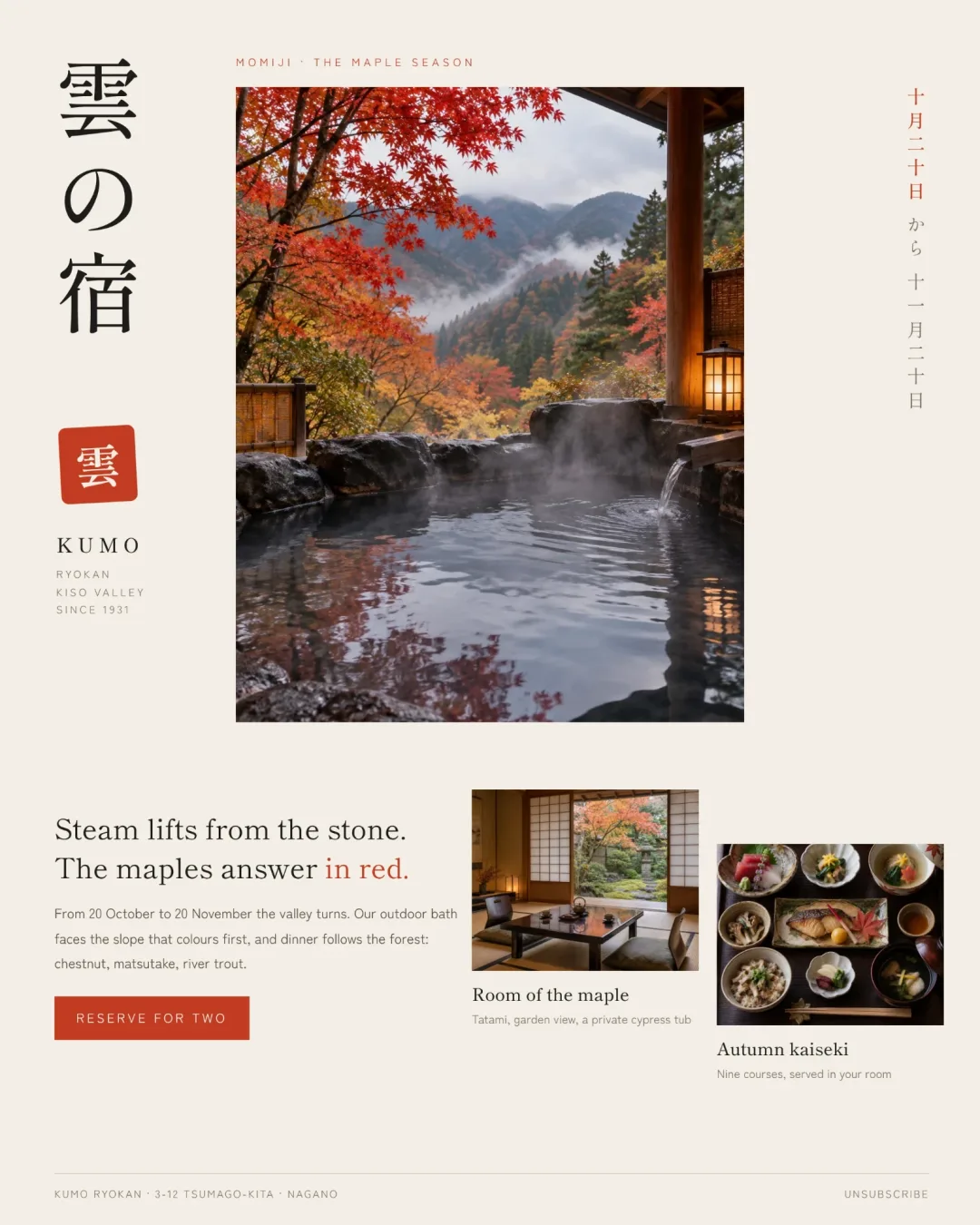
Kumo Ryokan in the Kiso Valley, open since 1931, announces the maple season with the most restrained newsletter in this list. Vertical Japanese text, a red seal logo, a photo of the outdoor bath under red maples, and a headline that reads like a short poem: “Steam lifts from the stone. The maples answer in red.” Below, a room with a garden view and a nine-course autumn kaiseki.
Why it works: the season is the offer. From 20 October to 20 November the valley turns, and the newsletter only has to say so beautifully. The copy is concrete where it matters: the outdoor bath faces the slope that colours first, and dinner follows the forest with chestnut, matsutake and river trout.
What to borrow: if your location has a season people travel for, announce its dates and stop there. Restraint reads as confidence.

On WhatsApp: the guest asks about the kaiseki first. The AI describes the nine courses and invites any dietary wishes, then the front desk reserves the Room of the maple with kaiseki on both evenings.
Why the best hotel newsletter is one guests can answer
Look at the 15 WhatsApp versions again and the pattern is clear. The newsletter does the same job as the email: one photo, one reason, one offer. What changes is what happens next. On email, the guest’s options are click or leave. On WhatsApp, the guest can ask a question, and the question is where most of the revenue in these examples came from: the balcony suite and the chef’s table, the spa ritual after the booking, the room after the harvest dinner, the babysitting evening.
The other difference is whether the newsletter is read at all. IMLAUER Hotels in Salzburg and Vienna send WhatsApp newsletters for seasonal offers, restaurant experiences and in-house services, and reach a 93% open rate, against roughly 20% for email (read the IMLAUER case study). Spa Resort Geinberg measured 95% on WhatsApp against about 20% on email (Geinberg case study).
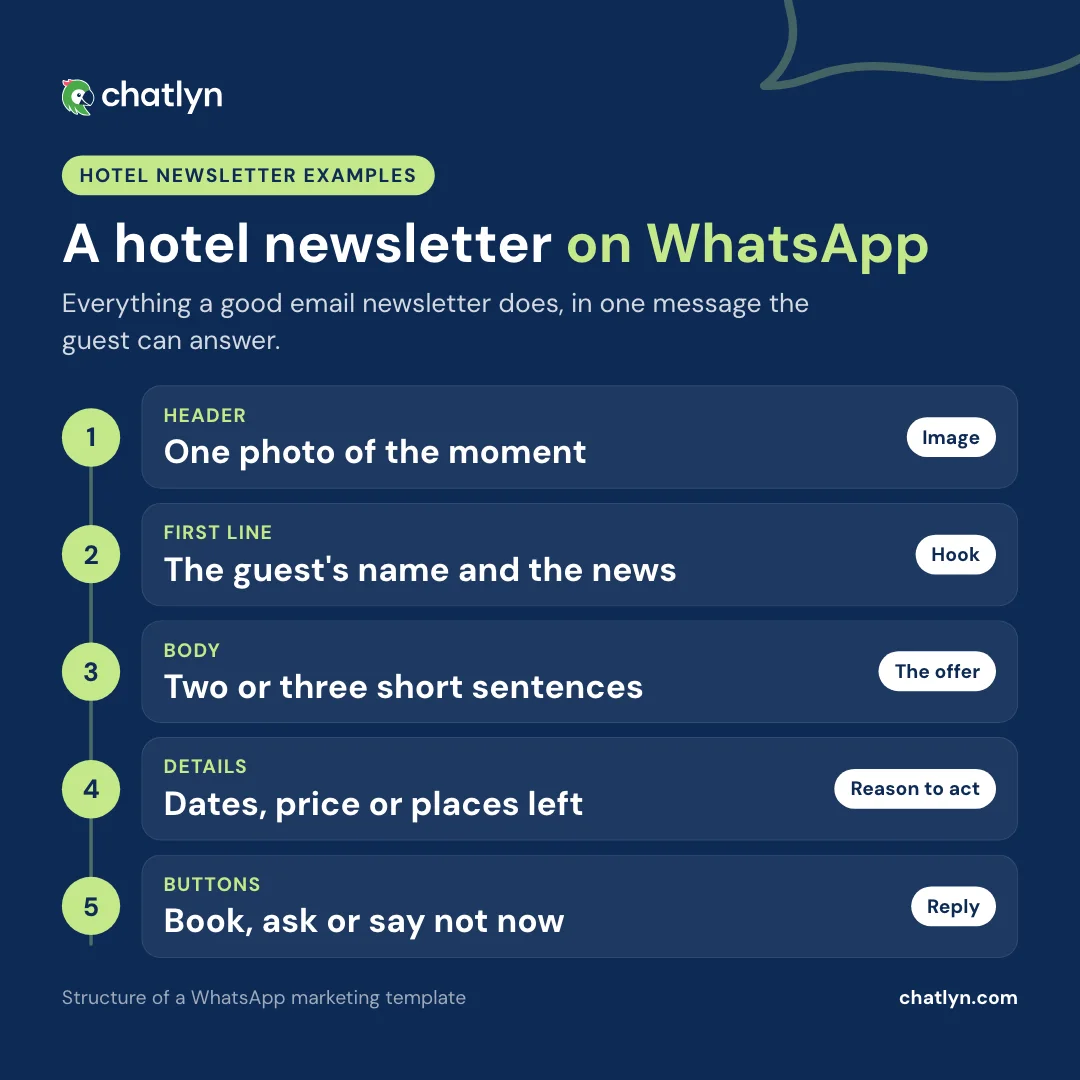
A WhatsApp newsletter is built like this:
- Header: one photo, the same hero image you would use in the email.
- First line: the guest’s name and the news, as a bold title.
- Body: two or three short sentences. WhatsApp templates allow up to 1,024 characters, but the examples above stay well under 300.
- Details: dates, a price, places left. The reason to act now.
- Buttons: up to three quick replies that cover the likely answers, such as “Reserve a seat”, “Tell me more” and “Not this time”, or a link button to your booking page.
| Email newsletter | WhatsApp newsletter | |
|---|---|---|
| Where it lands | Inbox or promotions tab | The guest’s chat list |
| Opened | About 20% (IMLAUER) | 93% (IMLAUER) |
| Length | Long reads, several stories | One story, one offer |
| What the guest can do | Click a link | Tap a button or ask a question |
| Who answers | Whoever reads the mailbox | The AI for routine questions, your team for the rest |
| Best for | Long editions, archives, detailed programmes | Offers, invitations and season news you want answered |
This does not make email newsletters obsolete. A long edition like the Wilhelmina Chronicle or a full season programme still reads best as an email. But for the offer you want answered, send it where guests answer. Our guide to hotel email marketing examples shows which guest messages belong on which channel.
What happens after you press send

With chatlyn, a WhatsApp newsletter is a broadcast: one approved message sent to a list or a segment of guests who opted in, each in their own language. Every reply lands in the shared guest messaging inbox, next to the guest’s other conversations, so the right colleague picks it up.
- The AI answers routine questions at any hour, from your own information: opening times, what is included, whether the offer applies to certain dates. It sends your booking page and passes requests to your team, who confirm them. See how it works on the hotel chatbot page.
- Your team confirms the booking, the table, the treatment or the tickets, in the same chat.
- Interest is saved for next time. A newsletter sent as a journey can add guests who tap “Tell me more about the spa” to a list, so the next spa offer goes only to them.
- Clicks are measured. Links in a journey can be tracked with UTM parameters, so you see which newsletter brought which visits to your booking engine.
More on setting this up: WhatsApp for hotels and our step-by-step guide on how to create a WhatsApp newsletter.
How to turn your email newsletter into a WhatsApp newsletter
- Collect opt-ins. WhatsApp marketing messages need the guest’s consent to hear from your hotel on WhatsApp. Ask at booking, at check-in, in the confirmation message or with a QR code in the room.
- Pick the one story. Take your email newsletter and choose the single offer, event or season you most want answered. That is your WhatsApp newsletter.
- Write it as a marketing template. Header photo, a bold first line, two or three sentences and two or three buttons. Meta approves the template before it can be sent: review usually takes minutes, but plan for 24 hours. Our free playbook of 30 WhatsApp templates for hotels has wording you can adapt.
- Choose the audience. Past guests for a season opening, arriving guests for this week’s events, families for half-term, event planners for the kick-off offer. A smaller, relevant list beats a large one.
- Send at a human hour. Late morning or early evening in the guest’s time zone, not at 23:00.
- Be ready for replies. Make sure the AI knows the offer, and that the team knows who confirms bookings, tables and treatments.
- Respect the limits. Meta caps how many marketing messages each person receives per day across all businesses, so a newsletter a week is plenty. Once or twice a month works for most hotels.
Hotel newsletter ideas for every month
Stuck for a reason to write? Here are hotel newsletter ideas through the year, taken from the examples above.
| Month | Newsletter idea | Like example |
|---|---|---|
| January | Winter weekends and quiet-season offers | NOVA/12 |
| February | Valentine’s dinner or a fondue for two | Alpenglüh |
| March | Easter and spring holidays for families | Sunny Cove |
| April | Season opening for summer properties | Isla Calma |
| May | Long weekends and wellness retreats | Sereno |
| June | Summer events on the terrace or rooftop | The Volt |
| July | Field notes or a letter from the owners | Kora Ridge, Hostal Dos Lunas |
| August | Early booking for autumn conferences | Grand Forum |
| September | Harvest dinners and food events | Domaine de Vérel |
| October | Autumn foliage, late season, half-term | Kumo Ryokan, Isla Calma |
| November | Winter season dates and early bird | Alpenglüh |
| December | The ball, the gala, gift vouchers | Grand Hotel Wilhelmina, Maison Orsalle |
For more seasonal angles, see our WhatsApp campaign ideas and how to increase hotel occupancy in the low season.
Common hotel newsletter mistakes
- Five offers in one newsletter. Every extra offer weakens the others. Keep one, link the rest.
- A no-reply sender. If a guest answers your newsletter, someone should read it. On WhatsApp, someone always can.
- Discount first, reason second. “20% off” without a reason to come trains guests to wait for the next discount. The examples above lead with a season, an event or a story.
- The same newsletter for everyone. Families, couples and event planners want different things. Segment by what you know about the guest’s past stays.
- Stock photos. Guests can tell. One real photo of your own terrace beats any image library.
- Sending without opt-in. On WhatsApp, a newsletter to people who never agreed to receive it gets reported, and too many reports can get the number restricted. Only send to guests who said yes.
FAQ
What should a hotel newsletter include?
One reason to write (a season, an event or an offer), one strong photo, a few sentences in the hotel’s own voice, concrete details such as dates, price or places left, and one clear call to action. The best ones also make it easy to reply.
How often should a hotel send a newsletter?
Once or twice a month is enough for most hotels. Seasonal properties often send around their key dates: the season opening, the early bird deadline and the main events. Sending less often, with a real reason each time, keeps open rates high.
What is a good open rate for a hotel newsletter?
Hotels report open rates of roughly 20% for email newsletters. On WhatsApp, IMLAUER Hotels reached 93% for its newsletters and Spa Resort Geinberg 95% for its WhatsApp messages.
Can a hotel send its newsletter on WhatsApp?
Yes, to guests who agreed to receive messages from the hotel on WhatsApp. The newsletter is sent as an approved WhatsApp marketing template, with a photo, short text and buttons, and guests can reply in the same chat. With chatlyn, you send it to a list or a segment, and replies land in the shared inbox where the AI and your team answer them.
Should hotels stop sending email newsletters?
No. Email remains a good home for long editions, detailed programmes and an archive of past issues. Use WhatsApp for the offers, invitations and season news you want guests to answer, and email for the long read.
Are the hotels in these examples real?
No. The 15 hotels and their newsletters are concept designs created for this guide, to show 15 different styles side by side. The open rates quoted come from real chatlyn customers: IMLAUER Hotels and Spa Resort Geinberg.